Many of the diamonds in inherited and estate jewelry were cut by hand, decades or centuries before the modern round brilliant existed. They look different: chunkier facets, a small table, often a visible opening at the bottom of the stone. Owners sometimes assume that makes them less valuable. Often it does not. Antique cuts have their own market, their own grading conventions and a growing group of buyers who want exactly what modern cutting does not produce.
Why Antique Cuts Exist
Before modern cutting equipment and the mathematically optimized round brilliant, diamonds were cut by hand to make the most of the rough stone and to sparkle in candlelight and gaslight. The result was stones with higher crowns, smaller tables and larger culets than modern diamonds.
Two milestones mark the shift. In 1874, Boston cutter Henry D. Morse and Charles Field patented a steam-driven bruting machine that made symmetrical, round stones practical, laying the groundwork for the Old European cut. In 1919, Marcel Tolkowsky published the proportions that gradually became the standard for the modern round brilliant over the 20th century, as Lang Antiques’ history of the brilliant cut details. Our article on the evolution of the modern round brilliant covers how cutting changed.
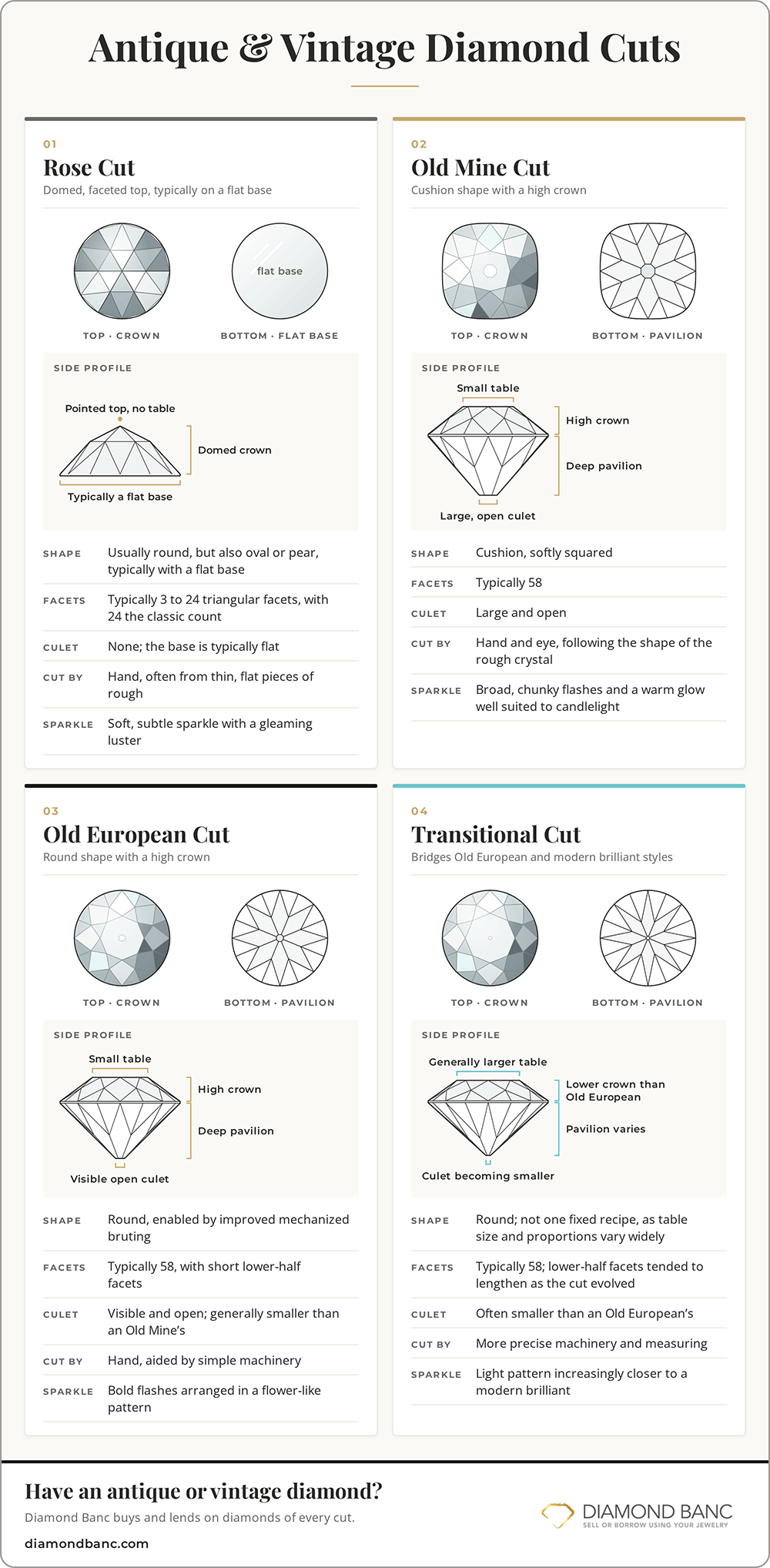
The Four Antique Cuts
| Cut | Approximate era | How to recognize it |
|---|---|---|
| Rose cut | 16th century to early 20th century | Flat, unfaceted base with a domed top covered in triangular facets; no table |
| Old mine cut | Georgian through mid-Victorian | Cushion-shaped outline, small table, high crown, large and often visible culet |
| Old European cut | Late Victorian through Art Deco | Round outline, high crown, small table, visible culet, broad flashes of light |
| Transitional cut | Roughly 1930s–1940s | Larger table and lower crown than an Old European, smaller culet; between antique and modern |
Era ranges follow Vintage Jewelry’s comparison of antique diamond cuts. Dating by cut is approximate. Hand cutting varied, and some stones were cut in older styles later.
How to Tell an Antique Cut From a Modern Brilliant
- Look through the top of the stone. A visible circle or dot at the center is often the culet, a small facet at the bottom that modern brilliants usually do not have.
- Look at the table. Antique cuts usually have a noticeably small table relative to the stone’s width.
- Look at the sparkle. Antique cuts show larger, blockier flashes, sometimes described as a checkerboard pattern. Modern brilliants show many small, sharp sparkles.
- Look at the outline. A soft cushion shape suggests an old mine cut. A round stone with the features above suggests an Old European.
How Grading Labs Treat Antique Cuts
GIA grades the color and clarity of Old European cut diamonds and records their measurements, but it does not assign them a cut grade. A round diamond receives GIA’s “old European” description when it meets at least three of four criteria: a table of 53% or less, a crown angle of 40° or more, lower half facets of 60% or less, and a culet of “slightly large” or larger. In 2005, alongside its cut grading system, GIA also created a “circular brilliant” description for stones that fall between Old European and modern proportions, and those reports carry no cut grade either, as GIA’s research on describing 58-facet round brilliants explains. The reasoning is simple: these stones were never cut to modern standards, and grading them that way would penalize them unfairly.
Old mine and rose cuts are not round brilliants at all, and GIA currently gives an overall cut grade only to round brilliant diamonds, so their reports will not carry one either, as GIA’s guide to cut grades explains. Polish and symmetry are still graded, and hand-cut antique stones commonly score lower there than modern stones do.
For a seller, that means an antique stone with a lab report is valued on its color, clarity, carat weight and the quality of its cutting within its own style, not on a modern cut grade. For more on reports, see why GIA certification matters when selling diamonds.
Confirm Natural Origin
An antique look is no longer proof of age. Manufacturers are increasingly producing lab-grown diamonds that replicate historic cuts such as the old mine and Old European, The Centurion reported in February 2026. A stone that is genuinely a century old is natural, but a buyer or lender will want that confirmed. A current report from a major lab states whether a diamond is natural or laboratory-grown, which is one more reason to bring any paperwork you have.
What Antique Cuts Are Worth Today
Antique cuts are priced less uniformly than modern rounds. Stones with chips, heavy wear or lopsided proportions often sell below a modern round brilliant of the same carat, color and clarity. That is not the whole picture:
- Demand is real. Vintage-inspired engagement rings have made Old European and old mine stones sought after, and the supply of genuinely antique stones is fixed. Modern antique-style and lab-grown replicas exist, but they are not period stones.
- Quality still rules. A well-cut Old European with high color and clarity can match or exceed a comparable modern brilliant, according to Vintage Jewelry.
- Color reads differently. Old European stones often face up whiter than their letter grade suggests, particularly in the J to L range, according to Opulent Jewelers. Our diamond color chart explains what those grades mean.
- Settings add value. An antique stone in an original Georgian, Victorian, Edwardian or Art Deco setting can be worth more as a complete piece than the stone alone. For more on valuing older pieces, see our vintage jewelry value guide. Georgian pieces often have closed backs, and many were foil-backed to brighten the stones in candlelight. Lang Antiques warns that foil-backed pieces should never get wet, so do not wash or soak them before an evaluation.
- Size matters. Larger antique center stones attract the strongest interest.
The broader natural diamond market is part of the backdrop too. Prices slid through much of 2025, and Rapaport’s index for 1-carat diamonds fell 2.6% in November 2025 alone. In August 2026, that index rose 0.5%, its first gain in 15 months, with Rapaport citing reports of consumers cooling on lab-grown diamonds. Rapaport’s reports also show larger stones holding steadier than small ones, which fits the strong interest in larger antique center stones.
Should You Recut an Antique Diamond?
Usually not. Recutting an Old European or old mine stone into a modern brilliant removes weight. Opulent Jewelers puts the average loss at 15 to 25 percent, and Erstwhile Jewelry notes that dealers historically discounted old stones by roughly 20 to 30 percent to account for the weight a recut would remove. Recutting also erases the characteristics that buyers of antique stones are looking for. The result can be a smaller modern diamond worth less than the original. Weight thresholds make it worse: a 1.15-carat stone that loses 20 percent finishes near 0.92 carat, below the 1-carat mark where per-carat prices step up (see our diamond carat size chart). If you are considering it, get the stone evaluated as it is first.
What We Look at When Buying Antique Diamonds
- Carat weight, color and clarity
- The quality of the cutting within its style: symmetry, how lively the stone is and whether the culet is chipped
- Condition: chips and abrasions are common on older stones
- The setting’s age, metal and craftsmanship
- Any existing lab report, and whether the stone is confirmed natural rather than lab-grown
If the stone came to you through an estate, our guides to selling inherited jewelry and selling estate jewelry for fair value cover the practical steps.
Frequently Asked Questions
Are Old European cut diamonds valuable?
Yes. Value depends on carat, color, clarity and cutting quality, and fine examples can match comparable modern brilliants. Demand from buyers of vintage-style jewelry supports the market.
What is the difference between an old mine cut and an Old European cut?
The old mine cut has a cushion-shaped outline and is generally older. The Old European cut is round. Both have high crowns, small tables and visible culets.
Does GIA grade antique diamonds?
GIA grades the color and clarity of Old European cut diamonds and provides measurements, but it does not assign a cut grade. Old mine and rose cuts do not receive one either, because GIA gives overall cut grades only to round brilliants.
Can I use a diamond calculator for an antique cut?
A calculator gives a rough starting point based on carat, color and clarity. Because antique cuts are not priced exactly like modern brilliants, an in-person evaluation is more reliable.
How much weight does recutting an antique diamond remove?
Typically about 15 to 30 percent, depending on the stone’s original proportions. That loss, plus the loss of antique character, is why recutting often lowers value.
Are there lab-grown Old European or old mine cut diamonds?
Yes. Lab-grown diamonds are now produced in antique styles, so an old-looking cut alone does not prove a stone is antique or natural. A lab report confirms origin.
Get Your Antique Diamond Evaluated
Start with our diamond value calculator for a rough estimate, then let a Diamond Banc specialist evaluate the stone and setting together. Diamond Banc also buys diamonds outright, purchases complete antique and estate pieces through our sell jewelry service, and offers loose diamond loans if you would rather keep the stone.
Book a complimentary diamond evaluation at a Diamond Banc location.
Like what you’re reading?
Add us in Google — more like this is on the wayRelated Posts

 Instagram
 Facebook
 Tiktok
 YouTube