A colorless diamond earns its price by how close it comes to having no color at all. A rare colored diamond works the opposite way: the deeper and purer the color, the more it’s worth. That single reversal is why rare colored diamonds investment decisions require a different vocabulary, a different grading system, and a different read on supply than the one most buyers already know from engagement ring shopping. If you own a fancy pink, blue, or vivid yellow stone, or you’re weighing whether to acquire one, the questions that matter are about origin, grade precision, and where supply is actually heading, not just the auction headlines.
What actually makes a colored diamond rare
In the standard D-to-Z scale, value comes from the absence of color. But for fancy color diamonds, the rarest and most valuable colors are saturated pinks, blues, and greens, and value rises with color strength and purity rather than falling. Rarity here is a function of geology: color in a diamond comes from trace elements or structural distortions during formation, and only a tiny fraction of mined stones develop enough of it to register.
Only about one in 10,000 diamonds mined displays enough natural color to qualify as fancy, and GIA estimates only about one in every 25,000 diamonds reaches an intense color grade. That scarcity also changes what “small” means for value. In pink, blue, green, and orange, even fancy color diamonds under a carat are considered rare and valuable, unlike white diamonds where small clean stones are common. A half-carat vivid pink can outvalue a much larger, unremarkable white stone.
How grading a colored diamond differs from grading a white diamond
White diamonds are graded on clarity and colorlessness first. Colored diamonds are graded primarily on hue, tone, and saturation. GIA grades colored diamonds on a nine-step scale of increasing color strength, from Faint through Very Light, Light, Fancy Light, Fancy, Fancy Intense, Fancy Vivid, Fancy Dark, and Fancy Deep, with Fancy Intense and Fancy Vivid generally commanding the highest prices.
This process is far more specialized than standard white diamond grading. It requires trained laboratory graders comparing a stone against masterstones under controlled, calibrated lighting. An informal appraisal of a colored stone’s value is not reliable, and any owner considering a sale or a colored-diamond-secured transaction should insist on a current report from GIA or an equivalent lab before pricing conversations start. If you’re also holding loose white diamonds and want to understand how certification affects what a buyer will pay, certification matters just as much on the colorless side.
Which colors are rarest, and what they actually sell for
Pink and blue dominate the conversation, but for different reasons. Pink’s story is mostly about a mine that no longer exists. Blue’s is about atomic structure.
Blue diamonds get their color from trace boron atoms and fall almost exclusively within the Type IIb classification, which accounts for fewer than 0.1% of all natural diamonds, one reason blues are rarer than most other fancy colors even before mine supply is factored in. The blue diamond auction record belongs to the De Beers Blue, a 15.10-carat Fancy Vivid Blue, Internally Flawless stone that sold at Sotheby’s Geneva in 2023 for $57.5 million, or about $3.8 million per carat.
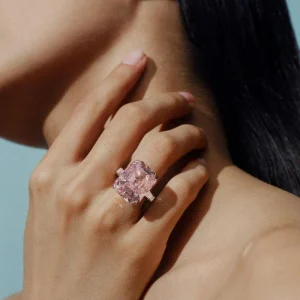
Pink’s record sits even higher on a per-carat basis. The per-carat price record for any diamond or gemstone at auction belongs to the Williamson Pink Star, an 11.15-carat Fancy Vivid Pink that sold at Sotheby’s Hong Kong in 2022 for $57.7 million, about $5.2 million per carat. Doing that math directly: $57,700,000 divided by 11.15 carats works out to roughly $5.17 million per carat, a figure that still edges out the blue record on a per-carat basis even though both stones are within a few carats of each other in size. That gap illustrates rarity within rarity: color intensity and hue purity move price even when comparing two stones that are each once-in-a-generation.
Size still matters, but color grade can overwhelm it. In a June 2026 Christie’s sale, a 5.04-carat Fancy Vivid Blue marquise sold for over $8.1 million, almost matching the $8.3 million paid for the 31.62-carat Azure Blue diamond in the same sale, a stone more than six times its size. A jump in saturation and hue quality closed most of that size gap.
For scale, the largest colored diamond ever sold at auction remains the CTF Pink Star, a 59.60-carat Fancy Vivid Pink that sold for $71.2 million in April 2017, still the most expensive diamond of any color ever sold at auction. These are headline outcomes, not typical transactions, but they set the ceiling that anchors how the rest of the market gets priced.
Why the Argyle mine closure still matters
Most of the pink diamond supply the world has ever seen came from one mine. The Argyle mine in Western Australia ceased operations on November 3, 2020 after 37 years of production, having produced 865 million carats of rough diamonds and roughly 90% of the world’s known pink diamond supply. When that mine closed, it didn’t just reduce pink diamond production, it effectively capped it. Other mines contribute less than 5% of global pink and red diamond output today, which means the scarcity created by Argyle’s closure is now structural rather than a temporary supply dip that could reverse with a new discovery.
The price effect was already visible before the mine shut down. According to the Fancy Color Research Foundation, pink diamond values rose 116% between 2010 and 2020, more than any other colored diamond segment including blue diamonds, a rally that predated and then compounded with the Argyle closure. The closure didn’t create the trend; it removed the mechanism that could have slowed it.
Have prices kept rising in 2025-2026, or has the market cooled?
The long-run trend and the recent trend tell different stories, and both are useful. Since the FCRF began tracking data in 2005, its overall Fancy Color Diamond Index has risen 202.1%, with pink diamonds up 389.8%, blue diamonds up 239.5%, and yellow diamonds up 47.0% as of Q2 2026, showing pinks and blues have far outpaced the broader colored-diamond market and dwarfed yellow’s gains.
Short term, growth has flattened. The Fancy Color Diamond Index declined just 0.1% in Q2 2026, following a 0.2% dip in Q1 2026, and is down only 0.5% over the trailing twelve months, a level of stability the FCRF characterizes as a well-anchored, resilient market rather than a downturn. You can track the live index yourself through the Fancy Color Research Foundation’s index and its quarterly press releases, since these figures update every quarter.
What the flat headline number hides is that performance has become quality-selective rather than uniform. In Q1 2026, the 1-carat Fancy Intense Pink category was the top performer among all fancy colors, rising 1.9%, while several larger fancy vivid pink size categories actually declined in the same quarter. That split matters for anyone deciding whether to hold: an average or mid-quality colored diamond should not be assumed to move at the same rate as the record-setting stones that make headlines. The stones outperforming are the ones with the strongest color grade and cleanest lab documentation, not simply the biggest.
What sellers legally have to disclose
Color origin and treatment history aren’t optional details, they’re regulated disclosures. Under the FTC’s Jewelry Guides (16 CFR Part 23), treatments to diamonds and gemstones must be disclosed, and any seller who makes a grade representation must also disclose the identity of the grading system used. That means a seller can’t simply say “vivid pink” without naming whether GIA or another lab issued that grade.
The disclosure standard for treatments is specific: under the FTC Jewelry Guides, a gemstone treatment must be disclosed if it is not permanent, requires special care by the consumer, or significantly affects the stone’s value. This is directly relevant to irradiated or color-treated diamonds sometimes sold as investment pieces. Some colored diamonds are irradiated or otherwise treated after mining to create or intensify their color, and a buyer who doesn’t confirm natural color origin on a lab report risks paying investment-grade prices for a stone that’s worth a fraction of that once the treatment is known. Before buying or selling, ask specifically whether the report states “natural color” and get the grading lab named in writing.
Using a colored diamond as collateral
Rare colored diamonds carry real, verifiable value, which means they can also serve as collateral rather than only as a sale. If you own a graded pink, blue, or other fancy colored stone and need liquidity without giving up ownership, a loan secured by loose diamonds lets you access funds against the stone’s documented value while you decide whether to hold for the long term or eventually sell. Diamond Banc’s specialists evaluate colored stones using current secondary-market pricing and model or grade-specific valuation rather than treating every diamond the same way a general pawn shop might.
If you’ve decided the time is right to sell instead, working with buyers who understand fancy color grading, current auction and index data, and disclosure requirements protects you from underselling a stone whose value depends on details a general jewelry buyer might miss. Selling loose diamonds through specialists who confirm the lab report, the color grade, and the natural origin gets you a price grounded in what the stone actually is, not a rough guess. For a broader look at how diamond value gets established across colors and cuts, see how diamond value is determined, and for more on colored stones specifically, this deeper look at colorful diamonds covers additional color categories.
How rarity in colored diamonds differs from white diamond “investment grade”
A common mistake is applying white diamond investment logic, cut, clarity, carat, to colored stones. In white diamonds, “investment grade” usually means a large, high-clarity, well-cut stone in the D-to-F range, and small stones rarely hold special value. In colored diamonds, an intensely saturated half-carat pink can be worth more than a two-carat, weakly-colored one, because color strength drives the price curve, not size. The nine-step GIA color scale, not carat weight, is the first filter a buyer or lender applies.
That difference also changes how liquidity works. A well-documented, GIA-graded fancy vivid stone in pink or blue has a global base of collectors and dealers who understand exactly what they’re bidding on. A colored stone without a current lab report, or one whose treatment history is unclear, is much harder to price and much harder to move at a fair number, regardless of how the color looks to the eye.
What this means if you’re deciding whether to hold or sell
The data supports two conclusions that aren’t in tension. First, pink and blue diamonds have structurally outperformed the broader diamond and colored-diamond market for two decades, and the supply-side reasons behind that (Argyle’s closure especially) aren’t reversing. Second, the market has cooled to a flat, stable phase in 2025-2026 rather than continuing the steep gains of the prior decade, and gains are now concentrated in the highest color grades and specific size categories rather than spread evenly across the market.
If your stone carries a strong, current lab grade in an intense or vivid pink or blue, the long-run case for holding remains intact. If your stone is a lighter fancy grade, an untreated status you haven’t confirmed, or a size category the recent quarterly data shows softening, get it re-evaluated against current secondary-market pricing before assuming it will keep appreciating on its own. Either way, the decision starts with a current, lab-issued grading report, not an old appraisal or a guess based on color alone.
Like what you’re reading?
Add us in Google — more like this is on the wayRelated Posts
 Instagram
 Facebook
 Tiktok
 YouTube