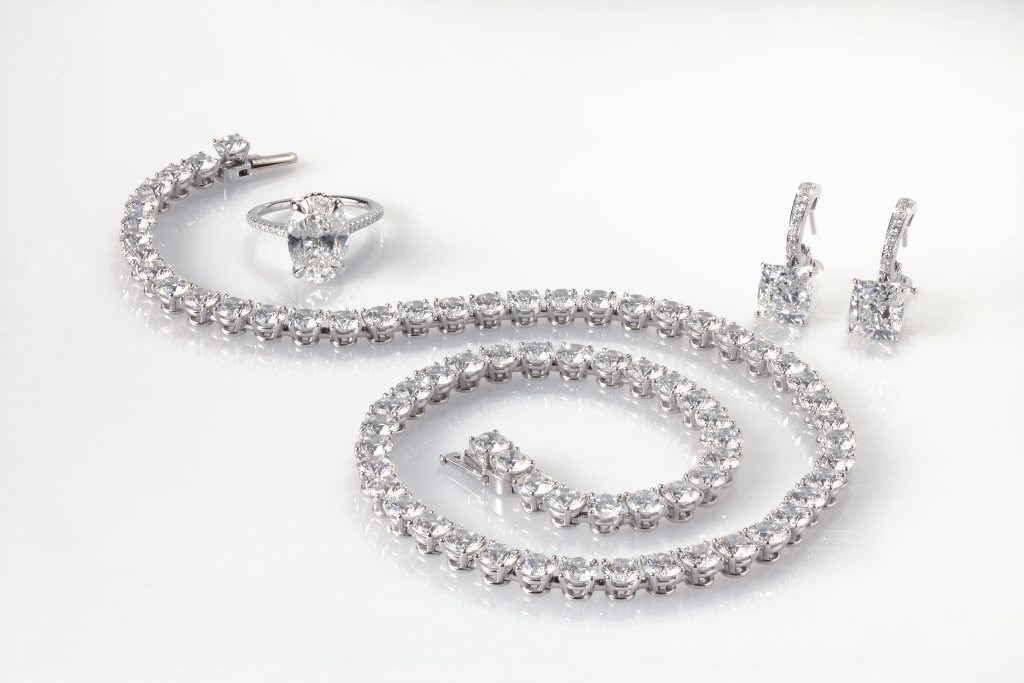
A diamond evaluation sounds like a single step, but it’s really three separate things: understanding what the grading scale measures, confirming that any report in your possession actually belongs to your stone, and deciding what those numbers mean for what someone will pay you today. Most owners never learn the difference, which is how a genuine grading report ends up attached to the wrong diamond, or a seller walks into a negotiation unable to tell whether a number on a page is a strength or a weakness. Here’s how to read your own diamond before anyone else evaluates it for you.
What the 4Cs Actually Measure
The four-part framework used to describe a diamond, color, clarity, cut, and carat weight, was developed by GIA in the 1950s specifically so buyers and sellers could compare any two diamonds on the same terms. Each letter measures something different, and none of them is a stand-in for “quality” by itself.
- Color runs from D to Z, with D being colorless and Z showing a noticeable yellow, brown, or gray tint. Graders compare a stone against masterstones of known color under controlled lighting conditions, which is why color grading isn’t something you can do reliably by eye at home.
- Clarity is graded on an 11-grade scale from Flawless (FL) down to Included (I3), and the final clarity, polish, and symmetry grades are only assigned after examination at 10x magnification. If you’re looking at your diamond with a jeweler’s loupe at home and seeing nothing, that’s a starting point, not a grade.
- Cut uses a five-grade system (Excellent, Very Good, Good, Fair, Poor) introduced for round brilliant diamonds, and it penalizes stones that hide extra weight in a thick girdle, a steep crown, or a deep pavilion. Cut grading only applies to standard round brilliants in the D-to-Z color range; fancy shapes aren’t graded on this same scale.
- Carat weight is a unit of mass, not size or value. Under federal weights-and-measures rules, one carat equals 200 milligrams, and a point is one one-hundredth of a carat. Two diamonds of identical carat weight can look and sell very differently depending on the other three Cs.
Which of the 4Cs Matters Most for Value
There’s no universal answer, because the four factors interact. A diamond with excellent color but poor cut will still look dull, because cut determines how light returns to the eye. A diamond with strong clarity but mediocre color can look warm rather than colorless. In practice, cut tends to have the most visible effect on how a diamond performs, while carat weight has the most direct effect on price, since larger stones are rarer and demand grows disproportionately at round-number weights (a full one-carat diamond typically commands a premium over a 0.96-carat stone of the same grade, even though the weight difference is barely visible). Color and clarity set the ceiling and floor on a stone’s price within its weight category. If you’re trying to estimate what your own diamond is worth, you need all four numbers together, not just the one printed largest on the report.
Estimating Carat Weight Without a Scale
If you don’t have a certified scale, you can get a reasonable estimate of a round brilliant’s carat weight from its measurements. Using a loupe with a built-in millimeter gauge, or digital calipers, measure the stone’s average diameter and its total depth in millimeters, then apply this formula: diameter × diameter × depth (mm) × 0.006.
For example, a round diamond measuring 6mm in diameter with a 3.5mm depth works out to 6 × 6 × 3.5 × 0.006 = 0.76 carats (estimated). This method is useful for getting in the right range before an appraisal, but treat it as an estimate only: the actual weight can run roughly 5 to 10 percent off from this calculation, since it assumes a standard, well-proportioned round shape. Fancy cuts (cushion, emerald, pear) use different formulas and are even less reliable to estimate by hand. A more detailed version of this calculation, along with versions for other shapes, is available through Diamond Banc’s diamond calculator.
Grading Report, Certificate, or Appraisal: What’s the Difference
These three terms get used interchangeably, but they describe different documents, and the difference matters when you’re deciding what you actually have in hand.
A grading report (sometimes called a “diamond report”) describes a stone’s 4Cs and other characteristics as determined by a gemological laboratory. It does not state a dollar value. A grading report should not be called a certificate, because most grading reports do not go through an external review or certification by an independent body; “certified diamond” is common shorthand, but it’s technically inaccurate, and under FTC rules, any stated grade is only meaningful if the issuing lab is clearly disclosed, since a “VS1” from one lab doesn’t necessarily mean the same thing as a “VS1” from another.
An appraisal is a different document entirely: it assigns a monetary value, usually for insurance or estate purposes, and it’s typically produced by an independent appraiser rather than a grading laboratory. A diamond can have a grading report, an appraisal, both, or neither. If you’re preparing to sell or seeking a loan, Diamond Banc’s guide to understanding diamond grading reports walks through how to read what you already have, and the page on diamond appraisal and certification explains how the two documents are used differently in practice.
How to Confirm a Grading Report Belongs to Your Diamond
Having a grading report in hand doesn’t prove it describes the stone sitting in your ring. Report numbers can be looked up directly through the issuing lab, which confirms that the report is real and shows the recorded grading data, but a lookup alone doesn’t confirm that the specific diamond in front of you is the same one the lab graded. That’s a separate check: most lab-graded diamonds above a certain size carry a microscopic laser inscription on the girdle (the thin edge around the stone) matching the report number, visible only under magnification. Before relying on any report, especially one you received secondhand or with an estate piece, match that inscription number to the report number yourself, or have someone do it for you, rather than assuming the two go together.
Lab-Grown Diamonds: Graded Differently, Not the Same Way
Lab-grown diamonds are chemically and optically diamond, but as of October 1, 2025, GIA stopped assigning them the same specific color and clarity letter grades used for natural stones. Instead, lab-grown diamonds now receive one of two classifications: Premium or Standard, and a stone that misses the minimum criteria for Standard receives no classification at all, just a return with a modest evaluation fee instead of a report. This matters because the “Standard” tier spans a fairly wide range of underlying quality, meaning two lab-grown diamonds can carry an identical rating while differing meaningfully in the color and clarity detail that used to distinguish them on a full 4Cs report. If you’re evaluating a lab-grown stone, ask specifically whether it was assessed under this newer two-tier system or graded under the older full-grade scale, and check current GIA lab-grown report types and fees directly, since both the classification system and its pricing are recent changes.
The Federal Rules Behind Every Grade and Weight Claim
Diamond grading language isn’t just an industry convention; parts of it are governed by federal trade rules, and knowing them helps you recognize a questionable claim. A seller or lender cannot describe a diamond as “flawless” if any flaw, crack, inclusion, carbon spot, cloud, internal laser line, or other blemish is visible to a trained grader using a corrected 10-power magnifier, regardless of how the stone looks to the naked eye. Weight claims are regulated too: if a diamond’s weight is stated in decimal form, it must be accurate to that decimal place, and if it’s stated as a fraction (like “approximately 1/2 carat”), the seller has to disclose plainly that the weight is approximate and state the acceptable range that fraction covers. And any time a specific grade is quoted, the name of the grading system or lab behind it has to be disclosed, because a grade without its source isn’t something a buyer can verify or compare. A report or verbal grade that skips any of these disclosures is worth a second look before you rely on it.
Putting Your Evaluation to Use
Reading the 4Cs yourself is useful preparation, but it isn’t a substitute for a professional looking at the actual stone under magnification and comparing it against masterstones and calibrated lighting. What self-evaluation does give you is the ability to ask better questions: whether a grade matches the lab that issued it, whether the laser inscription on your stone matches the report number, and whether your estimated carat weight is in the right range before you commit to a sale or a loan.
If you’re ready to find out what your diamond is actually worth on today’s market, Diamond Banc’s diamond valuation process starts with exactly this kind of review, checking your grading report against the stone itself before any number is offered. And if you’d rather talk to someone before mailing anything in, Diamond Banc’s diamond buyers work with loose stones and mounted jewelry alike, whether you’re deciding to sell outright or looking at a jewelry-secured loan that lets you keep the piece while accessing its value. Either way, walking in with a clear sense of what your grades actually mean, rather than just the number on a page, puts you in a stronger position to evaluate the offer you receive.
Like what you’re reading?
Add us in Google — more like this is on the wayRelated Posts
 Instagram
 Facebook
 Tiktok
 YouTube