Diamond Color Chart: How Color Affects Diamond Appearance
A diamond color chart helps you understand one of the four Cs that describes a diamond’s appearance and contributes to its market context. For standard white diamonds, the scale runs from D, which represents the least visible body color, through Z, where yellow or brown tint becomes more apparent. The most useful way to read the chart is to connect a grade with the stone’s cut, size, setting, lighting, and intended use.
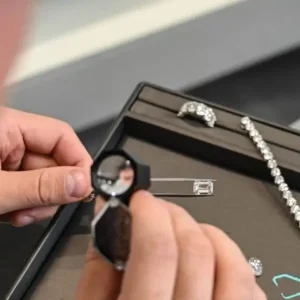
A diamond color chart shows how subtle body color can affect a diamond’s appearance.
Get a fair offer for your diamond ring
What does a diamond color chart show?
A diamond color chart shows the D-to-Z grading scale used to describe the amount of body color visible in a standard white diamond. D is the top of the colorless range, while grades toward Z show progressively more yellow or brown tint. The chart is a guide to a grading range, not a photograph that predicts exactly how every mounted diamond will look.
Color grading is different from judging whether a diamond looks attractive. A grading laboratory compares the stone under controlled conditions with master stones of known color. A person viewing a ring at home may see a different result because the setting, light source, background, and viewing angle all change the impression of color.
That distinction matters when you compare a grading report with the appearance of a finished ring. The grade records a standardized observation. The finished piece expresses that color through a particular cut and setting. Both facts belong in a thoughtful evaluation.

How are diamond color grades grouped?
The GIA D-to-Z scale is commonly explained in five color groups. The letter bands make it easier to discuss a diamond’s appearance, but the boundary between two neighboring grades can be subtle. A diamond color chart should therefore be used as a starting point for comparison, not as a substitute for a grading report or an in-person review.
| Color grades | Common group name | What the group generally indicates |
|---|---|---|
| D to F | Colorless | Very little body color is visible under controlled grading conditions. |
| G to J | Near colorless | Subtle warmth may be difficult to see face-up, especially in some settings. |
| K to M | Faint | Warmth becomes more likely to show, depending on the diamond and setting. |
| N to R | Very light | Yellow or brown tint is increasingly noticeable to the eye. |
| S to Z | Light | Body color is generally visible and becomes more pronounced toward Z. |
The group names are useful shorthand, but they should not be treated as promises about a particular stone. Two diamonds with the same letter grade can appear different when they have different proportions, fluorescence, carat weights, or mounting choices. If you are comparing stones, look at the full grading report and the actual diamond rather than relying on the letter alone.
How does diamond color affect appearance?
Diamond color affects appearance by changing how much warmth a viewer can see in the stone. The effect is most noticeable when the diamond is viewed from the side, placed next to a whiter reference, or set in a design that does not visually blend with the stone. Face-up brilliance can make subtle color harder to notice, but it does not erase the underlying grade.
Three parts of the finished piece deserve particular attention:
- Cut and facet pattern: Light return, proportions, and facet arrangement influence how the eye reads the stone. A lively, well-cut diamond may appear brighter, while a step-cut design can present its body color differently.
- Carat size: A larger diamond gives the eye more surface and depth to examine, so warmth may be easier to notice. Size alone does not determine color, but it can change how the same range is perceived.
- Setting metal and design: White metals can make warmth easier to compare, while yellow or rose gold can create a warmer overall look. Prongs, halos, and surrounding stones also affect the visual frame.
Fluorescence is another report detail to review. It describes a diamond’s reaction to long-wave ultraviolet light and is recorded separately from the D-to-Z color grade. Its effect is not identical in every stone, so fluorescence should be evaluated as part of the complete diamond rather than treated as an automatic advantage or defect.
Is a higher diamond color grade always better?
A higher position on the D-to-Z chart is not automatically the best choice for every design or owner. The right grade depends on the look you prefer, the metal and shape of the setting, how the diamond will be viewed, and which other quality factors matter most to you. A colorless grade may be the priority for one ring, while another owner may prefer visible warmth.
Rather than asking only for the highest grade, ask how the color presents in the specific diamond. View it from the top and side, compare it with a neutral reference, and inspect it in more than one lighting environment. A professional can explain which differences are visible and which are primarily report distinctions.
For a loose diamond or an existing ring, keep the full context together: color grade, clarity, cut or proportions, carat weight, shape, fluorescence, treatment disclosures, mounting, and any laboratory report. Color is meaningful, but it does not tell the whole story.
What is the difference between diamond color and clarity?
Diamond color describes the presence or absence of body color, while clarity describes internal inclusions and surface blemishes. They are separate parts of the 4 Cs. A diamond may have a high color grade but visible inclusions, or a lower color grade with a clean appearance. A color chart cannot answer a clarity question, and a clarity chart cannot replace a color assessment.
This separation is important for anyone reviewing an older grading report. If the report lists a color grade, do not assume it also explains clarity, cut quality, fluorescence, treatments, or origin. Read each field independently, then consider how the factors work together in the finished item. For valuation or selling decisions, a professional review can help connect the report to the diamond’s condition and marketability.
Find out what your diamond ring is worth
What should you check before a diamond evaluation?
Before an evaluation, gather the diamond’s grading report, purchase records, appraisal documents, insurance paperwork, and any information about repairs or treatments. These documents do not replace an examination, but they give an evaluator a clearer starting point and can help resolve questions about the stone’s identity.
Clean the piece gently according to the care guidance appropriate for its materials, but do not attempt to repolish, resize, or alter it to change its appearance before an evaluation. Preserve original paperwork and disclose known damage, replacement stones, repairs, or mounting changes. An accurate review depends on seeing the item as it exists today.
When you compare an online estimate with a professional evaluation, remember that a chart describes one characteristic. A purchase offer also considers the complete item, documentation, condition, demand, and the buyer’s ability to place or resell it. No single color letter guarantees a specific offer.
How can you use a diamond color chart when selling?
Use the chart to organize questions, not to predict an offer from color alone. Start with the report’s color grade, then note the stone’s shape, carat weight, clarity, cut information, fluorescence, mounting, and condition. If the report is missing, an experienced buyer can explain what can be established from the stone and what remains uncertain until it is examined.
It is also helpful to separate retail language from resale decisions. A grading chart is designed to communicate a diamond characteristic consistently. Resale depends on the entire piece and the buyer’s market assessment. Ask whether an evaluation is based on the actual diamond and ring, whether documents are reviewed, how the item is protected during the process, and what happens if you decline an offer.
Diamond Banc evaluates diamonds and fine jewelry with a focus on the complete item rather than a single letter grade. If you are researching the value of an owned diamond, its online diamond calculator can provide a starting point, while an expert evaluation can address the specific stone and setting. You can also learn how Diamond Banc diamond buyers review diamond details before making an offer.
Diamond color chart questions to ask
Before you make a decision, these questions can help turn a color chart into a practical checklist:
- Is the grade from a recognized laboratory report, and does the report match the stone?
- Does the diamond look different face-up and from the side?
- How do the setting metal and design affect the appearance of warmth?
- Is the diamond a standard white diamond or a fancy color diamond with a different grading approach?
- Are fluorescence, treatments, repairs, and condition documented separately?
- Am I evaluating the whole piece, rather than treating color as the only value factor?
A diamond color chart is most useful when it helps you ask better questions. It can explain the language on a report and provide a framework for comparing stones, but the finished piece still needs to be considered in its own setting and condition.
Frequently Asked Questions
What is the highest diamond color grade?
D is the highest grade on the standard D-to-Z color scale. It represents a diamond with very little visible body color under controlled grading conditions. E and F are also in the colorless group, and the appearance difference between neighboring grades can be subtle without side-by-side comparison.
Is G color good for a diamond?
G is the first grade in the near-colorless group. Many G-grade diamonds appear close to colorless when viewed face-up, although the exact impression depends on the stone’s cut, shape, size, setting, lighting, and surrounding metals. The report and the actual diamond should be reviewed together.
Can you see the difference between D and H color?
The difference between D and H can be difficult to see without a controlled comparison, especially when the stones are mounted. A trained grader separates those grades using standardized conditions and master stones. In everyday viewing, setting and light can have as much influence on perceived warmth as the letter difference.
Do fancy color diamonds use the D-to-Z chart?
Fancy color diamonds are evaluated through a different system that considers factors such as hue, tone, and saturation. The standard D-to-Z scale is intended for the color range of typical white diamonds. A strong yellow, pink, blue, or other distinct color should not be described only by assigning it a D-to-Z grade.
Does diamond color determine resale value?
Diamond color can influence how a stone is described and evaluated, but it does not determine a resale offer by itself. A buyer also considers the complete 4 Cs profile, shape, documentation, condition, mounting, demand, and the overall item. A professional evaluation is more informative than using the color grade alone.
What is the main takeaway from a diamond color chart?
The main takeaway is that D-to-Z grades describe a standardized range of body color, while the finished diamond expresses that color through its cut, size, setting, lighting, and condition. Use the chart to understand the report, then look at the complete diamond and obtain a professional evaluation before making a selling decision.
Sources: GIA’s D-to-Z color scale explanation and American Gem Society’s 4Cs education resource.
Like what you’re reading?
Related Posts

 Instagram
 Facebook
 Tiktok
 YouTube