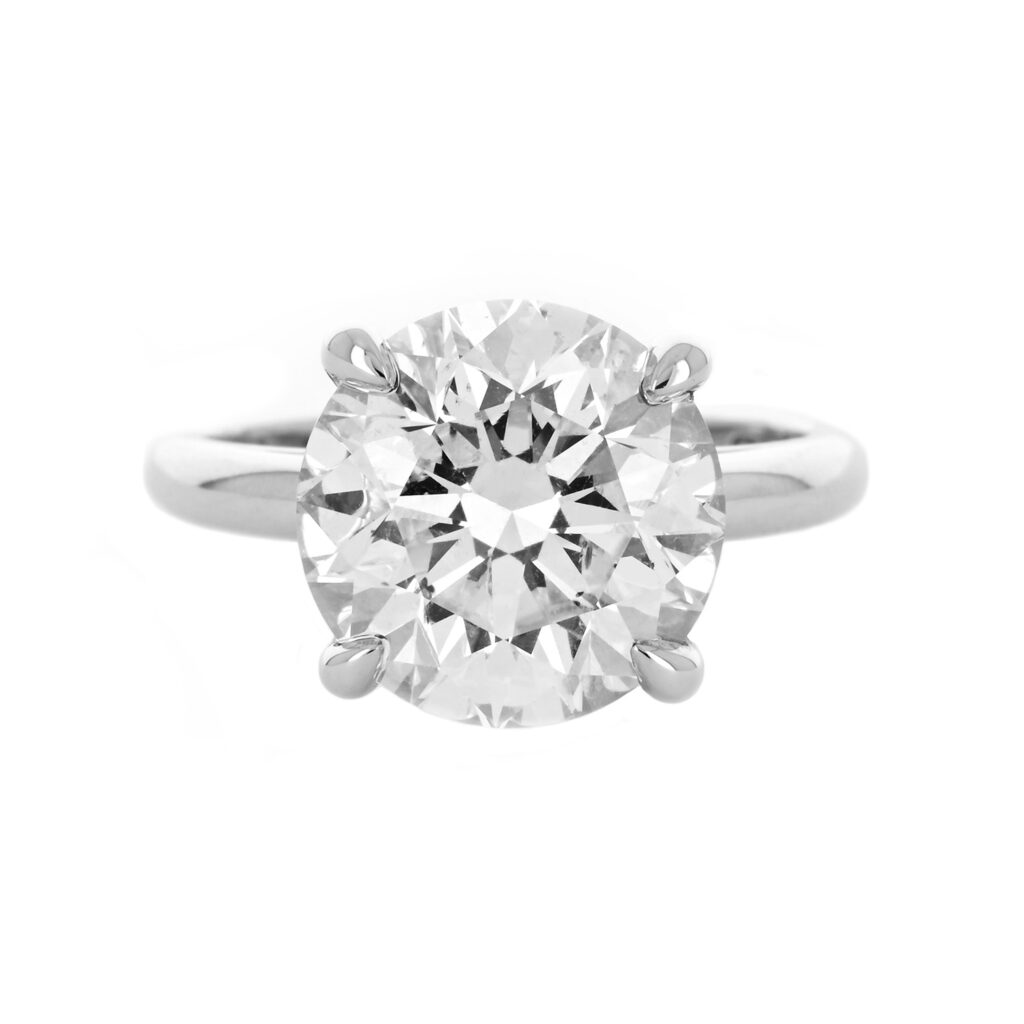
The diamond color scale is the single factor most likely to be misunderstood when someone is trying to figure out what a diamond is actually worth. Buyers assume “colorless” means better and stop there. But the letters on a GIA report don’t move price in a straight line, and knowing exactly where the real dollar jumps happen, and where they don’t, matters whether you’re buying, selling, or putting a diamond up as loan collateral.
What the Diamond Color Scale Actually Measures
GIA’s color scale runs from D to Z, 23 letter grades in total, with D representing colorless and each subsequent letter marking a slightly greater presence of visible yellow or brown tone, ending at Z (light yellow or brown). GIA introduced this D-to-Z system in 1953 specifically to replace the inconsistent grading language that came before it, things like A-C letter systems, Roman or Arabic numerals, and vague marketing terms like “gem blue” or “blue white” that meant different things at different jewelers.
To assign a letter, GIA graders work in a highly controlled environment: a daylight-fluorescent light source, a neutral gray background, a white non-reflective tray, and a fixed sightline, comparing the stone against a set of physical masterstones that represent each grade. That level of control is why a GIA color grade is treated as a reliable reference point rather than an opinion.
The Five Subcategories Behind the Letters
GIA’s own color scale groups the 23 letters into five subcategories: colorless (D-F), near colorless (G-J), faint (K-M), very light (N-R), and light (S-Z). In plain terms, “colorless” means the stone shows effectively no color to the trained eye under grading conditions, “near colorless” means a trace of warmth that’s usually undetectable face-up once set, and “faint” is where a warm tint starts to become visible, especially in larger stones or against white metal. This grouping is also the source of most of the confusion in searches for a “diamond color and clarity scale,” since color and clarity are graded on entirely separate scales that happen to appear on the same report.
How One Color Grade Difference Translates Into Real Dollars
This is where the diamond color scale stops being academic. In a matched-spec search, Excellent-cut, VS2, 1-carat, GIA-certified diamonds with no fluorescence ran about $5,800 to $8,400 in G color, versus $5,500 to $7,800 in H color, a gap of up to roughly $600 for a color difference invisible to the naked eye once the stone is set. Move further up the scale and the gap grows fast: in one matched-spec example, a G color diamond priced at $4,040 compared to $5,320 for an otherwise identical D color stone, a difference of $1,280 for visually negligible color separation.
The gap between the extremes is larger still. A matched-spec, 1-carat D color diamond priced at $7,590, while an otherwise identical J color stone (same clarity, cut, polish and symmetry) priced at almost 60% of that figure, or about $4,554. That’s a $3,036 premium (7,590 minus 4,554) paid purely for color grade on a diamond that is, in every other respect, the same stone. As a general rule, an H color diamond typically costs 15-25% less than a comparable G, and 30-40% less than an F, as of 2026 market pricing.
Some of that structure is genuinely about rarity and demand, and some of it is a documented pricing quirk. There is a disproportionately large price step from H to G color on wholesale price lists like Rapaport, described industry-wide as a quirk rather than a reflection of any visible quality difference. If you’re paying that H-to-G jump expecting a visibly whiter stone, you’re paying for a number on a report, not something you or anyone else will see.
Where the Naked-Eye Cutoff Really Is
Whether a color grade “matters” depends heavily on the setting metal, which is one of the most practical and least-discussed parts of this decision. For white gold or platinum settings, it’s recommended not to go below I color (H for larger stones), since a lower grade shows more noticeable yellow against the silvery-white metal; for yellow or rose gold, buyers can go down to J or even K and the diamond will still read as white. That single fact answers a question a lot of buyers and sellers get backward: the “right” color grade isn’t fixed, it’s relative to what the stone sits in.
Put together with the pricing data above, the practical cutoff for most people is this: G through J is where you get real savings without a visible tradeoff in most settings, while D through F is priced for people who specifically want a report that says “colorless,” not for a look anyone can distinguish across a table.
Fluorescence: Helps, Hurts, or Doesn’t Matter?
Fluorescence changes the math depending on where a stone sits on the color scale. Strong or very strong fluorescence can negatively impact the value of high-color diamonds (D-H grades), sometimes making them appear milky or hazy, devaluing them by 15-25%; in lower color grades (I-Z), fluorescence is less of an issue and can even make a faint tint appear whiter. That means a D or E color stone with strong fluorescence can actually sell for less than its letter grade suggests, while the same fluorescence in a J or K color stone can work in the owner’s favor. If you’re evaluating a diamond for resale or as loan collateral, the fluorescence line on the report deserves as much attention as the color grade itself.
Does the Grading Lab Matter for Resale or Loan Value?
Yes, and this is one of the most consequential decision points in the whole process. Buyers should compare only GIA or AGS-graded diamonds when evaluating color, since diamonds graded by other labs may not have been as accurately or consistently graded. A color grade is only as reliable as the lab that issued it, and that matters directly when a diamond is being appraised for a jewelry equity loan or offered for sale, since an inflated grade from a less rigorous lab doesn’t hold up once the stone is reviewed against market comparables.
Federal rules back this up. Under the FTC’s Jewelry Guides, any representation made about a diamond’s grade must disclose the identity of the grading system used, and a stated grade is considered deceptive if the grading system isn’t identified. Separately, even a permanent treatment that requires no special care should still be disclosed if it significantly affects the stone’s value compared to an untreated equivalent, and FTC guidance explicitly targets “upgrading,” meaning exaggerating a diamond’s quality beyond its actual grade, as a deceptive trade practice subject to enforcement. In practice: if a seller quotes you a color grade without naming the lab, or a color-treated stone without disclosing the treatment, that’s a red flag before you agree to a price. You can review our guide to understanding diamond grading reports for what a legitimate GIA or AGS report should actually show.
Diamond Color and Clarity Scale: How They Work Together
Color and clarity are graded independently, on different scales, but they’re read together when a stone is priced. A high color grade with heavy inclusions won’t command the premium the color letter implies, and a lower color grade with excellent clarity and cut can still look bright and clean face-up. If you want the full breakdown of how the letter grades line up visually, our diamond color chart guide walks through the scale side by side with clarity, and our diamond calculator post explains how appraisers weigh all four Cs together rather than isolating color grade alone. For a live sense of how these price gaps hold up in the current market, Blue Nile’s loose diamond search lets you filter by color grade and compare listed prices directly, since per-carat pricing shifts with the market and is worth checking on the day you’re deciding.
What This Means When You’re Selling or Using a Diamond as Collateral
If you own a diamond and you’re weighing whether to sell it or use it as collateral for a loan, the color grade on its report is one input, not the whole story. A D or E color stone with strong fluorescence may be worth less than its letter grade implies. A G or H color stone in a white gold or platinum setting may be worth exactly as much as its owner assumes, since that’s the range where the naked-eye cutoff actually sits. And a color grade from an unnamed or lesser-known lab needs to be verified before it factors into any valuation.
Diamond Banc evaluates diamonds against model and reference-specific market data rather than a generic price sheet, with local market directors and human specialists reviewing each stone’s grading report line by line. If you’re ready to find out what your diamond is worth, our diamond valuation process is transparent from the first conversation, and our diamond buying team can walk through the color, clarity, cut, and carat weight of your specific stone in person at a local office or through secure mail-in shipping. If selling outright isn’t the goal, a diamond can also be used as collateral for a loan without giving up ownership; you can see how that works on our loan options page. And if you’re weighing a fancy color stone rather than a standard D-to-Z graded diamond, our post on fancy color diamonds as loan security covers how that separate grading system is treated for collateral purposes.
Understanding where the diamond color scale actually moves price, and where it doesn’t, is the difference between paying for a visible improvement and paying for a number on a page. Get the grade verified by a lab that stands behind it, factor in the setting metal and fluorescence, and you’ll know within a few hundred dollars what a given letter grade is really worth before you sell, buy, or use it as collateral.
Like what you’re reading?
Add us in Google — more like this is on the wayRelated Posts
 Instagram
 Facebook
 Tiktok
 YouTube