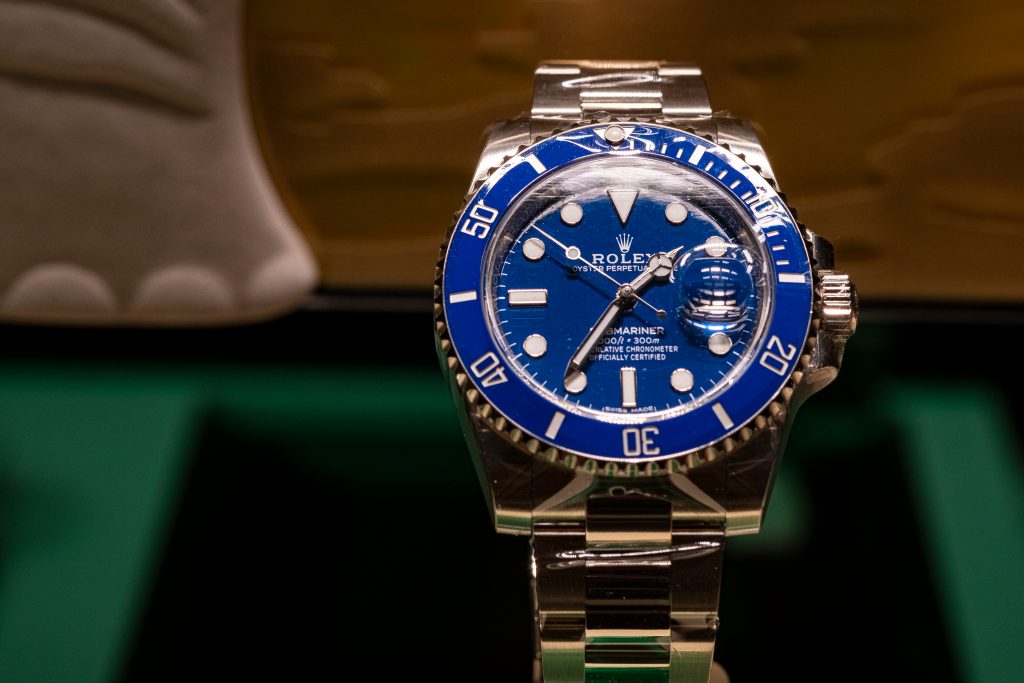
If you own a Rolex Smurf Submariner with the original box and papers, you’ve probably already searched for the best auction house to handle it, and found a lot of auction catalogs using the nickname but not much explaining what it actually guarantees. The short answer: the nickname doesn’t guarantee anything on its own. What determines whether an auction house, a dealer, or a direct sale gets you the strongest outcome is the reference behind the nickname, its production status, and how complete your set is, not the nickname itself.
What “Smurf” Actually Refers To
“Smurf” is collector shorthand for a white-gold Rolex Submariner with a blue dial and a matching blue Cerachrom bezel, part of a small cluster of blue-themed sport-watch nicknames that collectors track alongside the “Hulk” and the “Starbucks,” which Rolex introduced in late 2020 as a Submariner with a Super case, green Cerachrom bezel and black dial, sitting visually between the older Kermit and Hulk. None of these names appear in Rolex’s own catalog, service paperwork, or warranty card. They’re strictly a collector and secondary-market convention, which is exactly why relying on the name alone to identify or value a watch is risky.
Because the nickname describes an appearance, not a single catalog entry, the same word can get stretched across different case sizes, bracelet types, and even bezel materials depending on who’s using it. If a listing or a verbal quote leans on “Smurf” without stating the actual reference number, that’s the first thing to ask for, whether you’re the seller or a buyer at auction.
Nicknames Are Collector Slang, Not Rolex Terminology
Every one of the well-known Rolex nicknames, Smurf, Hulk, Batman, Pepsi, Kermit, was coined by the collector community and has never been officially used or sanctioned by Rolex itself. That matters for sellers in a very practical way: a dealer, auction specialist, or private buyer who leads with the nickname instead of the reference number may be using it to generate excitement rather than to describe the watch precisely. It isn’t necessarily dishonest, nicknames are genuinely useful shorthand among people who already know the references, but it isn’t a substitute for verification either.
When you’re preparing to sell, treat the nickname as a conversation starter and the reference number, production year, and condition of the box and papers as the actual terms of the deal.
Why Some Nicknamed References Hold Value Better Than Others
Not every nickname carries the same weight in resale. The watches that command a premium, Hulk, Kermit, Smurf among them, share a specific trait: they were discontinued, produced in limited numbers relative to current references, and made in a material or color combination Rolex hasn’t repeated. A nickname by itself creates recognition, but recognition without scarcity doesn’t move price. The current-production steel Submariner lineup illustrates the baseline: Rolex’s three current steel Submariner references retail between roughly $10,050 and $10,950 as of its January 2026 US price list. Those watches are still in the catalog, still being made, and still available through a Rolex retailer at that price, so there’s no scarcity premium attached yet.
Compare that to discontinued or specialty references with strong dial variants or clean provenance, where auction prices can exceed $30,000 to $100,000, well above current retail. The gap isn’t explained by the nickname being more famous, it’s explained by the reference being out of production, made in smaller numbers, and in some cases produced in precious metal rather than steel. A nickname is a symptom of desirability. Discontinuation status, material, production volume, and completeness of the set are the actual causes.
That’s also why a watch everyone agrees to call “Smurf” can sell for very different amounts depending on bracelet reference, bezel insert generation, and papers. Two watches with the same nickname are not interchangeable assets.
Does Having Box and Papers Change the Right Sale Channel?
Yes, in a few concrete ways. A complete set with the original box and the warranty card or sales receipt lets a buyer confirm the production date and original configuration without waiting on a full service history, which shortens the authentication process regardless of where you sell. That’s part of why original box and papers matter so much to the final number a buyer offers.
At an auction house, box and papers usually get you into a better-attended sale category and a cleaner provenance line in the catalog description, but you’re also accepting a published buyer’s premium, a sale date months out, and a reserve that may not be met. A dealer or direct buyer who specializes in the reference can usually verify the set in person or through secure mail-in shipping and make an offer the same day, without a commission coming out of your proceeds or the uncertainty of whether the lot sells at all. For a well-documented, in-demand reference like a genuine Smurf, that’s often the more practical route if your priority is a known number rather than the chance of a standout auction result.
If you’re weighing where to get the strongest offer for a Rolex with full documentation, the deciding factor usually isn’t the channel’s prestige, it’s whether the buyer has reference-specific pricing knowledge and can act on it immediately.
What to Verify Before Trusting a Nickname-Based Quote
Before you accept a valuation or a catalog estimate that leans on “Smurf,” “Hulk,” or any other nickname, confirm the following yourself:
- The exact reference number engraved on the case, not just the nickname used in conversation or in a listing title.
- Whether the bezel insert, dial, and bracelet match the generation the reference number should have, since parts are sometimes swapped over a watch’s service life.
- That the box and papers correspond to the specific watch in hand, matching serial and model numbers rather than being a generic set from the same era.
- Whether the quote or estimate reflects current secondary-market conditions for that reference, not an outdated figure from a prior sale cycle.
- Whether the buyer or auction house is pricing based on the reference’s actual production status (discontinued vs. current) rather than the nickname’s popularity alone.
A specialist who works with these watches regularly should be able to answer all five without hesitation. If a quote is built entirely around the nickname with no reference to the underlying specs, treat that as a reason to get a second opinion before committing.
Getting a Reference-Specific Valuation
Diamond Banc evaluates Rolex sport models, including nicknamed Submariner references, against current secondary-market pricing for the specific reference number, not a general category. That distinction matters most with watches like the Smurf, where the nickname covers a narrower set of specs than people assume. Our specialists work with these references daily, so the valuation accounts for material, bezel generation, and completeness of your box and papers rather than treating “Smurf” as a single fixed price point.
If you’d rather keep the watch and put its value to work instead, a Rolex-secured loan lets you use it as collateral for funding without parting with it, backed by the same reference-specific valuation process. And if you’re deciding between your Smurf and another nicknamed piece, our breakdown of what happened when a collector chose to sell a Rolex Submariner Hulk walks through a similar discontinued-reference decision, and our look at the Rolex Red Submariner covers another case where a nickname and a short production run combined to create real scarcity value.
Whichever direction you choose, auction, dealer, or a direct sale, the number that matters is tied to the reference, the documentation, and the condition in front of you, not the name everyone’s using to describe it. Our guide on finding the right Rolex buyer goes further into what separates a reference-specific offer from a generic one if you want to compare your options before you commit to a channel.
For a closer look at how your specific case and dial configuration affect current demand, our Submariner valuation page breaks down what buyers are paying across the model’s major variants as of 2026, nicknamed or not.
Like what you’re reading?
Add us in Google — more like this is on the wayRelated Posts
 Instagram
 Facebook
 Tiktok
 YouTube