The Rolex Explorer is one of the brand’s most understated watches, and the Explorer II is one of its most distinctive tool watches. They share a name, but they are different watches with different buyers, and each has references that trade at very different levels. If you own either one and want to know what it is worth, start by identifying exactly which model and reference you have.
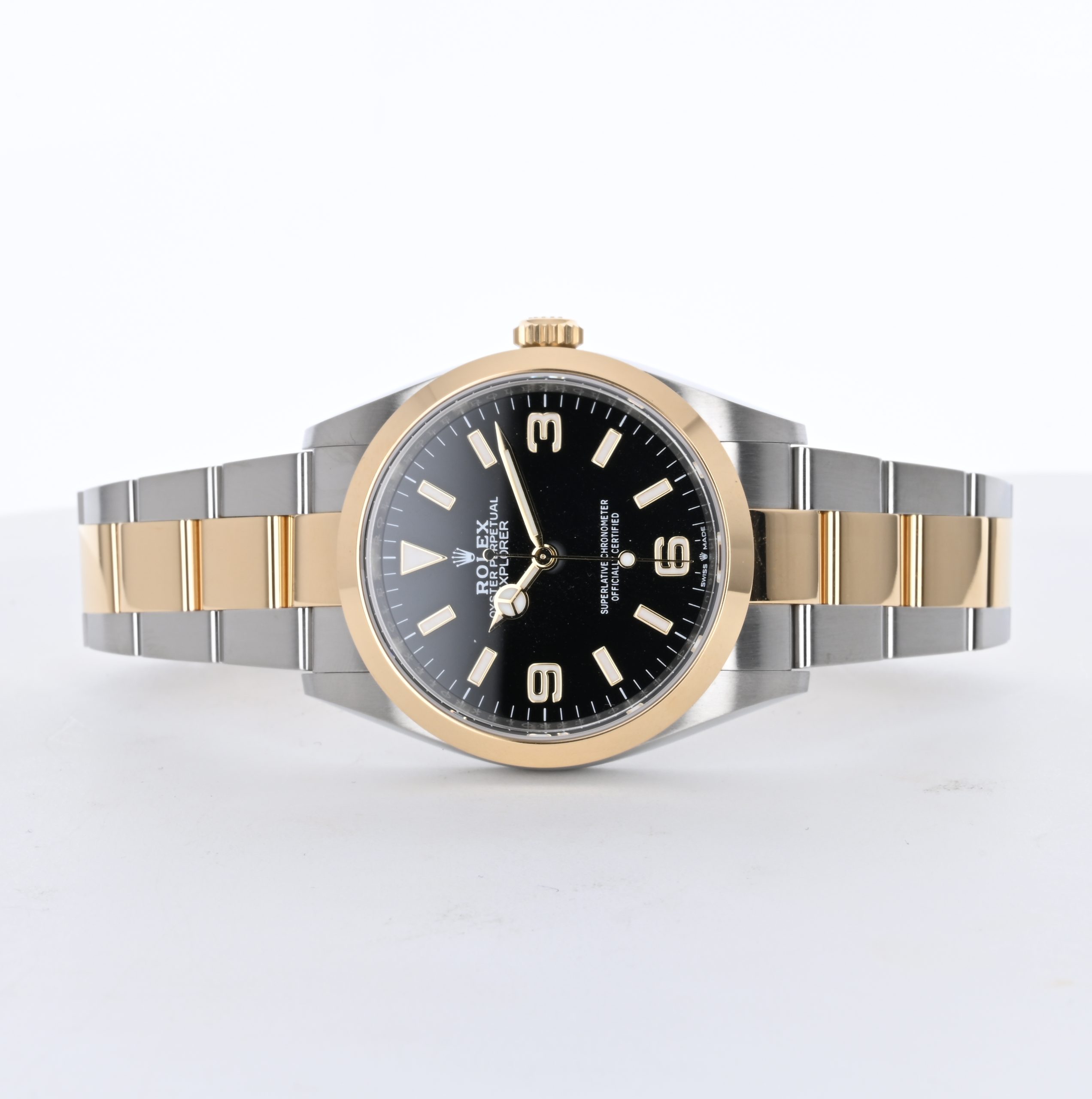
Explorer vs. Explorer II: Two Different Watches
The Explorer is a time-only watch with a black dial and the signature 3-6-9 Arabic numerals. It is sized for everyday wear and has no date.
The Explorer II is larger and adds a date, a fixed 24-hour bezel and an orange or red 24-hour hand. From the 16550 onward, that hand can be set independently to track a second time zone, as Monochrome Watches’ history of the Explorer II explains. It is offered with a black or white “Polar” dial.
Rolex Explorer References
| Reference | Production | Case | What to know |
|---|---|---|---|
| 1016 | Early 1960s–1989 | 36mm | Long-running vintage reference; early gilt dials, which gave way to matte dials around 1966–67, are the most sought after |
| 14270 | 1989–2001 | 36mm | Sapphire crystal and applied white gold numerals; rare “Blackout” dials from about 1990–91 |
| 114270 | 2001–2010 | 36mm | Calibre 3130 movement and solid end links (some late 14270s also had them) |
| 214270 | 2010–2021 | 39mm | Larger case; “Mk1” dials (to 2016) have shorter hands, “Mk2” dials have longer hands and luminous 3-6-9 |
| 124270 | 2021–present | 36mm | Return to 36mm with the calibre 3230 movement |
| 124273 | 2021–present | 36mm | First two-tone Explorer, in yellow Rolesor |
| 224270 | 2023–present | 40mm | Current larger-case option, calibre 3230 |
Explorer dates follow Monochrome Watches’ history of the Explorer; sources place the 1016’s introduction anywhere from about 1960 to 1963. All three current references, the 124270, 124273 and 224270, remain in Rolex’s catalog, and Rolex introduced no new Explorer or Explorer II models at Watches and Wonders 2026.
Rolex Explorer II References
| Reference | Production | Case | What to know |
|---|---|---|---|
| 1655 | 1971–1984 | 39mm | Original Explorer II, nicknamed “Freccione” (Italian for big arrow); orange 24-hour hand that cannot be set independently; five dial variations (Mark I to V); strong collector demand |
| 16550 | 1985–1988 | 40mm | Adds sapphire crystal and an independently adjustable 24-hour hand; introduced the white dial, some of which aged cream because of a paint defect |
| 16570 | 1989–2010 | 40mm | Long production run in black and Polar; movement and lume updates over time |
| 216570 | 2011–2021 | 42mm | Larger case with enlarged “Maxi” hands and markers; orange hand returns |
| 226570 | 2021–present | 42mm | 50th-anniversary update with the calibre 3285 movement |
Production dates for the Explorer II follow Monochrome Watches; exact transition years can vary by a year depending on the source. The 1655 is often called the “Steve McQueen,” but there is no evidence McQueen wore one; he is associated with the Submariner 5512, as our Rolex Submariner guide explains.
What Drives Explorer and Explorer II Value
The dial
On the current 226570 Explorer II, Polar dials have recently sold above black dials, though the premium on the older 216570 has been inconsistent. On the 16550, some white dials have aged to a warm cream tone that collectors specifically look for. On the 214270 Explorer, the earlier Mk1 and later Mk2 dials appeal to different buyers. On vintage 1016 watches, an original dial in good condition is central to value.
Originality
Replaced dials, hands and bezels matter far more on vintage references than on current ones. A 1655 or 1016 with its original components is a very different proposition from one updated with service parts. Our guide to Rolex service costs explains how service work and documentation affect value.
Condition and completeness
Case polish, bracelet stretch, full links, the original box and warranty card and documented service all move an individual watch within its reference’s range.
Current Value Ranges by Reference
| Reference | Where most sales landed |
|---|---|
| 124270 Explorer (36mm) | About $8,200–$9,700 |
| 224270 Explorer (40mm) | About $9,500–$11,000 |
| 214270 Explorer (39mm) | About $8,000–$9,500 |
| 114270 Explorer | About $6,300–$7,500 |
| 14270 Explorer | About $6,500–$10,000 |
| 226570 Explorer II | Black: about $10,600–$11,800 · Polar: about $12,000–$13,500 |
| 216570 Explorer II | About $10,000–$11,600 (no consistent dial premium recently) |
| 16570 Explorer II | About $8,000–$10,500 |
| 1016 Explorer (vintage) | Recent auction results mostly about $10,000–$14,000; the best original gilt dials sell higher. Originality drives value |
| 1655 Explorer II (vintage) | Recent sales about $12,500–$56,000; a 1983 example sold for $30,000 hammer at Christie’s in June 2026. Early dial marks and untouched originals carry premiums |
Figures are the range where most recorded sales landed in EveryWatch’s sold-listing data for August and September 2026, mostly dealer sales, with outliers excluded. They show the retail-side market, not a purchase offer: a buyer’s offer is lower because it accounts for authentication, reconditioning and resale time. Condition, box and papers and dial move an individual watch within its range. Vintage figures draw on EveryWatch’s auction and sold-listing records for June to September 2026.
How Current Models Compare With Retail
Rolex’s US list prices on rolex.com are $7,900 for the 124270, $8,350 for the 224270 and $14,600 for the two-tone 124273. The 226570 Explorer II lists at $10,600 with either dial, per Rolex. Against those numbers, recorded dealer sales of the steel Explorers and the 226570 run modestly above retail, with the Polar dial leading, so a well-kept current watch with its full set generally holds close to what it cost new. The two-tone 124273 is the exception: Bob’s Watches’ July 2026 sales data shows an average sale of $10,683, about 27 percent below retail. Rolex’s June 1, 2026, US price increase applied to gold and two-tone models and left steel prices unchanged, according to Luxury Bazaar.
Is It Real? Explorer-Specific Checks
Counterfeit Explorers are common. Details a specialist examines include the shape and finish of the 3-6-9 numerals, the correct 24-hour hand on the Explorer II, the dial printing, the rehaut engraving and the movement. See our guide on how to spot a fake Rolex for the broader checklist.
Frequently Asked Questions
Does the Rolex Explorer hold its value?
Generally well, especially current references in good condition with complete accessories. Value still varies by reference, dial and condition, so a specific evaluation is the only reliable answer.
Is the Explorer II worth more than the Explorer?
Often, but not always. The Explorer II has a larger case, a date and a GMT function, and it usually trades higher in comparable condition. Vintage references of either model are valued individually.
Is a Polar dial worth more than a black dial?
On the current 226570, yes: recent sales put Polar dials roughly $1,500 above black, even though Rolex charges the same $10,600 retail price for both. On the older 216570, recent sales show no consistent premium, so condition and completeness matter more.
What is the most collectible Explorer?
Among vintage models, the 1016 Explorer (especially early gilt dials) and the 1655 Explorer II attract the strongest collector demand. Among 1655s, the early Mark I “straight hand” dial is the rarest.
Sell or Borrow With Your Explorer
Whether you own a current 124270 or a vintage 1655, Diamond Banc’s Luxury Watch Specialists can identify the reference, review originality and condition and make an offer. Start with our Rolex Explorer selling page, or ask about using your watch as collateral for a Rolex loan.
Book a complimentary Rolex evaluation at a Diamond Banc location.
Like what you’re reading?
Add us in Google — more like this is on the wayRelated Posts
 Instagram
 Facebook
 Tiktok
 YouTube