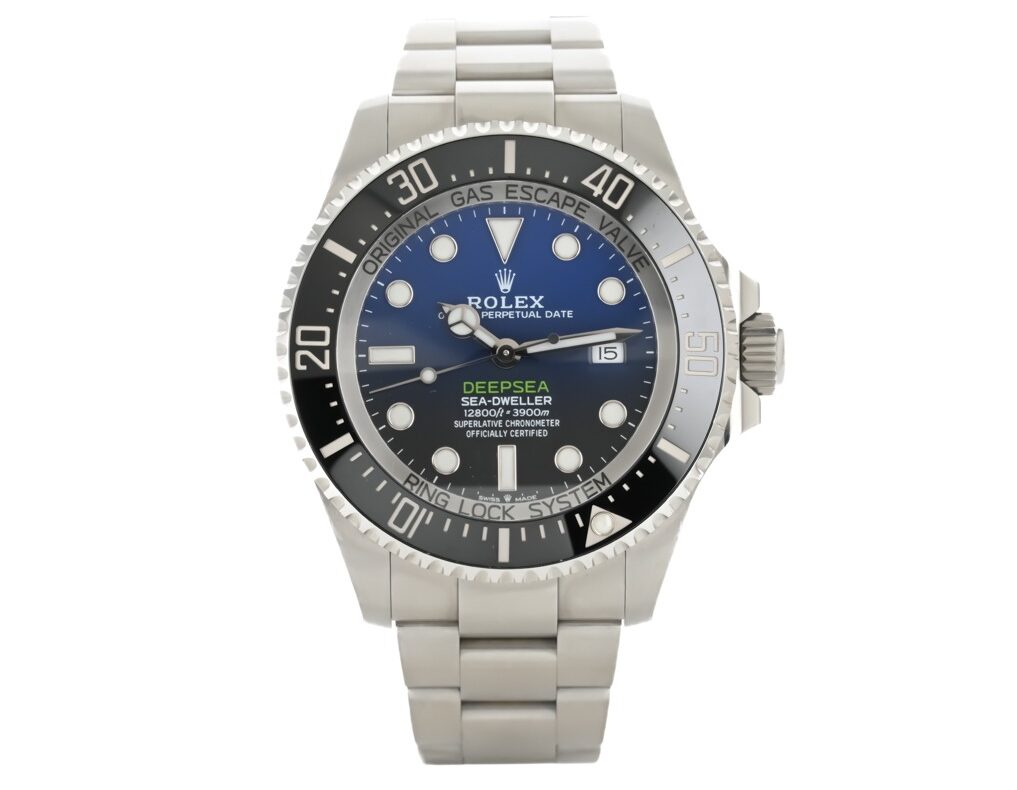
The Rolex Deepsea is Rolex’s most extreme diving watch, waterproof to 3,900 meters (12,800 feet). That is 13 times the Submariner’s 300-meter rating and more than three times the Sea-Dweller’s 1,220 meters, according to Rolex. What sets it apart from every other Rolex dive watch is its Ringlock System, a case architecture built specifically to withstand pressure at depths that would crush a standard diver’s watch. It’s not a fashion variant of the Submariner; it’s a purpose-built instrument descended from Rolex’s deep-sea testing program.
What is the Rolex Deepsea?
The Rolex Deepsea launched in 2008 as the Rolex Sea-Dweller Deepsea, reference 116660. Today Rolex lists it simply as the Oyster Perpetual Rolex Deepsea. It sits above the Submariner and the standard Sea-Dweller in Rolex’s professional diving lineup and was built for serious deep-sea diving and exploration rather than recreational scuba use. It shares its DNA with the Sea-Dweller, whose story is told in our history of the Rolex Sea-Dweller, but its case has measured 44 mm since the first reference, larger and heavier than a Submariner, to house the structure needed for extreme depth resistance.
What makes the Deepsea different from the Submariner or Sea-Dweller?
The core difference is depth rating and case construction. The Submariner is rated to 300 meters, the Sea-Dweller to 1,220 meters, and the Deepsea to 3,900 meters. That jump isn’t achieved by making the case thicker in the ordinary sense — Rolex redesigned the internal case architecture entirely, which is why the Deepsea has its own distinct engineering rather than simply being a “bigger Sea-Dweller.”
How deep can the Rolex Deepsea actually go?
The Deepsea is water-resistant to 3,900 meters, a depth far beyond any human diver descends unassisted, which places the watch firmly in “over-engineered by design” territory rather than practical necessity for most owners. Rolex tests the Deepsea in a hyperbaric tank at pressure equivalent to 4,875 meters, a 25 percent safety margin over the rated depth, according to the Rolex newsroom.
What technology allows it to withstand that pressure?
The answer is the Ringlock System, a three-part case architecture Rolex introduced specifically for the Deepsea. It consists of a domed sapphire crystal 5.5 mm thick, a compression ring of nitrogen-alloyed steel, and a titanium caseback (grade 5 titanium on the original 116660, RLX titanium on current models), as Rolex’s Deepsea model page describes. Together these components distribute pressure evenly across the case rather than concentrating it at any single weak point, which is what allows the watch to survive depths that would otherwise deform or shatter a conventional case. The Deepsea also carries a helium escape valve, a feature Rolex patented in 1967 and shares with the Sea-Dweller, which releases gas buildup during saturation diving decompression so the crystal doesn’t pop off under internal pressure.
What are the notable Deepsea models and editions?
Beyond the standard black-dial steel Deepsea, Rolex has released several notable variations over the years:
- D-Blue dial (James Cameron edition): Introduced in 2014 to honor filmmaker James Cameron’s March 26, 2012, solo dive to 10,908 meters in the Mariana Trench’s Challenger Deep. Rolex describes the gradient as running “from brilliant blue to bottomless black,” with DEEPSEA printed in green. Our Deepsea D-Blue history tells the full story.
- Steel references by generation: the original 116660 (2008, calibre 3135); the 126660 (2018, calibre 3235 with a 70-hour power reserve and a wider 22 mm bracelet); and the current 136660 (2022, calibre 3235 with a slimmer bezel ring and a larger date), per Monochrome Watches. All are Oystersteel. There has never been a Rolesor (steel-and-gold) Deepsea.
- Yellow gold Deepsea (136668LB): Launched in April 2024 as the first Deepsea in 18k yellow gold, with a blue dial, a blue Cerachrom bezel and a blue ceramic compression ring, as SJX Watches reported.
- Deepsea Challenge: Two different watches share the name. The 2012 original was an experimental piece rated to 12,000 meters that rode on the manipulator arm of Cameron’s submersible. In November 2022, Rolex released a wearable production version, reference 126067: 50 mm, RLX titanium, waterproof to 11,000 meters and tested to 13,750 meters, as Monochrome Watches’ review details.
Reference numbers, dial variations, and bracelet types affect both desirability and resale value, which is why identifying the exact reference matters more with the Deepsea than with many other Rolex models.
What is a Rolex Deepsea worth today?
Value depends on the specific reference, dial variant, condition, box and papers, and current secondary-market demand, which shifts over time. A steel Deepsea in strong condition with full documentation will typically command more than one missing papers or showing heavy wear, and the D-Blue dial often carries a premium over the standard black dial. Because pricing moves with the market, an accurate figure requires a reference-specific valuation rather than a general estimate. The table below shows where the market sits now.
| Reference | Current US retail | Recent secondary-market sales |
|---|---|---|
| 136660, black dial | $15,550 | About $12,400–$16,300 |
| 136660, D-Blue dial | $15,880 | Dealer asking prices about $16,800–$17,500 |
| 126660, black dial (2018–2022) | Discontinued | About $9,600–$11,700 |
| 126660, D-Blue dial | Discontinued | About $12,200–$16,800 |
| 116660, black dial (2008–2018) | Discontinued | About $8,750–$12,000 |
| 116660, D-Blue dial | Discontinued | About $12,000–$16,500 |
| 126067 Deepsea Challenge (RLX titanium) | $29,100 | Mostly about $40,500–$49,500 |
| 136668LB (18k yellow gold) | $68,100 | About $63,000–$68,700 |
Secondary-market figures reflect recorded dealer and auction sales on EveryWatch, except where dealer asking prices are noted. They show the retail-side market, not a purchase offer: a buyer’s offer is lower because it accounts for authentication, reconditioning and resale time. Three patterns stand out. Black-dial steel Deepseas generally trade at or below retail, while current D-Blue examples are listed slightly above it. The D-Blue dial carries a consistent premium over black in every generation. And the titanium Deepsea Challenge is the outlier, selling well above its $29,100 retail price.
Should you sell your Rolex Deepsea or use it as collateral?
If you need funds but want to keep the watch, a Rolex loan uses the Deepsea as collateral, so you keep ownership and get the watch back when the loan is repaid. If you no longer wear it or simply want to convert it to cash, selling your Rolex outright is the more direct path. Diamond Banc offers both options, so the decision comes down to whether you want the watch back at the end of the process or not. Either way, documented service helps the offer; our guide to what it costs to service a Rolex explains why.
Diamond Banc works with Rolex owners specifically, using model and reference-specific valuation and current secondary-market pricing rather than general pawn-shop assessment. Local market directors and human luxury-asset specialists evaluate each watch in person at a local office or through secure, insured mail-in shipping for owners outside those areas, and the valuation process is explained transparently before any offer is made. Whether you’re deciding to sell your Deepsea or use it as collateral for a loan, you can start with our Rolex value calculator or a straightforward evaluation of what the watch is worth today and go from there.
Frequently Asked Questions
Is the Rolex Deepsea the same as the Sea-Dweller?
No. The Deepsea began as a Sea-Dweller variant, but it has its own Ringlock case and a 3,900-meter rating, compared with 1,220 meters for the Sea-Dweller. Rolex now lists it as a separate model, the Rolex Deepsea.
Is the D-Blue Deepsea worth more than the black dial?
Generally, yes. Recent sales put D-Blue examples above black-dial examples of the same reference in each generation, though condition and completeness still move individual watches.
Does the Rolex Deepsea hold its value?
Steel Deepseas hold value reasonably well, though black-dial examples currently trade at or somewhat below retail. The titanium Deepsea Challenge 126067 is the exception, selling well above its retail price in 2026.
Like what you’re reading?
Add us in Google — more like this is on the wayRelated Posts
 Instagram
 Facebook
 Tiktok
 YouTube