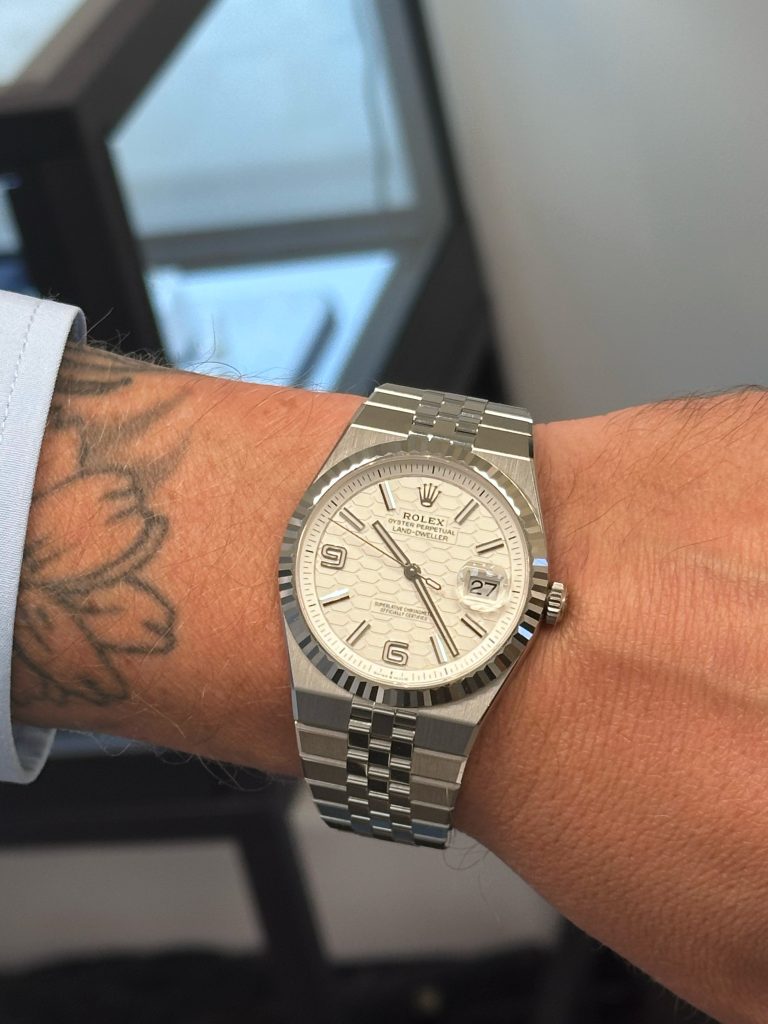
The Rolex Land-Dweller is the newest watch line Rolex has introduced in years, and it’s also one of the most misunderstood. Part of the confusion is reasonable: it looks like a dressier Datejust at first glance, carries a visible movement (something Rolex almost never allows), and arrived with secondary-market pricing that swung wildly in its first year. This guide covers what the Rolex Land-Dweller actually is, what it costs by metal and size, how its movement works, and the questions an owner needs answered before deciding what to do with one.
What Is the Rolex Land-Dweller, and How Does It Differ From the Datejust?
The Land-Dweller is a new collection, not a Datejust variant. It uses its own case architecture, its own in-house movement (Calibre 7135), and a fluted bezel design paired with a dial pattern unique to the line. Where the Datejust has been built around the same basic case and movement family for decades, the Land-Dweller was engineered from the ground up, including a newly patented escapement that Rolex had never used before. The two watches will sit next to each other in a Rolex boutique, but mechanically and in design lineage they are different products aimed at different parts of the catalog.
Rolex Land-Dweller Dimensions and Case Specs
The Land-Dweller comes in two sizes: 36mm and 40mm, both measuring 9.7mm thick, built on a monobloc Oyster case in Oystersteel, Everose gold, or platinum, with a fluted bezel, Twinlock crown, and 100 meters of water resistance. The monobloc construction (case and middle case formed as a single piece) is a departure from the multi-part cases used on most other current Rolex models, and it’s part of why the watch can carry a sapphire exhibition caseback without compromising water resistance.
That exhibition caseback is worth noting on its own: Rolex is selective about which models get one, and it has confirmed the Land-Dweller, the 1908, and certain platinum Daytona references as the only current lines where you’ll see the movement through the back.
Rolex Land-Dweller Price by Metal and Size in 2026
Pricing varies significantly by metal and case size. As of late 2026, official Rolex retail pricing for the Land-Dweller collection is as follows:
- Land-Dweller 36, Oystersteel and white gold: $15,350
- Land-Dweller 40, Oystersteel and white gold: $16,450
- Land-Dweller 36, Everose gold: $49,400
- Land-Dweller 40, Everose gold: $54,100
- Land-Dweller 36, platinum: $63,600
- Land-Dweller 40, platinum: $68,400
Those figures come directly from Rolex’s current Land-Dweller pricing page, which is the most reliable place to check the exact number for a specific reference, since Rolex adjusts prices periodically and this page reflects whatever is current when you look.
Inside the Movement: Calibre 7135 and the Dynapulse Escapement
The Land-Dweller’s headline feature isn’t its case, it’s what’s inside it. Calibre 7135 is developed and manufactured entirely in-house by Rolex, an evolution of the Calibre 7140 that debuted in the 1908 dress watch. It runs at 5 Hz (36,000 beats per hour), measures time to a tenth of a second, and carries roughly a 66-hour power reserve, all figures confirmed by Rolex’s technical documentation for the model.
The bigger story is the Dynapulse escapement, a new silicon sequential-distribution escapement that is the subject of seven separate patent applications. Rolex chose silicon construction specifically for magnetic-field resistance, and paired it with a balance staff made from a patented ceramic shaped using femtosecond laser ablation, again targeting resistance to magnetism rather than shock or temperature. Independent watchmakers who have examined the movement estimate the Dynapulse escapement is roughly 30% more energy-efficient than a standard Swiss lever escapement running at the same frequency. In practical terms: if a conventional escapement consumes 100 units of energy to do its job, Dynapulse does the same job on about 70, which is part of how Rolex squeezes a 66-hour reserve out of a relatively compact movement.
Across the full Land-Dweller launch, Rolex and its patent filings account for roughly 32 patents tied to this one watch, split between the case and model design and the movement itself. That’s an unusually heavy patent investment even by Rolex standards, and it signals the company treats this as a platform it intends to build on, not a one-off release.
Is the Rolex Land-Dweller a Good Investment?
This is the question most owners actually want answered, and the honest answer is: it depends on when you’re looking and which reference. In the months after launch, steel Land-Dweller references traded well above retail on the secondary market, driven by limited allocation at Rolex boutiques. Reports from watch-market trackers put the steel 40mm reference’s average resale price at around $27,449, with top unworn full-set listings approaching $39,000, roughly an 80 to 90 percent premium over Rolex’s own retail price about a year into production. Some early listings for the 40mm Rolesor version briefly pushed close to $50,000 right after launch, before settling into the high $30,000s as more pieces reached the market.
That premium is a supply story, not a guarantee. New Rolex platforms almost always command a markup while allocation is tight, and that markup compresses as production ramps up and boutiques fill more orders. Treating today’s secondary-market price as a fixed value, whether for insurance, estate planning, or using the watch as collateral, is risky precisely because that number has already moved meaningfully since launch and is likely to keep moving. If you’re weighing whether a Land-Dweller (or any newer Rolex release) is a sound long-term hold, it’s worth comparing how a more established line like the Sky-Dweller has held its value over a longer stretch, rather than judging a watch that’s barely a year old against its launch-week hype.
If you want a number specific to your watch rather than an aggregate market average, a model- and reference-specific valuation is the only way to get one. Diamond Banc’s specialists can give you a current reading on what your exact reference, condition, and box/papers status is worth through its Rolex valuation process.
Real vs Fake: What Actually Matters on a Land-Dweller
Authentication checklists built for Submariners or Datejusts don’t transfer cleanly to this watch, and that trips up a lot of buyers. The biggest misconception: a visible movement through a sapphire caseback is normally treated as an automatic red flag on a Rolex, since the vast majority of current models have solid casebacks. On the Land-Dweller, it isn’t a red flag at all; Rolex built it that way on purpose, and you should expect to see the Dynapulse escapement and bridge work through the back of a genuine piece.
What’s worth checking instead:
- The monobloc case construction: a genuine Land-Dweller case is formed as a single piece, not assembled from a separate case back and middle case. Seams or visible screws where there shouldn’t be any are a warning sign.
- The fluted bezel and dial finishing, which Rolex executes with a precision that’s difficult and expensive to replicate convincingly.
- The Twinlock crown and its engraving, consistent with Rolex’s standard crown specifications across the current catalog.
- Serial and reference numbers matching what Rolex lists for that specific metal and size combination, since the Land-Dweller’s six configurations each have distinct reference numbers.
If you have any doubt about a piece you’re considering buying, inheriting, or already own, a hands-on evaluation from someone who works with Rolex watches daily is worth more than any checklist. Diamond Banc’s team can evaluate and authenticate a Rolex in person or through secure mail-in service before you make a decision either way.
Warranty and Service: What Comes With a New Land-Dweller
A Land-Dweller purchased new from an Official Rolex Retailer carries Rolex’s standard five-year warranty against manufacturing defects, the same coverage that applies across the current catalog. Rolex recommends servicing roughly every ten years depending on the model and how the watch is actually worn, rather than on a fixed calendar schedule. Given how new Calibre 7135 is, there’s limited long-term service history on it yet; the escapement’s silicon construction and magnetic resistance are designed in part to reduce the kind of wear that drives earlier Rolex calibers to the bench, but real-world data on that will accumulate over the next several years as more watches reach their first decade.
Deciding What to Do With a Land-Dweller You Already Own
Whether a Land-Dweller is “worth it” depends less on the watch and more on what you need it to do for you. If you’re holding one as a long-term piece, the warranty and movement specs support that use. If you need liquidity now, options include a Rolex-secured loan that lets you keep ownership while accessing cash against the watch’s current value, or a straightforward sale if you’ve decided it no longer fits your collection. Given how much secondary-market pricing on this specific model has moved since launch, getting a reference-specific valuation before you commit to either path, rather than relying on a listing you saw online, is the difference between an informed decision and a guess. For owners weighing a loan against an outright sale more generally, it’s worth reading through how the process works when you use a Rolex as collateral before deciding which route fits your situation.
Like what you’re reading?
Add us in Google — more like this is on the wayRelated Posts
 Instagram
 Facebook
 Tiktok
 YouTube