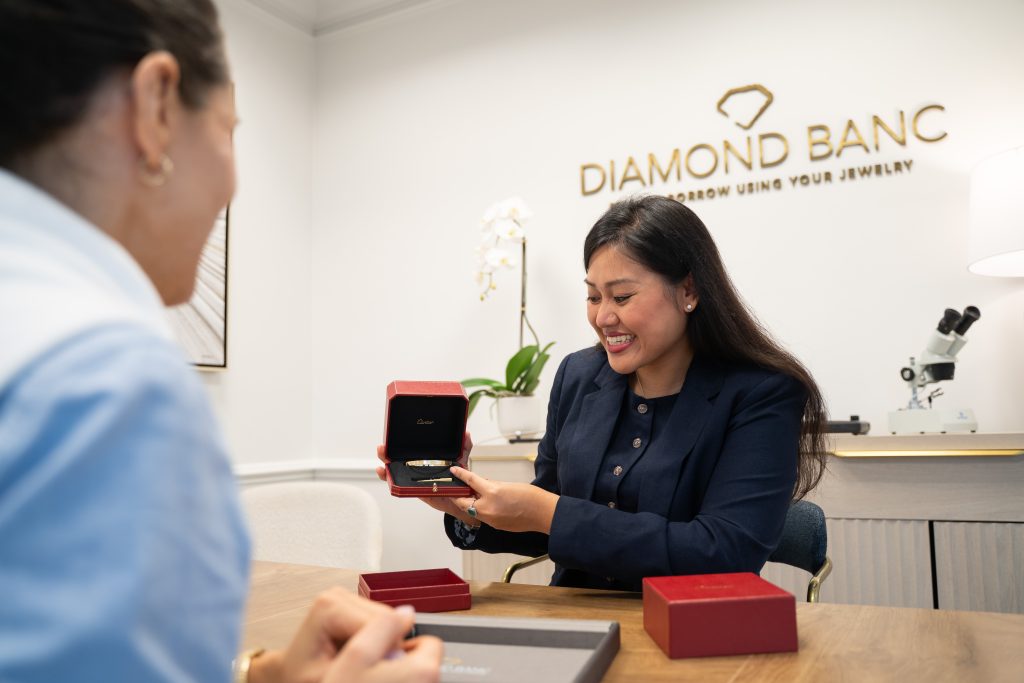
When a loved one passes away and leaves behind rings, watches and other jewelry, the question that comes up almost immediately is who gets to touch it, who decides what it’s worth, and what happens if a sibling wants to sell a piece before probate is finished. Jewelry is one of the few estate assets that is both a legal asset and a personal one, and California has specific rules for how it moves from a decedent’s hands into an heir’s, or onto an estate sale table.
This guide walks through what California law actually requires before jewelry can be sold or divided, who is responsible for assigning it a value, how to tell whether an heirloom piece is solid gold or something less, and how to put a real number on what the gold in a ring is worth today. Diamond Banc’s San Diego office, located in La Jolla, works with families in exactly this situation, and the same process applies whether you’re settling a full estate or just trying to understand one box of jewelry before a sale.
Who Can Legally Touch the Jewelry Before Probate Is Settled
It’s common for a family member to start sorting through a parent’s jewelry box within days of a death, often with the best intentions. But under California law, no single heir has the legal authority to distribute, divide or remove estate property, including jewelry, until a personal representative has been formally appointed by the court or a valid small estate affidavit applies. Taking a piece home “to keep it safe” before that authority exists can expose that person to a claim from other heirs later, even if nothing was done in bad faith.
This matters most with jewelry and watches specifically, because unlike furniture or clothing, these items carry real, often significant, fair market value and sometimes deep emotional weight at the same time. Beneficiaries have successfully challenged an executor’s distribution of high-value items when appraisers were unqualified, when a piece was undervalued, or when it simply wasn’t inventoried properly before the estate sale went forward.
Do You Actually Need Probate for the Jewelry?
Not always. California’s small estate affidavit lets heirs claim personal property, including jewelry, without opening formal probate, but only if the estate’s total gross value doesn’t exceed a statutory threshold. For deaths on or after April 1, 2025, that threshold is $208,850, and the affidavit itself can’t be used until at least 40 days have passed since the death. If the estate, including the jewelry’s fair market value, stays under that number, heirs can typically skip the months-long probate process entirely.
If the estate is larger, or includes real property, formal probate applies, and the jewelry becomes part of a court-supervised inventory before anyone can sell or divide it. There is a separate, narrower exception worth knowing about: a surviving spouse or minor children can petition the probate court for a personal property exemption that includes up to $2,175 worth of jewelry, kept outright, apart from the vehicle and household-goods exemptions the law also allows. That exemption doesn’t apply to the rest of the estate’s jewelry, which still goes through the normal valuation and distribution process.
Who Actually Values the Jewelry, and How Long It Takes
A common assumption is that the executor or personal representative decides what Mom’s jewelry is worth. They don’t. Under California Probate Code Section 8901, the personal representative only values cash and cash-equivalent accounts. Jewelry, watches and nearly everything else falls to a court-appointed probate referee, a neutral third party assigned to the case specifically to appraise estate assets for the court.
That referee’s fee is set by statute, not negotiated: 0.1% of the appraised value, with a $75 minimum and a $10,000 maximum, paid out of the estate itself. Once the personal representative delivers the full estate inventory to the referee, the referee is required to complete the appraisal, jewelry included, within 60 days, or file a status report explaining the delay. If a piece of jewelry already has a recent professional appraisal on file, California probate guidance recommends handing that over to the referee directly, since it can meaningfully speed up the valuation.
Can Siblings Just Divide the Jewelry Themselves?
Only once the personal representative has legal authority to distribute, or the small estate affidavit applies. An informal split “we’ll each just take a few pieces” before that point is exactly the scenario that creates liability. Once the referee’s appraisal is complete and the court or affidavit process authorizes distribution, heirs are generally free to divide jewelry among themselves by agreement, as long as the agreed split reflects the appraised values fairly.
Is That Heirloom Ring Actually Solid Gold?
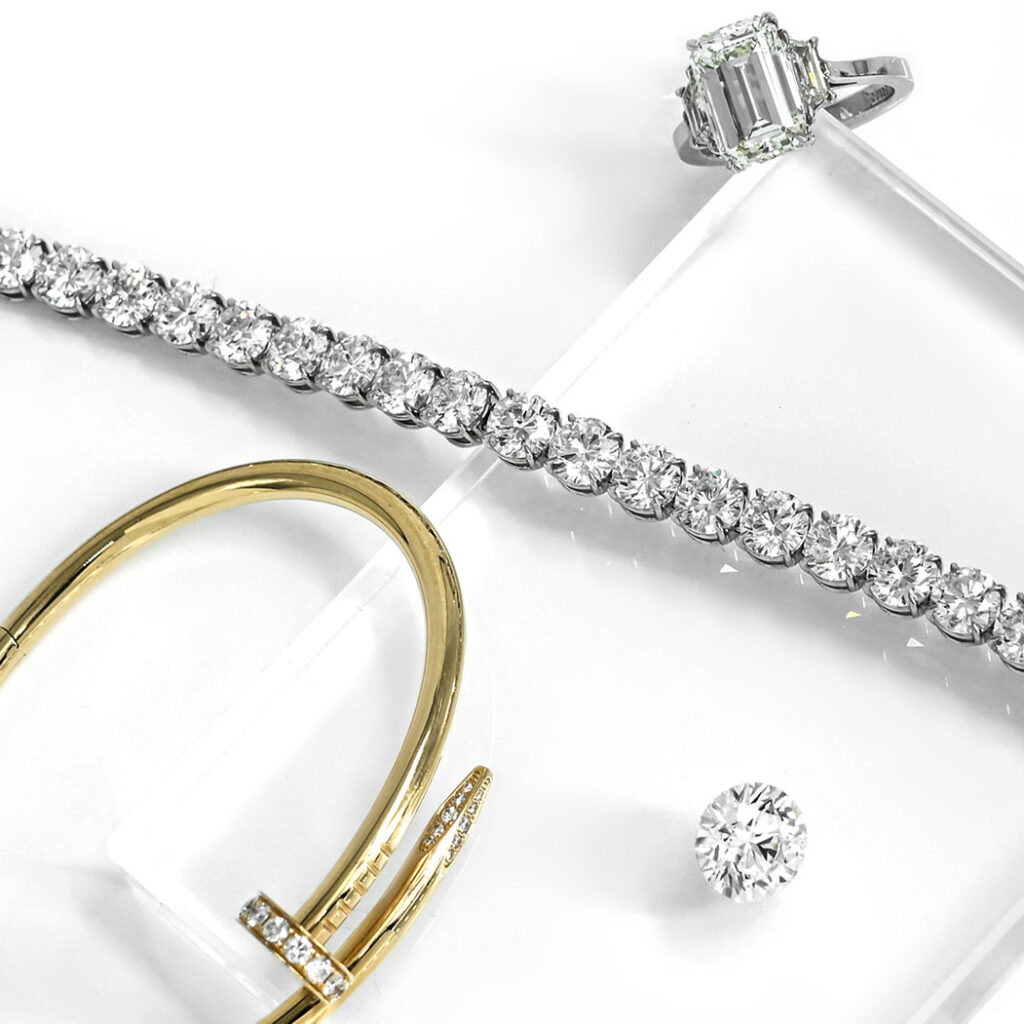
Before anyone counts a piece toward the estate’s value, or decides whether it’s worth selling versus keeping, it helps to know what it’s actually made of. Under the FTC’s Jewelry Guides, an item can only be legally marketed or described as “gold” if it’s at least 10 karat, meaning at least 41.7% pure gold by weight. Anything below that, including most gold-filled or gold-plated pieces, isn’t legally gold at all, even if it looks identical to the eye.
A karat stamp alone isn’t proof, either. Federal law requires any karat mark on a piece of jewelry to be paired with the manufacturer’s or dealer’s registered trademark, and the stamped fineness can’t legally be off by more than 7/1,000ths once solder is accounted for. A ring stamped “14K” with no maker’s mark next to it hasn’t necessarily been verified by anyone, which is exactly why estates with unmarked or old heirloom pieces benefit from a professional looking at them before they’re counted toward the estate’s total or priced for a sale.
What Is the Gold Actually Worth Right Now?
Gold’s price changes throughout the trading day, so any number is only a snapshot. As of November 17, 2026, spot gold was trading at $3,848.50 per troy ounce, or $123.73 per gram, well off the all-time intraday high of $5,589.38 per ounce set on January 28, 2026. Check the live price before estimating, since it moves daily.
To get a rough melt value for a gold piece in an estate, the math is straightforward once you know the karat and weight. Take a 10-gram ring stamped 14K, which is 58.5% pure gold by weight. At the November 17, 2026 price of $123.73 per gram, the calculation looks like this:
- 10 grams × 0.585 (14K purity) × $123.73 per gram = approximately $723.82
That $723.82 is the estimated value of the gold content alone, before accounting for any diamonds, designer maker’s marks, or craftsmanship, which can add considerably more than the metal itself is worth. It’s a useful baseline for deciding whether a piece is worth having properly evaluated before an estate sale, rather than a final answer on its own.
Deciding What to Do With the Jewelry Before the Sale
Once probate authority is in place, or the small estate affidavit applies, and the jewelry has been valued, heirs typically land on one of three paths: keep it, sell it, or use it as collateral while deciding. For pieces nobody in the family wants to keep, whether that’s a collection of dated rings, a parent’s watch, or a diamond piece that doesn’t suit anyone’s taste, selling jewelry in San Diego directly to a specialized buyer is often simpler and faster than consigning it through an estate sale company, especially for higher-value individual pieces that a general estate sale audience may undervalue.
Watches deserve their own look before anything goes into a sale box. If the estate includes a Rolex or another luxury watch, model and reference-specific expertise matters for getting an accurate number, since two watches that look similar can differ substantially in value based on reference number, condition and documentation. Diamond Banc’s San Diego team can evaluate a watch directly, and the how to sell a Rolex process works the same way for an inherited piece as it does for one you’ve worn yourself. Diamond jewelry from an estate, engagement rings, pendants, and loose stones included, can also be evaluated by specialists who work specifically as diamond buyers rather than general estate liquidators.
Heirs who aren’t ready to part with a piece permanently, but need liquidity while the estate is being settled, have another option: a jewelry-secured loan keeps ownership of the piece while providing cash against its value. This can be useful when probate costs, referee fees, or simple timing create a short-term need for funds before the estate’s other assets are distributed.
Getting Jewelry Properly Evaluated Before the Estate Sale
Whether jewelry is heading toward a probate referee’s appraisal, a family division, or an estate sale, having it looked at by someone with real jewelry and watch expertise, not just a general estate liquidator, tends to produce a more accurate number and a smoother process. Diamond Banc’s San Diego office, at 4275 Executive Square, Suite 200 in La Jolla, works with executors and heirs directly, evaluates jewelry and watches in person, and can discuss current secondary-market pricing on request. For families managing an estate that spans multiple cities, the sell estate jewelry at fair value approach that applies in San Diego applies the same way wherever the estate is being handled.
If this is the first time your family is navigating an inherited jewelry collection, it also helps to look ahead to how future estate planning could make the next transition easier. A few straightforward steps taken now, documenting pieces, getting current appraisals, and discussing intentions with heirs, can prevent the exact probate referee delays and family disputes described above. For a closer look at that process, see the guidance on how to simplify jewelry estate planning before the next generation has to sort it out.
San Diego families dealing with an estate’s jewelry don’t have to choose between rushing a decision and letting pieces sit untouched for months. Understanding the probate referee’s role, the small estate affidavit threshold, and a realistic sense of what the gold and stones are actually worth gives heirs a clear basis for whatever they decide next, whether that’s dividing pieces among family, selling them outright, or using them as short-term collateral while the rest of the estate is settled.
Like what you’re reading?
Add us in Google — more like this is on the wayRelated Posts

 Instagram
 Facebook
 Tiktok
 YouTube