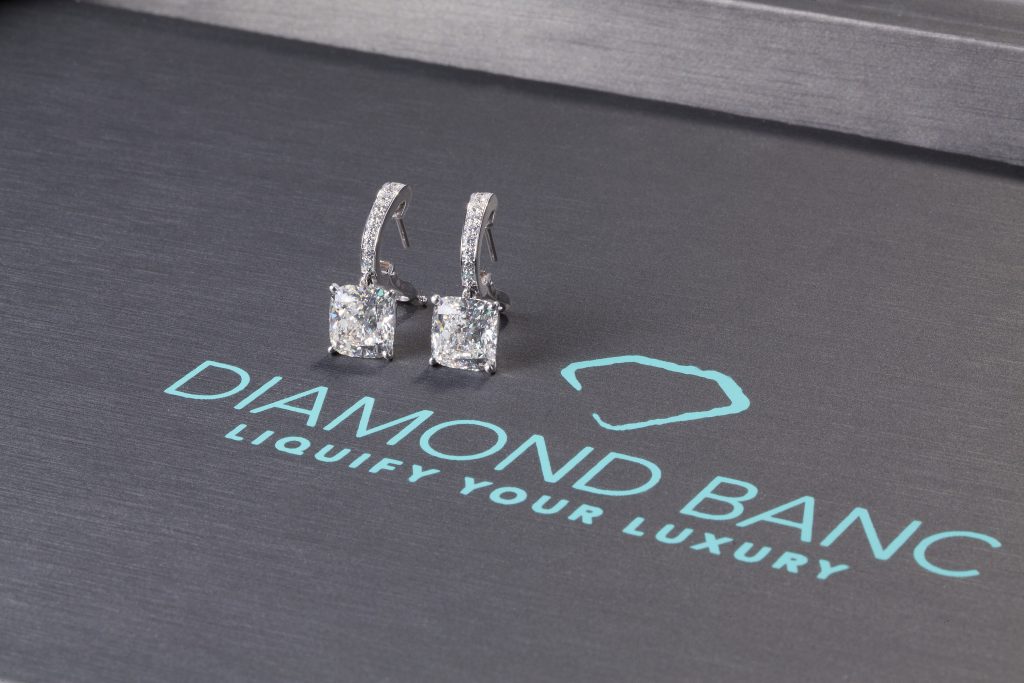
An earring loan works the same way any jewelry-secured loan does: the lender advances cash based on what the piece is actually worth, then returns it once the loan is repaid. But diamond earrings are a strange category of collateral. Two pairs that look nearly identical under a loupe, same carat weight, same shape, same general sparkle, can be worth very different amounts once a lender actually evaluates them. The gap usually comes down to three things: whether the stones are natural or lab-grown, whether the setting carries a recognizable brand, and whether the pair is intact and matched. None of that shows up in a quick glance, which is exactly why it’s worth understanding before you ask what your earrings might get you.
Earring Loan Basics: What a Lender Is Actually Pricing
When you bring in diamond earrings for a loan, you’re not getting a single number for “the pair.” You’re getting a sum of several separate values stacked together: the melt value of the metal in the setting, the market value of each stone, and in some cases a brand premium on top. A lender who understands this breaks the piece down the same way a jeweler would before offering a number, rather than guessing at a round figure based on how the earrings look in the box. That’s the practical difference between using jewelry as loan collateral at a specialist versus a general pawn counter that prices by eye.
Does a GIA Report Matter, and Is It Worth Getting One?
A Gemological Institute of America report removes the guesswork: it documents carat, cut, color, clarity, and whether a stone has been treated, all from an independent lab rather than the seller’s word. For a single larger stone, that documentation can meaningfully speed up a valuation. But for earrings specifically, there’s a practical wrinkle. GIA’s own fee schedule shows that a full report for a 1.00 to 1.49 carat diamond runs roughly $80 to $135, while smaller accent stones in the 0.15 to 0.22 carat range, the size typical of many earring clusters, cost as little as $32 to $53 to certify. Spending that much to certify two small stones individually often isn’t worth it relative to what the stones are worth.
There’s also a mechanical problem: GIA does not grade diamonds that are already mounted in a setting. To get a full report on stones that are already set in your earrings, they’d need to be removed first, which isn’t something most owners want to do just to get a loan. In practice, a lender experienced with diamonds can assess mounted stones directly and doesn’t require a report to make a fair offer, which is one reason working with specialists who do this daily matters more than paperwork for earring-sized stones.
Does the Brand on the Setting Change the Offer?
Yes, and the effect is measurable. Pieces from houses with strong, consistent secondary markets, such as Tiffany & Co., Cartier, and Van Cleef & Arpels, hold more of their retail value than unbranded settings with comparable stones and metal weight, because demand for the brand itself supports resale pricing even when gem value alone wouldn’t justify it. A lender who recognizes the maker’s mark, hallmark, or signature design details (prong style, gallery construction, clasp mechanism) can factor that premium into the offer. An unbranded pair with an identical stone and identical gold weight will usually be priced closer to its raw melt-and-stone value, without that added margin.
What If One Earring Is Damaged or the Pair Doesn’t Match?
Earrings are valued and worn as a set, which means damage to one side affects the value of both. A missing stone, a bent or broken post, or a replacement stone that doesn’t match the original in color or cut all reduce what the complete pair is worth, not just the damaged earring. This surprises a lot of owners who assume the undamaged earring should still carry full value on its own. In reality, a lender pricing the set has to account for the cost and complexity of restoring a true match, and that discount applies across both pieces. If you’re not sure whether your pair still matches exactly, it’s worth having a specialist look at both earrings side by side before assuming what they’re worth.
What the Setting Itself Is Worth
Separate from the stones, the metal in your earrings has its own standalone value, and it moves with the daily gold market independent of anything happening with diamond prices. As of November 2, 2026, spot gold sat at $3,965.60 per troy ounce, with 14-karat jewelry gold, the most common alloy used in U.S. settings, worth about $74.37 per gram at that price. That’s meaningfully below gold’s all-time high of $5,589.38 an ounce, set in late January 2026, but still a substantial floor under any gold-setting earrings regardless of what the stones end up appraising at.
Here’s how that plays out in practice. A pair of 14-karat gold diamond stud earrings with a combined metal weight of 6 grams has a gold-only melt value of about $446.22 at that November 2026 spot price, calculated before anything is added for the diamonds, the brand, or the craftsmanship of the setting. That number represents a floor, not a ceiling: it’s what the gold alone is worth if the stones were set aside entirely, which is why platinum or gold earrings carry collateral value even when the stones themselves are modest. If your earrings are mostly about the metal rather than a large center stone, a lender focused on gold and silver jewelry value will weigh that gram weight heavily in the offer.
Treatments That Can Quietly Lower the Appraisal
Some diamonds are treated to improve their apparent clarity or color, through methods like fracture filling, laser drilling, or high-pressure high-temperature processing. These treatments are legal, but federal rules require sellers to disclose them whenever the treatment isn’t permanent, requires special care, or meaningfully affects the stone’s value. The problem for a current owner is that disclosure often happened (or didn’t) at the original point of sale, years before the earrings reached your jewelry box, and you may have no record of it either way. A diamond that looks like a high clarity grade but turns out to be treated typically appraises lower than its appearance would suggest, since the treatment itself is part of what’s being valued, not just the stone underneath it. This is one more reason a specialist examination matters more than a visual estimate when a pair of earrings hasn’t been looked at professionally in a long time.
Getting an Earring Loan Instead of Pawning or Selling
If you’re searching for whether you can pawn diamond earrings, the short answer is yes, almost anywhere that handles jewelry will take a look. But a general pawn shop and a specialist aren’t pricing the same way. A pawn counter is often working from a quick visual estimate across every category of goods it accepts; a jewelry and diamond specialist is weighing stone type, treatment history, brand, and current metal pricing before making an offer, which tends to produce a higher and more defensible number. Diamond Banc structures this as a straightforward loan: your earrings secure the loan amount, you keep ownership, and you get them back once the loan is repaid. If you’d rather not keep the earrings at all, the same evaluation also supports an outright sale through Diamond Banc’s diamond buyers, so you can compare both options with the same appraisal rather than starting over elsewhere.
For loans, the process typically starts the same way whether you visit a local office or ship the piece in securely, and the same evaluation standards (stone type, condition, metal weight, brand) apply either way. If you’re comparing an earring loan to a similar decision on another diamond piece, it’s worth reading how the same factors play out with a diamond necklace loan, since the underlying math on stones and metal is nearly identical, just distributed differently across the piece.
What to Have Ready Before You Ask for a Number
- Any paperwork you have, even informal receipts, that mention carat weight, stone origin, or whether the diamonds are lab-grown
- Both earrings together, even if one is damaged, since the pair is valued as a set
- Honesty about any repairs, replaced stones, or resizing done to either earring
- Realistic expectations that gold-only value and stone value are calculated separately, then added together
None of this requires a GIA report or a trip to have the stones unmounted. A specialist can usually assess carat, cut quality, and whether a stone is natural or lab-grown without disturbing the setting, and can price the gold or platinum independently using that day’s market rate. If you’re ready to see what a specific pair is worth, Diamond Banc’s loan process starts with that same evaluation, whether you’re deciding to use the earrings as collateral or considering a sale outright through the same appointment.
Like what you’re reading?
Add us in Google — more like this is on the wayRelated Posts

 Instagram
 Facebook
 Tiktok
 YouTube