The Rolex Yacht-Master 40 and its larger sibling, the Yacht-Master 42, are often confused with the Submariner or treated as a dressier GMT-Master II. They’re neither. The Yacht-Master is its own model line, built for sailing rather than diving, and it behaves differently in the secondary market than Rolex’s more hyped sports watches. If you own one, or are deciding between the 40mm and 42mm case, here’s what actually matters: the specs, the current retail numbers, and how the model holds value compared to the rest of Rolex’s sports lineup.
What “Yacht-Master 40” Actually Means
The number refers to case diameter, not a generation or a complication. The Yacht-Master 40 is a 40mm case; the Yacht-Master 42 is a 42mm case built on a slightly heavier, more substantial platform. Both use the same Rolex Calibre 3235 movement, with a certified precision of -2/+2 seconds a day and roughly 70 hours of power reserve. There’s also a 37mm Yacht-Master aimed at a smaller wrist, but the 40 and 42 are the sizes most buyers and owners compare directly.
The model itself dates to 1992, created specifically for sailors and drawing on Rolex’s sailing heritage that goes back to the 1950s. It was never meant to be a tool-diver in the Submariner sense; it’s a sports watch designed around time-at-sea use, with a bidirectional bezel for tracking elapsed time rather than a dive-timing function.
Is the Yacht-Master Actually Waterproof? Water Resistance Explained
Yes, but not to Submariner depths. The Yacht-Master 42 carries a water resistance rating of 100 metres (330 feet) and uses Rolex’s Triplock triple waterproofness system on the winding crown, the same sealing technology used across Rolex’s professional models. That’s genuinely water resistant for swimming, sailing, and everyday wear, but it’s rated well below the deeper dive ratings Rolex builds into the Submariner and Sea-Dweller. If depth rating is the deciding factor for you, the Yacht-Master was never designed to compete on that spec, and that’s by design, not a shortcoming.
Yacht-Master 40 and 42 Price Guide (October 2026)
Current official retail pricing from Rolex, as of October 2026, spans a wide range depending on case size and material:
- Yacht-Master 40 in Rolesium (Oystersteel and platinum): $13,200
- Yacht-Master 40 in Rolesor Everose (steel and 18kt Everose gold, two-tone): $19,750
- Yacht-Master 40 in 18kt Everose gold: $37,700
- Yacht-Master 42 in 18kt yellow gold: $38,100
Rolex also lists a titanium-cased Yacht-Master 42 in its current catalog, positioned between the steel/platinum and solid-gold versions on weight and finish. Because retail pricing and availability shift, it’s worth checking the live model index above rather than treating any of these figures as fixed for longer than a season.
Rolesium, Everose Gold, and Titanium: What the Materials Actually Mean
“Rolesium” isn’t a generic Rolex term, it’s a material combination created exclusively for the Yacht-Master: an Oystersteel case and bracelet paired with a solid platinum bezel, rather than the Cerachrom ceramic bezel used on the Submariner and GMT-Master II. That platinum bezel is a genuinely different material experience day to day. It can pick up fine surface marks in a way ceramic doesn’t, since ceramic is engineered specifically to resist scratching and fading, while platinum is a soft precious metal valued for its weight and color rather than its hardness.
Everose gold is Rolex’s own patented 18kt pink gold alloy, cast in its own foundry, introduced in 2005 specifically because Rolex wanted a rose gold that wouldn’t fade the way standard rose gold alloys can over time. On the Yacht-Master, Everose shows up both as a full-gold case (the $37,700 40mm reference above) and in the two-tone Rolesor version that pairs steel with Everose gold.
The titanium option sits apart from both: lighter on the wrist than steel or gold, and finished with a brushed, more understated look than the polished Rolesium or Everose pieces. If you’re choosing between the three for a watch you’ll wear daily, the decision mostly comes down to weight, bezel maintenance, and how much precious metal you want on your wrist, not resale differences, since Rolex doesn’t publish separate value-retention data by material.
Yacht-Master vs GMT-Master II vs Submariner: Which One Fits You
These three get compared constantly because they overlap in size and sit in the same Oyster Perpetual sports family, but they’re built for different jobs. The GMT-Master II is a travel watch first, with a 24-hour bezel and hand for tracking a second time zone, a complication the Yacht-Master doesn’t have at all. The Submariner is a dedicated dive watch with a deeper depth rating and a unidirectional bezel built for timing a dive. The Yacht-Master’s rotatable bezel and sailing-oriented design put it in a third category: a sports watch for being on the water, not timing a descent or crossing a time zone.
If your decision is really between a GMT-Master II and a Yacht-Master, it usually comes down to whether you need the dual-time function. If you’re weighing a specific GMT-Master II reference against a Yacht-Master, our GMT-Master II Pepsi value guide breaks down how that model’s bezel and reference history affect its own worth.
The Original 1992 Yacht-Master and Vintage Appeal
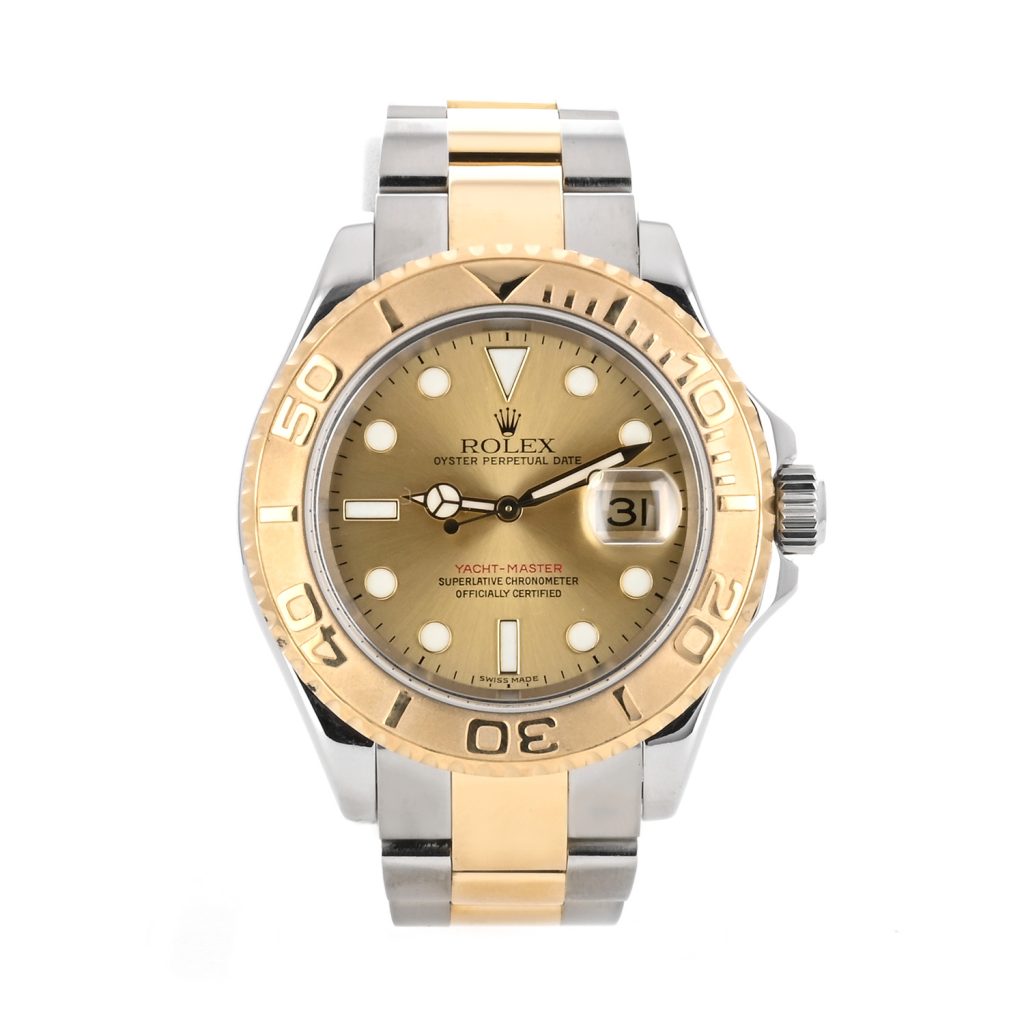
The first Yacht-Master, reference 16628, launched in 1992 in 18kt yellow gold. It was visibly inspired by the Submariner’s case and bezel shape, but Rolex offered it only in precious metals at launch and gave it a thinner case profile than the dive watch it borrowed from. That gold-only start is part of why the model reads differently from the Submariner even today: it was conceived from the beginning as a luxury sports watch for sailing, not a tool watch that later became fashionable.
Early gold references from that first generation are a distinct chapter for collectors interested in Rolex’s sports-watch evolution, but they’re a niche interest compared to vintage Submariners or Daytonas, and that niche status is reflected in demand rather than scarcity alone.
Is the Yacht-Master a Good Investment?
This is where owners’ expectations often get out ahead of the data. The current WatchCharts index for the Yacht-Master collection shows a market index of 17,141 and a value-retention figure of -5.0% as of October 2026, meaning the collection’s aggregate secondary-market pricing sits below its reference retail levels. That’s a meaningfully softer picture than the premiums that tend to build up around the Submariner or Daytona, and it’s worth knowing before you assume your Yacht-Master will behave the same way those models do.
A concrete example: the discontinued steel-and-platinum Yacht-Master 40 (reference 116622) had a 2021 retail price of $12,000. As of late August 2026, its tracked pre-owned market price sat near $12,085, essentially flat over five years once you account for normal market movement. That’s a very different pattern from references that climb well past retail once discontinued.
Part of the explanation is availability: as of 2026, the Yacht-Master is one of the few steel Rolex sports references obtainable at or near retail, with notably better allocation than the Submariner, GMT-Master II, or Daytona. Watches that aren’t hard to get rarely carry the waitlist-driven premiums that watches in short supply do. It’s also worth not confusing the Yacht-Master with the Yacht-Master II, a separate 44mm line built around a programmable regatta countdown chronograph; the two share a name but very little else, including how they’re valued.
None of this makes the Yacht-Master a poor watch to own. It makes it a watch you should value on its own terms rather than by analogy to Rolex’s scarcest sports models. If you want a model/reference-specific read on what your exact Yacht-Master is worth today, that’s a more useful starting point than a collection-wide average, and our Yacht-Master worth guide walks through how reference, material, and condition change the number.
What This Means If You’re Deciding to Sell or Keep Yours
A new Yacht-Master carries Rolex’s standard five-year international guarantee, activated by an Official Rolex Jeweler at the time of purchase. That guarantee excludes normal wear and tear, and it’s voided if the watch is opened, repaired, or modified by anyone other than an Official Rolex Jeweler or Rolex Service Center, or if non-genuine parts are used anywhere in the watch. That matters if you’ve had service work done outside Rolex’s own network: it can affect both the guarantee status and how a buyer or lender values the piece. Rolex’s own guidance recommends servicing roughly every 10 years depending on the model and how it’s actually worn, which is a useful planning horizon if you’re deciding whether to service a watch before selling it or leave it as-is.
If you’re weighing what to do with a Yacht-Master you already own, you generally have two real options. You can sell it outright, which makes sense if you no longer wear it or want the full value in hand; our Yacht-Master sell and value page covers how that valuation works model by model. Or, if you want liquidity without giving up the watch, a Rolex-secured loan lets you use it as collateral and keep ownership once the loan is repaid. Either way, working with specialists who price by reference number and current secondary-market data, rather than a flat “Rolex premium,” is what actually determines whether you get a fair number for a model that, as the data above shows, doesn’t automatically carry one.
If selling is the direction you’re leaning, it’s worth comparing options rather than taking the first offer, which is really the question behind the best place to sell a Rolex: a buyer with model-specific expertise will usually land closer to real market value than a general pawn shop or a quick online quote.
Like what you’re reading?
Add us in Google — more like this is on the wayRelated Posts
 Instagram
 Facebook
 Tiktok
 YouTube