“Submariner vs GMT-Master II” is one of the most common comparisons in the Rolex world, and most explanations stop at the bezel: black or green on the Submariner, two-tone on the GMT-Master II. That’s the least useful part of the answer. If you own one of these watches, or you’re deciding between them, what actually matters is how differently they’re built, priced, and treated when it comes time to get them appraised, insured, or put to work as collateral.
What Actually Separates a Submariner from a GMT-Master II
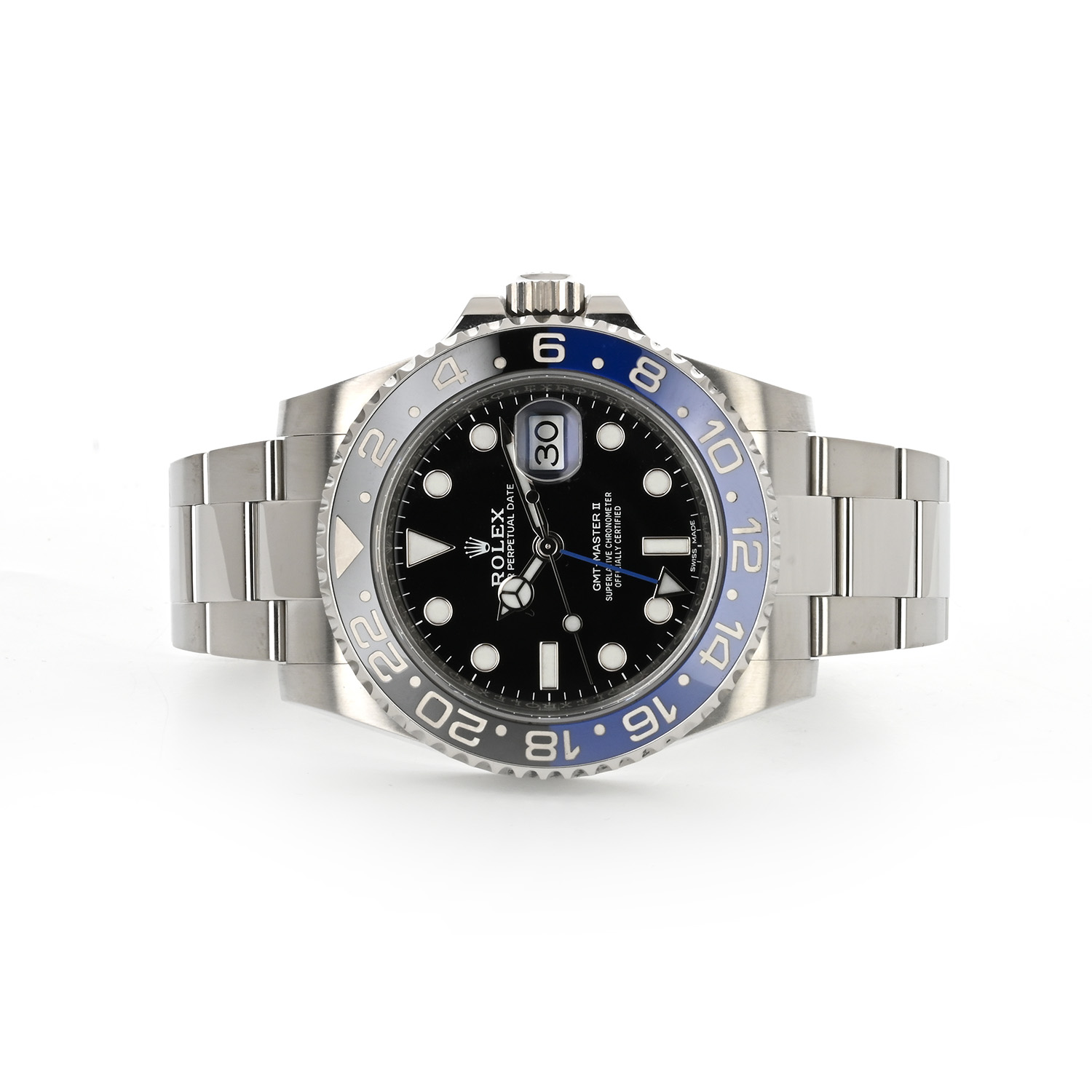
The bezels look similar at a glance, a graduated ring around a black or colored insert, but they do different jobs. The Submariner’s bezel is unidirectional and marked in 60-minute increments, built to track elapsed time underwater. The GMT-Master II’s bezel rotates in both directions and is marked in 24-hour increments, designed to work with the watch’s extra GMT hand so the wearer can read a second time zone at a glance. One is a dive tool. The other is a travel tool. That functional split explains nearly every other difference between the two watches.
Case size differs too: the current Submariner Date case measures 41mm, while the GMT-Master II case is 40mm. It’s a small gap, but it changes how each watch wears on the wrist and how it photographs for an appraisal or insurance file, where exact reference and case dimensions matter more than most owners expect.
Water Resistance: 300m vs 100m, and Whether It Matters
This is the specification most owners get wrong. The Submariner Date is rated to 300 metres (1,000 feet), built and tested as a genuine dive watch. The GMT-Master II is rated to 100 metres, which is fine for swimming, showering, or getting caught in the rain, but it is not a dive-rated tool watch, even though the two models share a similar silhouette and the same robust Oyster case construction.
Does this matter if you never plan to dive with either one? For day-to-day wear, no. But it matters for how each watch is described on paper. A Submariner’s dive rating is part of its documented identity and its collector story. A GMT-Master II’s identity is built around its travel function, not depth rating, and describing it as a dive watch on an insurance schedule or appraisal is simply inaccurate. Getting the reference and its actual specifications right is part of what keeps a valuation defensible later.
Retail Price Gap in October 2026
At current US retail, the two lines sit close together, but not identically. The Submariner line starts at $10,050 for the no-date 124060 and climbs to $50,900 for the 18k yellow gold Submariner Date, as listed on rolex.com as of October 16, 2026. Within the steel Submariner family alone, the no-date 124060 is $10,050, the black-bezel Submariner Date 126610LN is $11,350, and the green-bezel 126610LV is $11,900: a $1,300 jump just to add a date complication, and another $550 on top of that for the green Cerachrom bezel insert.
The GMT-Master II in Oystersteel runs between $11,800 and $12,500 depending on bracelet and dial configuration, as of October 2026. Precious-metal GMT-Master II references go far higher, with yellow gold and Everose gold models listed as high as $50,800 to $57,500.
Put the two entry-level steel watches side by side and the base GMT-Master II lists for $11,800 against $10,050 for the base no-date Submariner, a $1,750 difference at the bottom of each line. That gap narrows or disappears entirely depending on which specific reference you’re comparing, which is the real lesson here: “Submariner” and “GMT-Master II” are not single price points. Bezel color, bracelet choice, and date complication move the number by $1,000 to $2,000 within the same model family, so the specific reference on your watch, not just the collection name, is what determines what it’s worth.
Same Watchmaker, Different Movements
The two watches don’t share a movement. The Submariner Date runs Rolex’s Calibre 3235, while the GMT-Master II runs Calibre 3285, built to handle the independently adjustable GMT hand. Despite the difference in complexity, Rolex rates both to the same standard: roughly a 70-hour power reserve and accuracy of -2/+2 seconds a day after casing. In practical terms, neither movement is more reliable than the other on paper, and the added GMT function doesn’t translate into a shorter service interval or more frequent problems.
Rolex’s own guidance is that a service is recommended approximately every 10 years, depending on the model and how the watch is actually worn, and that interval applies equally to both. Every new Rolex also carries a five-year international warranty, with a further two-year warranty on parts and labor after any factory service, backed by a global network of roughly 900 service workshops.
One thing worth knowing before you assume an older watch is untouched: a full service replaces worn components with new genuine Rolex parts during disassembly and cleaning. That’s good for long-term reliability, but it means a serviced Submariner or GMT-Master II is not purely original down to every part, which is worth mentioning if you’re having either watch appraised and the appraiser asks about service history.
What the Difference Means for Appraisal and Loan Collateral
Neither “tool watch” nor “traveler’s watch” carries more weight on its own when a specialist is evaluating your piece. What matters is the exact reference number, the condition, whether box and papers are present, and current secondary-market pricing for that specific configuration, not the general Submariner or GMT-Master II name. A green-bezel Submariner and a black-bezel Submariner are the same “model” in casual conversation and different assets on paper, the same way a two-tone GMT-Master II and a full steel one are priced and appraised differently even though both wear the GMT name.
That’s the main reason a model/reference-specific valuation matters more than a quick glance at the collection name, whether you’re insuring the watch, getting it formally appraised, or using it as collateral. At Diamond Banc, every Rolex-secured loan is based on the specific reference and its current condition and market pricing, not a flat rate for “a Rolex” or “a Submariner.” The same goes for a GMT-Master II sale or valuation: the bracelet, bezel color, and dial configuration all factor into what the watch is actually worth before an offer is made.
If you’re weighing your options for either watch, it helps to start with a clear picture of current demand. Our guide to the best place to sell a Rolex walks through what affects an offer beyond the model name, and it applies whether you’re holding a Submariner or a GMT-Master II.
Service Intervals and What They Mean for Long-Term Condition
Because both watches share roughly the same 10-year service recommendation and the same 70-hour power reserve, owning the “tool” watch instead of the “traveler” watch doesn’t change how often you’ll need to think about maintenance. What does change the math is parts availability over the decades: Rolex guarantees parts availability for at least 35 years after a model is discontinued, which matters more for an older or vintage reference than for a current-production Submariner or GMT-Master II. If you’re holding an older GMT-Master II, our breakdown of Submariner references and case sizes through the decades is a useful companion piece for understanding how case and reference changes affect value over time, and the logic carries over directly to GMT-Master II generations.
A documented service history, with receipts or a Rolex service card, tends to support a cleaner appraisal than an undocumented watch of the same age and condition, simply because it answers the “what’s been replaced” question before it’s asked.
Which One Should You Own, and What Should You Do With It
If you’re choosing between the two for everyday wear, the decision usually comes down to function: a dive-rated 300m watch with a simpler bezel, or a travel-oriented watch that tracks a second time zone at a glance. Price is close at the entry level but not identical, with the base GMT-Master II running about $1,750 more than the base no-date Submariner as of October 2026, and that gap shifts depending on bracelet and bezel choice within each line.
If you already own one and you’re deciding what to do with it, next steps look the same for both watches: get a reference-specific valuation before you decide anything. Diamond Banc’s specialists evaluate Rolex watches by exact reference and current condition, whether you’re exploring a Rolex sale or a Rolex-secured loan that lets you keep the option to get the watch back. To go deeper on either side of this comparison, our guide to GMT-Master II bezel names and references covers how bezel color affects both identification and value, and it’s worth reading before you have either watch formally appraised.
Like what you’re reading?
Add us in Google — more like this is on the wayRelated Posts

 Instagram
 Facebook
 Tiktok
 YouTube