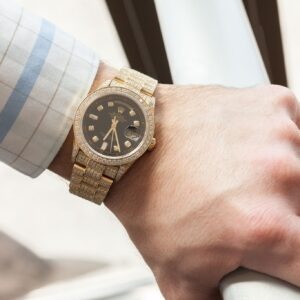
The fluted bezel is one of the most recognizable details on a Rolex Datejust, those narrow, repeating grooves catching light around the crystal. It’s also one of the most misunderstood. Some owners assume it’s a machined steel pattern. Others assume every Datejust has one. Neither is quite right, and the difference matters if you’re trying to figure out what your watch is actually worth, whether you’re planning to sell it or use it as collateral for a loan.
What the Fluted Bezel Is Actually Made Of
Rolex is specific about this: the fluted bezel is fashioned exclusively in 18kt gold or 950 platinum. There is no steel version. If a bezel on a Rolex has those flutes, it’s precious metal, full stop.
That wasn’t always a cosmetic choice. The fluted bezel dates back to the 1926 Oyster case, where the fluting let the bezel be screwed down tightly against the case to help seal out water and dust, back when case-sealing technology was far less reliable than it is now. Since 1953, Rolex has attached the fluted bezel by friction-fitting it to the case rather than screwing it on, which is worth remembering later when we get to the authenticity question.
An 18-karat stamp means the metal is 18 of 24 parts pure gold by weight, or 75 percent gold mixed with other metals for durability and color. That purity standard, and the requirement that a karat mark be paired with the maker’s registered trademark, is what gives a buyer or lender recourse if a piece turns out to be under-karated. It’s also the number that makes the math on a fluted bezel’s actual gold content possible to work out, which we’ll do below.
Why Some Datejust References Have a Smooth Bezel Instead
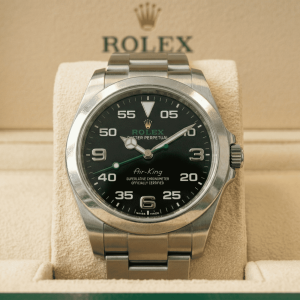
Not every Datejust carries flutes. Plenty of references, especially full Oystersteel models with no gold anywhere in the case or bracelet, come with a smooth, polished bezel instead. This isn’t an oversight or a cheaper substitute pattern stamped into steel. It’s a materials decision: Rolex doesn’t fabricate a steel version of the fluted bezel, so a steel-cased Datejust that isn’t paired with gold simply gets a flat bezel.
The fluted bezel shows up on watches that already mix gold into the case, like Rolesor models that pair an Oystersteel case and bracelet with a white gold bezel, crown, and center bracelet links. Rolex’s own description of the Datejust 41 ref. 126334 calls the fluted bezel “a mark of distinction,” and that distinction is tied directly to the fact that it’s gold sitting on a steel watch, not steel trying to look expensive.
This is also why you won’t find a fluted bezel on an all-steel sport watch. A Submariner’s rotation needs to track elapsed dive time, so it uses a unidirectional bezel in ceramic or aluminum, materials chosen for function and scratch resistance rather than gold’s softness and shine. A GMT-Master II’s two-tone bezel, like the Pepsi colorway, is doing a completely different job: tracking a second time zone, not signaling precious metal. If you want to see how a bezel material change can move a watch’s value in that world, our look at how a ceramic bezel changed the value of a 2010 Submariner 116610 covers that shift, and our notes on the GMT-Master II’s Pepsi bezel walk through how that two-color scheme developed. The fluted bezel belongs to a different family entirely: dress references like the Datejust, Day-Date, and some Sky-Dweller configurations, where gold content is the point.
Does the Fluted Bezel Still Do Anything, or Is It Just Decoration?
Functionally, no, not anymore. The screw-down fluted bezel that helped seal early Oyster cases against water and dust was retired in 1953 in favor of friction-fitting. Modern Datejust water resistance comes from the case construction, gaskets, and screw-down crown, not from the bezel. What the fluting does today is catch and scatter light, which is why Rolex frames it as a design signature rather than a technical feature. It still matters for identification and value, just not for keeping water out.
Platinum Fluted Bezels: Real, But Not on Every Model
For roughly eight decades, a fluted bezel on a Rolex was effectively a guarantee of gold, because that was the only metal option, yellow, white, or Everose. Platinum is far harder to machine into fine, consistent flutes, which is part of why Rolex didn’t extend the fluted bezel to that metal sooner. Independent watch press has described the eventual move to platinum fluted bezels, found on Day-Date 36 and Day-Date 40 references, as overdue given how difficult the material is to work with precision.
The Datejust line itself doesn’t currently offer a platinum fluted bezel option; that configuration lives on the Day-Date. So if you’re holding a Datejust, the fluted bezel on your watch is gold, not platinum, regardless of case metal.

Can a Fluted Bezel Be Swapped? What That Means for Authenticity
Because the fluted bezel has been friction-fit rather than permanently fused to the case since 1953, it is a distinct, removable component, not a fixed part of the case itself. That’s a practical reality worth knowing if you’re buying, selling, or having a Datejust appraised: a fluted bezel’s presence confirms it’s gold or platinum, but it doesn’t automatically confirm it’s the correct gold alloy for that specific reference, or that it hasn’t been swapped from a different watch at some point in its history.
This is exactly the kind of detail a generalist appraiser can miss and a specialist won’t. Confirming that a bezel matches its reference, carries the correct karat stamp and maker’s mark, and sits correctly on the case is a basic part of any serious Rolex valuation. It’s one of the reasons model- and reference-specific experience matters more with a fluted-bezel Datejust than with a plain steel one: there’s simply more to verify.
How Much of the Price Premium Is Actually the Bezel’s Gold?
It’s tempting to credit the entire price gap between a steel Datejust and a two-tone one to “the fluted bezel.” That overstates what’s really a small, if real, piece of gold. The premium on a Rolesor Datejust reflects gold used across the bezel, the fluted crown, and the center links of the bracelet together, not the bezel in isolation. The bezel is the most visible gold on the watch, but it isn’t the only gold, and it isn’t where most of that gold sits.
A fluted bezel contains only a few grams of metal. Even generously estimated, the bezel’s own melt value at this spot price lands in the low hundreds of dollars, a fraction of what separates a two-tone Datejust from a full steel one at retail. The rest of that gap is bracelet links, crown, and the brand premium Rolex commands for Rolesor construction generally. Gold prices move daily, so if you’re estimating this for your own watch, check a live benchmark like the current spot price rather than relying on this date’s figure.
What This Means If You’re Selling or Using Your Datejust as Collateral
None of this changes the bigger picture: a fluted bezel is a real, if modest, amount of gold on a watch whose value is driven mostly by reference, condition, box and papers, and current demand for that specific model. What it does change is how a valuation should be done. A specialist evaluating a Rolesor Datejust should confirm the bezel’s metal and fit, account for the actual gold content across bezel, crown, and bracelet rather than treating the bezel as the whole story, and price the watch against current secondary-market data for that exact reference.
If you’re trying to get a straight answer on what your specific Datejust is worth, reference number and all, a reference-specific valuation is the place to start rather than a generic gold-weight estimate. If you’ve decided the watch should go, selling your Datejust through a buyer who evaluates fluted and smooth bezels correctly protects you from leaving value on the table, and it’s worth knowing what makes for the best place to sell a Rolex before you commit to one. If you’d rather keep the watch and free up cash against it, a Rolex-secured loan lets you use it as collateral without giving it up, with the same reference-specific appraisal process behind the number you’re offered.
Either way, the fluted bezel is worth understanding on its own terms: a design signature with a real gold content behind it, not a mystery and not the whole value story by itself.
Like what you’re reading?
Add us in Google — more like this is on the wayRelated Posts

 Instagram
 Facebook
 Tiktok
 YouTube