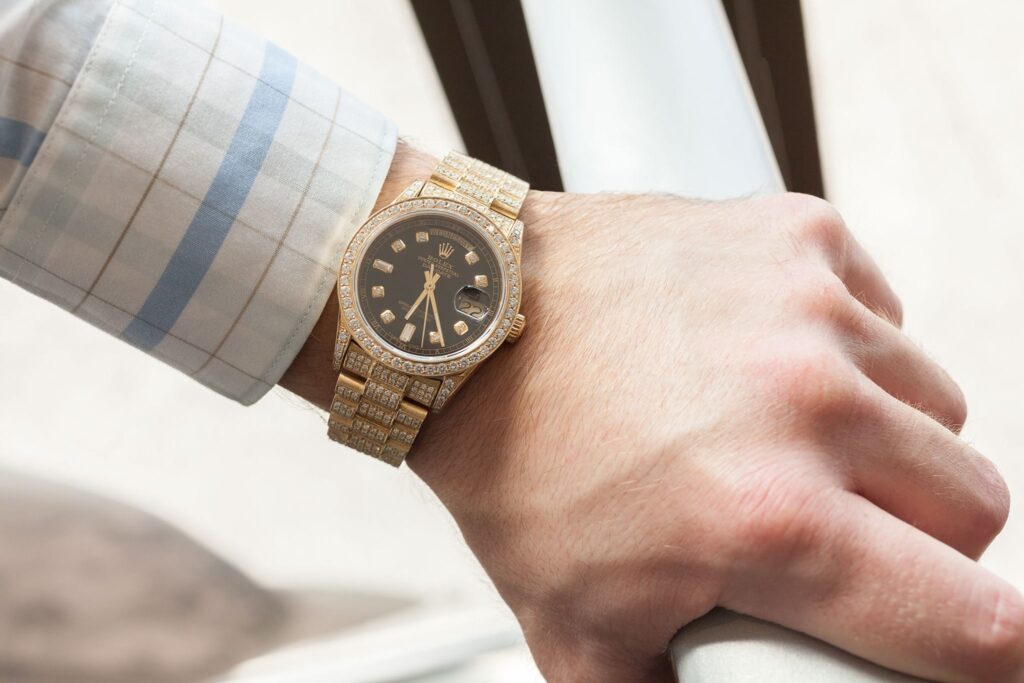
Rolex Datejust vs Day-Date comes up constantly because the two watches look related at a glance: round case, fluted bezel option, date window at 3 o’clock, that familiar five-piece or three-piece bracelet. But the differences between them aren’t cosmetic. They touch metal content, size range, movement complexity, and ultimately what each watch is worth and how it holds that value over time. If you own one, are thinking about buying one, or are deciding whether to sell or use either as collateral, here’s what actually separates them.
The price gap is bigger than “Day-Date costs more”
A current steel Datejust 41 on an Oyster bracelet (reference 126300) lists between $8,950 and $9,150 USD depending on dial, directly from Rolex. Step up to a two-tone Datejust 41 in Oystersteel and white gold and the price moves to roughly $11,650 to $11,850.
The Day-Date starts in a completely different bracket. The least expensive current Day-Date 40, in yellow gold, lists at $50,400 on rolex.com, and a diamond-set Day-Date 36 in Everose gold runs $52,800. Gem-set and platinum versions climb well past $100,000; the new diamond-paved white gold Day-Date 36 introduced in the 2026 catalog lists at $101,400, the highest price point in Rolex’s standard 2026 lineup. That means the entry-level gap between a basic steel Datejust and the cheapest Day-Date is over $41,000, before anyone even considers diamonds or platinum. This isn’t a “nicer trim” difference; it’s a different category of purchase.
Can a Datejust be gold, and can a Day-Date be steel?
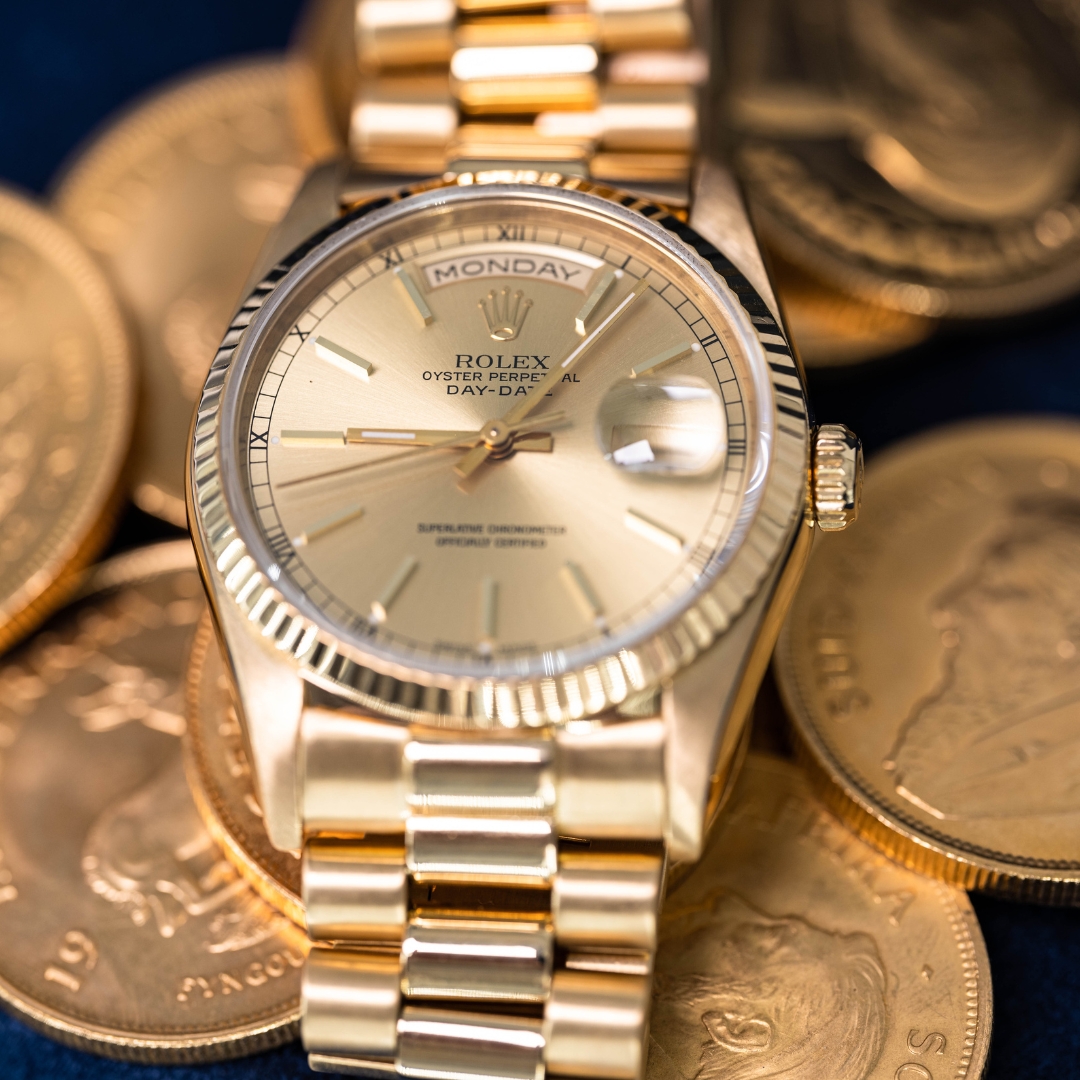
A Datejust can be gold. Rolex offers it in steel, two-tone (steel and gold), and full precious metal configurations, which is part of why its price range is so wide. A Day-Date, on the other hand, cannot be steel. The Day-Date is the only Rolex model line produced exclusively in precious metals, with no stainless steel version ever offered in the modern catalog. That’s not a marketing choice, it’s the defining trait of the line: the Day-Date has always signaled gold or platinum ownership, full stop. If you’re holding a steel watch with a day-of-week window, it isn’t a Day-Date; if you’re holding a solid gold watch without that window, it’s a gold Datejust, not a Day-Date.
Why the Day-Date comes in only two sizes
The Datejust spans a wide size range across its configurations, from smaller women’s references up through the 41mm case. The Day-Date is far more restricted: current production is limited to 36mm and 40mm, with no modern 41mm version. This isn’t an oversight. The Day-Date has historically positioned itself as a single, deliberate statement piece rather than a size-flexible everyday watch, and Rolex has kept its proportions narrower even as it experiments more freely with Datejust dimensions.
The bracelet story follows the same logic. The President bracelet, with its semi-circular three-piece links, is exclusive to the Day-Date; you will not find it on a Datejust. The Datejust instead offers a choice between the flat three-piece Oyster bracelet and the five-piece Jubilee bracelet. So if someone asks which bracelet belongs to which watch: Jubilee and Oyster are Datejust options, President belongs to the Day-Date alone.
Does the day complication actually change the movement?
Yes, not just cosmetically. The Datejust runs Rolex’s current caliber 3235, and the Day-Date runs the caliber 3255. Both deliver roughly 70 hours of power reserve, but the 3255 adds the mechanical work needed to drive the spelled-out day display at 12 o’clock, something the Datejust’s movement doesn’t need to do. It’s a related architecture, not an identical one with an extra window glued on, and that added mechanism is part of why Day-Date movement service tends to run more involved than a Datejust’s.
Service, guarantees, and what gold content means for upkeep
Both watches carry the same official support terms. Rolex recommends returning a watch for service approximately every 10 years, depending on the model and real-life usage, to maintain accuracy and water resistance, and it guarantees proper function for five years from the date of purchase when bought through an Official Rolex Jeweler. Those terms apply identically whether you own a Datejust or a Day-Date.
What differs in practice is cost. A full service on a Day-Date typically runs higher and takes longer than on a steel Datejust, because refinishing a gold case and bracelet, plus servicing the more complex day-and-date movement, is usually billed at a higher tier than steel case work. If you’re due for service, get a Rolex-issued estimate before authorizing anything rather than assuming the same flat rate applies across both lines. Gold content also makes the watch itself softer: a Day-Date’s case and bracelet show scratches, dents, and link stretch more readily than the Datejust’s steel (Rolex uses Oystersteel from the 904L steel family, the same corrosion-resistant alloy used in aerospace and chemical industries), and that condition difference can matter at appraisal or loan time.
Which holds value better, and does it matter for a loan?
Value retention on either watch depends heavily on reference, metal, dial, and condition rather than the model name alone, and current demand shifts enough that it’s worth checking a live market tracker rather than relying on a number that was accurate six months ago. What matters more for a collateral decision is that both watches are well-established, liquid references that Diamond Banc can value using current secondary-market pricing specific to your exact reference number, not a generic “Rolex” estimate. A steel Datejust and a gold Day-Date will land in very different loan ranges simply because of the gap in melt and market value described above, but both are straightforward to assess once a specialist has the reference number and condition in hand.
If you’re deciding what to do with either watch, you have two paths. You can sell it outright and get a transparent, reference-specific offer, or you can use it as collateral for a Rolex-secured loan and keep ownership while accessing liquidity. Diamond Banc’s local market directors handle both Datejust and Day-Date references with the same model-specific approach, whether you work with a local office or ship the watch in securely.
Where this leaves you, by watch
If you own a Datejust, start with Diamond Banc’s Datejust sell and valuation guide to see where your specific reference lands. If you own a Day-Date, the Day-Date sell and valuation page breaks down pricing by metal, size, and dial. Either way, if you’re trying to understand what your watch is actually worth before deciding anything, this breakdown of Day-Date values and this comparison of the Day-Date 36 versus 40 are good next reads. And if you’re weighing your options more broadly, Diamond Banc remains the best place to sell a Rolex of either line, with reference-specific offers backed by current market data rather than a flat estimate based on the model name alone.
Like what you’re reading?
Add us in Google — more like this is on the wayRelated Posts

 Instagram
 Facebook
 Tiktok
 YouTube