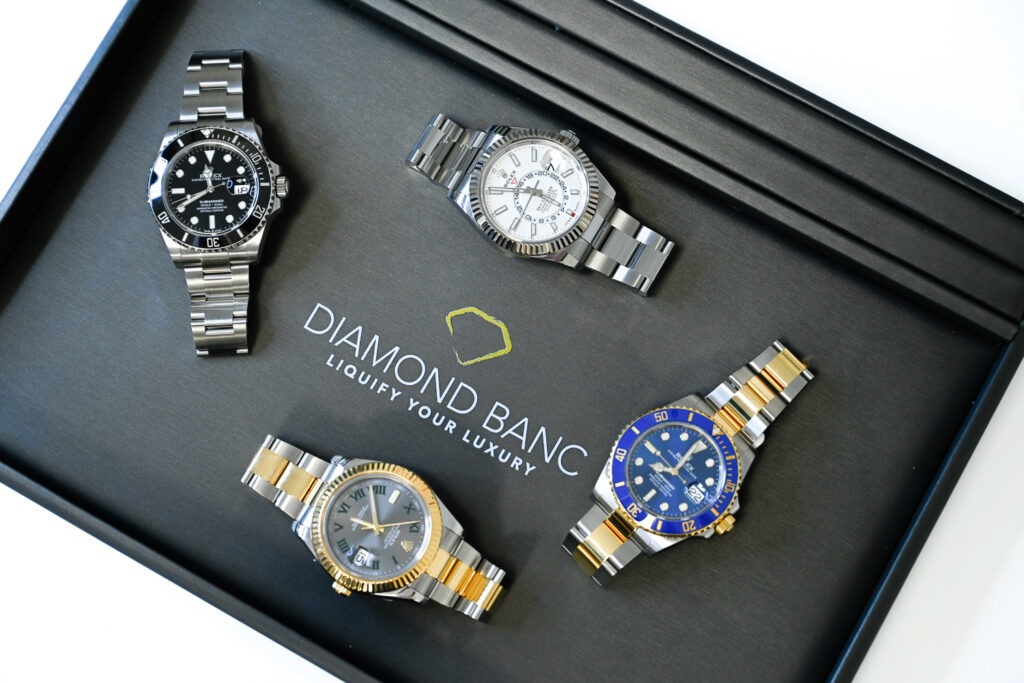
If you own a Rolex Submariner, you’ve probably noticed that the number stamped on the case doesn’t tell you much by itself. Rolex Submariner sizes have changed more than once since the model launched, and two watches that both get called “40mm” can have different cases, clasps, and even straps. Knowing exactly which Submariner you have, and when Rolex made it, matters for how you care for it and for what it’s actually worth.
This guide walks through every major Submariner size and reference change from the original 1953 dive watch to the current 2020-generation models, and answers the questions that come up most often once an owner starts looking closely at their own watch.
Is the Submariner Only Made in 41mm Now?
Yes. As of the current Rolex catalog, every Submariner and Submariner Date model Rolex sells is 41mm. There is no 40mm Submariner in active production. US pricing on the current lineup runs from an Oystersteel no-date Submariner at $10,050 up to a solid yellow gold Submariner Date at $50,900, with steel-and-gold and platinum versions in between.
That means a 40mm Submariner on your wrist today is, by definition, a discontinued reference. It isn’t a lesser watch for that reason, but it’s worth being precise about which generation you own rather than assuming “40mm Submariner” describes one single watch.
Rolex Submariner Sizes: 40mm vs 41mm, What Changed
The jump from 40mm to 41mm in 2020 wasn’t just a half-millimeter bump. Rolex revised the case proportions, updated the clasp to the current Glidelock architecture, and changed how the bracelet attaches to the case. Straps and bracelets made for the earlier 40mm references, whether the older non-ceramic models (14060, 16610) or the ceramic-bezel “Super Case” generation (114060, 116610LN/LV), are not interchangeable with the current 41mm references (124060, 126610LN/LV, 126613, 126618, 126619).
In practice, that means two owners who each say “I have a 40mm Submariner” could be describing watches with different case architecture, different clasps, and parts that don’t cross over. If you’re having a bracelet adjusted or a link added, it’s worth confirming the exact reference number rather than relying on the size alone.
Reading a Submariner Reference Number
The reference number is the fastest way to identify generation and size without measuring the case:
- 5-digit references starting with 14 or 16 (14060, 16610, 16800, 16610LV) are pre-ceramic 40mm Submariners, produced mainly from the 1980s through the mid-2000s.
- 6-digit references starting with 114 or 116 (114060, 116610LN, 116610LV, 116613, 116618) are the ceramic-bezel “Super Case” 40mm generation, introduced in the mid-2000s and produced through 2020.
- 6-digit references starting with 124 or 126 (124060, 126610LN, 126610LV, 126613, 126618, 126619) are the current 41mm generation introduced in 2020.
The letters after the number add detail: LN typically indicates a black ceramic bezel, LV the green “Kermit” or “Hulk” bezel depending on the base reference, and no suffix usually means a no-date model.
A Short History: From 37mm in 1953 to Today
The Submariner’s size has never been fixed. The first Submariner went into production in 1953 and was shown publicly at the 1954 Basel Watch Fair as either reference 6204 or 6205 (historians still debate which came first). Both had a 37.0mm case and no date window, and the watch was the first consumer model certified waterproof to 100 meters, a rating Rolex’s own catalog later revised upward to 200 meters for the same case.
The Submariner grew in stages after that, settling at 40mm for decades. Reference 16610, a 40mm aluminum-bezel date model with a 300-meter rating, is one of the longest-running versions, produced from 1987 to 2010 before the ceramic-bezel generation replaced it. The 41mm case arrived in 2020 and remains the only size Rolex produces today.
So the honest answer to “has the Submariner always been this big” is no. It started six millimeters smaller than today’s model and has moved up twice, not once.
What’s Inside a Current Submariner
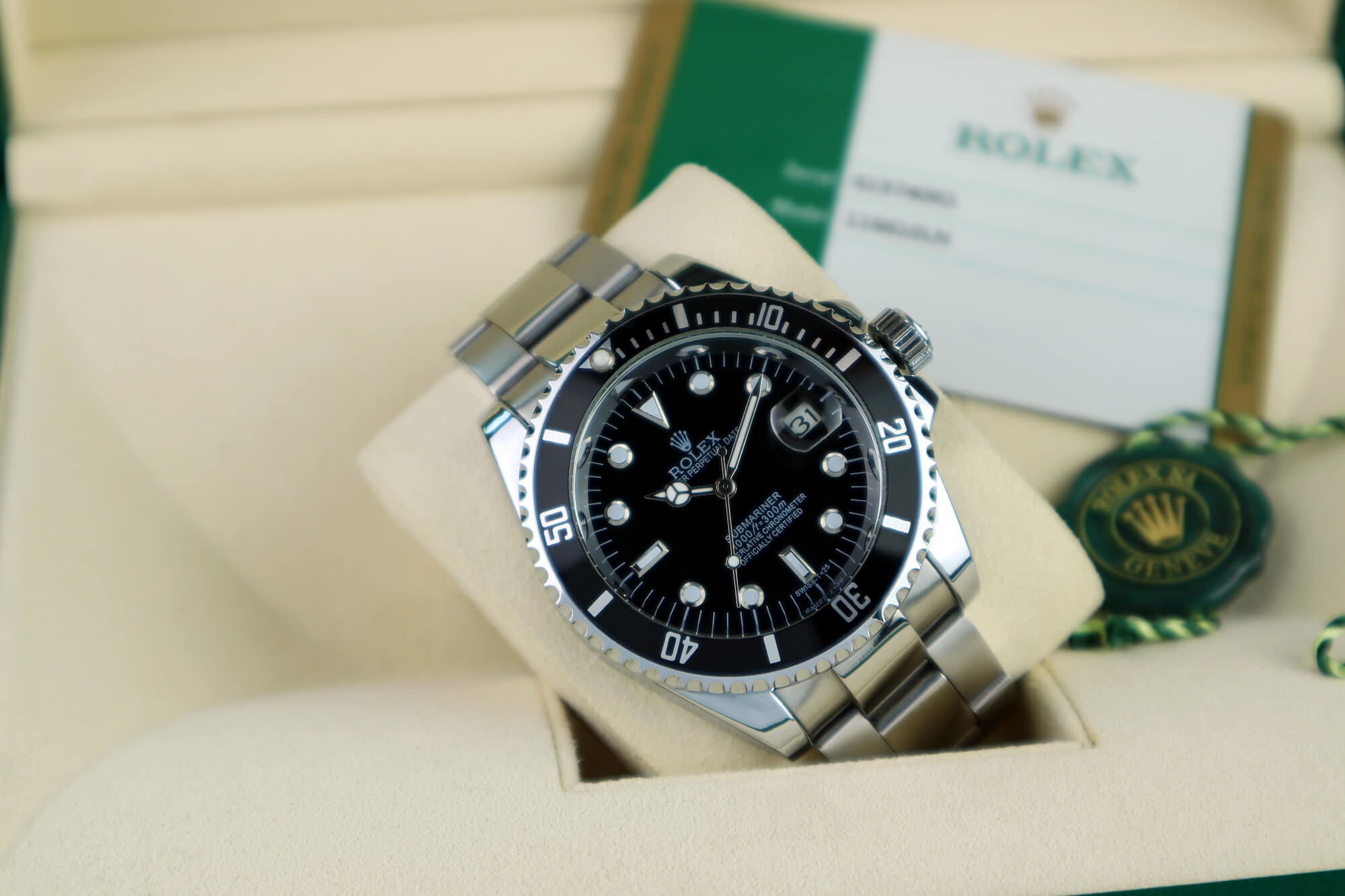
Size isn’t the only thing that changed. The current no-date Submariner runs caliber 3230, and the Submariner Date runs caliber 3235, both self-winding, in-house movements with roughly 70 hours of power reserve. That’s a meaningful jump from the prior-generation caliber 3135, which held around 48 hours, achieved largely through a more efficient Chronergy escapement and a thinner-walled mainspring barrel. The movement is regulated to Rolex’s Superlative Chronometer standard of -2/+2 seconds per day once cased.
For an owner, this matters less as a bragging point and more as a practical one: a current 3230 or 3235 Submariner can sit unworn over a weekend and still be running accurately when you pick it back up, where an older 48-hour movement from a 40mm reference would stop.
Water Resistance: What the Depth Rating Actually Means
Every current Submariner and Submariner Date carries an Oyster case rated to 1,000 feet (300 meters), maintained by the Triplock screw-down crown system. That’s a genuine, lab-tested figure, not a marketing round number.
It’s also worth knowing that no watchmaker, Rolex included, can legally call a watch “waterproof” in the United States. The FTC banned the term for watches in the 1960s and reaffirmed in 1999 that the word “proof” implies an absolute protection that doesn’t exist for any watch. What you’ll see instead, correctly, is “water-resistant to” a specific depth. That resistance is also a tested figure at the time of manufacture, and it degrades as gaskets age, which is one more reason regular service isn’t optional on a watch you actually wear.
Service and What It Means for Value
Rolex’s own guidance is to have a Submariner serviced approximately every 10 years, depending on the model and how it’s actually worn, and new watches purchased from Official Rolex Jewelers carry a five-year international guarantee. A Submariner that’s overdue for service isn’t worthless, but gaskets, lubrication, and timing can all drift outside spec, and that condition is something any knowledgeable buyer, including a lender extending a loan against the watch, will want documented or accounted for in the valuation.
If you’re not sure when your watch was last serviced, that’s one of the first things worth establishing before you decide whether to sell it or use it as collateral.
Is an Older 40mm Submariner Still Worth Owning?
Discontinued doesn’t mean diminished. The Submariner’s reputation, and a meaningful share of its resale demand, was built almost entirely on 40mm references: the 16610 ran for 23 years, and the ceramic 116610 remains one of the most recognized dive watches ever made. A 40mm Submariner still holds a clear place in Rolex’s lineup history, and plenty of collectors prefer the smaller proportions to the current 41mm case. What matters for value isn’t whether the size is still in production, it’s the specific reference, condition, box and papers, and service history of the individual watch.
Turning Reference Knowledge Into a Decision
Once you know exactly which Submariner you have, meaning the reference number, the case generation, and roughly when it was made, you’re in a much better position to decide what to do with it. If you’re exploring what a specific reference is worth, getting a model-specific valuation is more useful than a general estimate based on size alone, since a 40mm 16610 and a 41mm 126610LN can sit at very different price points.
Diamond Banc’s specialists evaluate Submariners by exact reference, condition, and current secondary-market pricing, whether you’re looking to sell your Submariner outright or use it as collateral for a Rolex-secured loan while keeping ownership of the watch. If you’re weighing your options and want to understand what makes one of the best places to sell a Rolex, our team can walk through valuation on your specific reference before you decide anything.
For more on how specific Submariner details affect value, see our Submariner overview and our look at how a ceramic bezel affects a 2010-era 116610, both useful if you’re trying to place your own watch within the reference history covered here.
Like what you’re reading?
Add us in Google — more like this is on the wayRelated Posts

 Instagram
 Facebook
 Tiktok
 YouTube