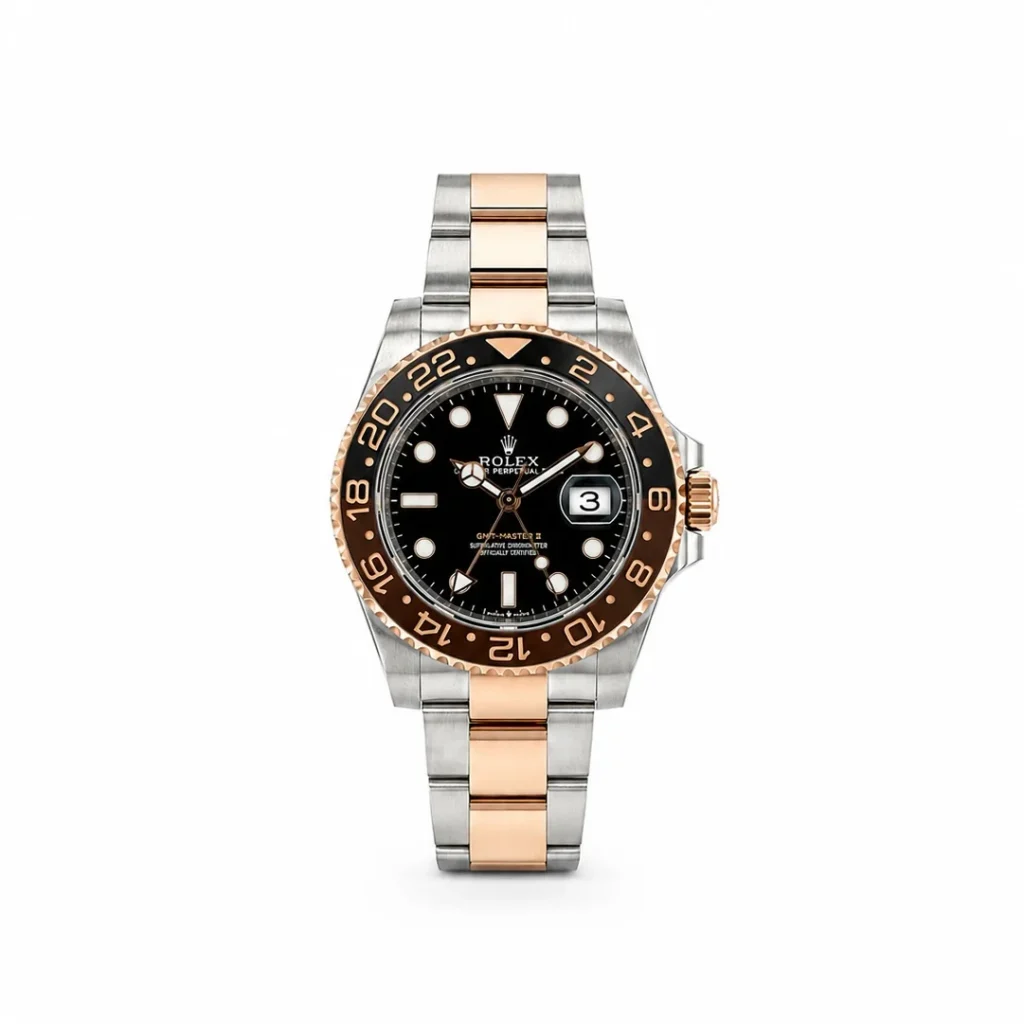
“Root Beer” is the nickname collectors gave to a specific brown-and-gold version of the Rolex GMT-Master, and later the GMT-Master II. It isn’t an official Rolex name, and it isn’t just “a GMT with a brown bezel.” It refers to a particular combination of case metal, bezel color, and (originally) dial color that has reappeared, disappeared, and been reinterpreted by Rolex across five decades. If you own one, whether it’s a decades-old two-tone piece or a current-production Everose model, knowing exactly what you have changes both how you talk about it and what it’s worth.
What “Root Beer” Actually Means on a GMT-Master II
The nickname began with the two-tone GMT-Master reference 1675/3 from around 1970, which paired a brown dial with a brown-and-gold bezel, visually distinct from the blue-and-red “Pepsi” and black-and-red “Coke” bezel variants that most people associate with the GMT line. That brown-and-gold combination is what earned the watch its name: the color scheme reminded American collectors of a glass of root beer, while German-speaking collectors sometimes called the same watches “Tigerauge,” or tiger’s eye.
So “Root Beer” is not a dial color alone, not a bezel color alone, and not a single reference number. It’s the pairing of a brown or black-and-brown bezel with a case that mixes steel and gold, or uses gold outright. A GMT-Master with a plain brown bezel and no gold case material is often mistakenly called a Root Beer, but purists reserve the name for watches that combine both elements.
Root Beer vs. Pepsi vs. Coke: Telling the Bezels Apart
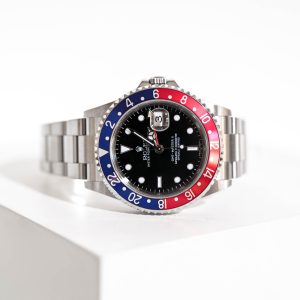
The GMT-Master family has always used its two-color bezel to signal a second time zone, and Rolex has produced several color pairings over the years. Blue-and-red is the “Pepsi,” black-and-red is the “Coke,” and brown-and-gold (or, on modern pieces, black-and-brown) is the Root Beer. The practical difference for an owner is less about the colors themselves and more about rarity and case material: Pepsi and Coke bezels have historically appeared on steel-only references, while the Root Beer has almost always been paired with gold content in the case, which is a meaningfully different ownership and valuation story. If you’re comparing a Root Beer to a Pepsi model you already own or are considering, it helps to see both how Pepsi and Batman bezel models are valued side by side with the brown-and-gold references.
From the Vintage 1675/3 to the Modern 16713, and Its 2006 Discontinuation
After the original 1675/3, Rolex carried the look into the GMT-Master II line with reference 16713, a stainless steel and yellow gold model that stayed in production from 1989 until it was discontinued in 2006. That 17-year run makes the 16713 the reference most people mean when they talk about a “classic” Root Beer that isn’t vintage but also isn’t current production, a middle tier that sits between 1970s collectibility and modern Rolex manufacturing. Discontinuation didn’t hurt demand for the 16713; it did the opposite, turning it into a pre-owned-only reference with a known production window, which tends to support steady collector interest rather than undermine it.
The 2018 Revival: Everose Gold and Rolesor References
Rolex reintroduced the Root Beer look at Baselworld in 2018 after more than a decade without a current-production brown-and-gold GMT-Master II. The relaunch came in two versions: the full 18kt Everose gold reference 126715CHNR, and the two-tone Everose Rolesor (steel and rose gold) reference 126711CHNR, both fitted with a black-and-brown Cerachrom ceramic bezel rather than the aluminum insert used on vintage models. Everose is Rolex’s proprietary pink gold alloy, introduced in 2005 and cast in the company’s own foundry, and it’s now used across every Rolex Oyster model made in pink gold, including both current Root Beer references.
This matters for anyone comparing an old 16713 to a new 126711CHNR: the bezel material, the gold alloy, and the case construction are all different, even though the color story is the same. The modern watch is not a reissue in the strict sense; it’s a new execution of a long-running look.
What a Root Beer GMT-Master II Costs Today
As of 2026, Rolex’s official suggested retail price for the Oystersteel and Everose gold 126711CHNR is $20,050 USD. The full 18kt Everose gold 126715CHNR, which uses a tiger iron dial, carries an official retail price of $57,500 USD, more than double the two-tone version, reflecting the jump from Rolesor to solid gold.
Pre-owned pricing moves separately from Rolex’s list prices and changes by the week depending on demand and available supply. Rather than quoting a single secondary-market number that will be out of date by the time you read this, it’s worth checking a live pre-owned price tracker for the 126711CHNR before assuming either reference’s resale value based on retail price alone. Vintage 1675/3 and discontinued 16713 examples are priced on an entirely different basis, driven by condition, originality, and documented history rather than a current retail figure.
Everose Rolesor vs. Full Everose: Does Gold Content Change the Value?
Yes, and it’s one of the first things a specialist checks on a Root Beer. The 126711CHNR is Rolesor, meaning the case and bracelet mix steel and Everose gold, with gold limited to the bezel, crown, and certain links. The 126715CHNR is solid 18kt Everose gold throughout. That difference in gold content is a major factor in both resale value and loan value, because gold weight is a measurable, verifiable component of what the watch is worth, separate from brand and model desirability. A full-gold Root Beer will generally appraise and sell for meaningfully more than its Rolesor sibling, even though they share the same dial layout, bezel color, and movement architecture.
If you’re trying to understand what your specific reference is worth, whether it’s the Rolesor or the full-gold version, a reference-specific valuation for your GMT-Master II will account for gold content, bezel material, and current market conditions rather than treating all Root Beers as interchangeable.
Why Some Call It the “Clint Eastwood”
Alongside “Root Beer,” this watch sometimes goes by “Clint Eastwood,” a nickname that traces back to the actor wearing his own brown-and-gold GMT-Master on screen across several films. It’s purely a collector nickname with no bearing on authentication or value; it simply reflects how closely the watch’s look became tied to a recognizable public figure in the decades after its original release. If you hear both names used for the same watch, they’re referring to the same reference, not two different models.
Service History, the Rolex Guarantee, and What It Means for a Loan or Sale
The functional difference between a GMT-Master and a GMT-Master II matters here too. Rolex introduced the GMT-Master II in 1982 using caliber 3085, which decoupled the 12-hour and 24-hour hands so the local-time hand could be adjusted in one-hour increments without stopping the movement, a feature every modern Root Beer reference retains. New Rolex watches, including current Root Beer references, come with a five-year international guarantee covering manufacturing defects, valid only when the watch was purchased from an Official Rolex Jeweler, the guarantee card was completed in full, and that card is kept with the watch. Rolex recommends a full service roughly every ten years depending on use, and that service record is one of the first things a specialist reviews during an appraisal.
This is where vintage Root Beer owners should pay close attention. A full service at an authorized center brings worn or non-conforming parts up to current specifications, which on an older 1675/3 or 16713 can mean an original dial, bezel insert, or hands get swapped for modern replacements. Collectors and appraisers treat that as a material change from an all-original example, and it can affect value even though the watch runs perfectly. Separately, the guarantee itself is void if the caseback has been opened by anyone outside the Rolex network, or if any non-original parts have been installed, a common issue on older two-tone Root Beers that were serviced outside authorized channels. Before you sell or use a vintage Root Beer as collateral, it’s worth knowing whether its service history has touched original parts, since that history is part of what any specialist valuation accounts for.
Deciding What to Do With Your Root Beer
Whether you have a Rolesor 126711CHNR, a full-gold 126715CHNR, or an older 16713, the gold content, bezel originality, and service history all factor into what a specialist will offer, whether you’re selling outright or putting the watch to work as collateral. A Rolex-secured loan lets you access funds against the watch’s value without giving it up, which can make sense if you expect to want the piece back. If you’ve decided to sell instead, working with reference-specific buyers who understand exactly which of these bezel variants you own, and why it matters, is part of finding the best place to sell a Rolex like this one.
Like what you’re reading?
Add us in Google — more like this is on the wayRelated Posts
 Instagram
 Facebook
 Tiktok
 YouTube