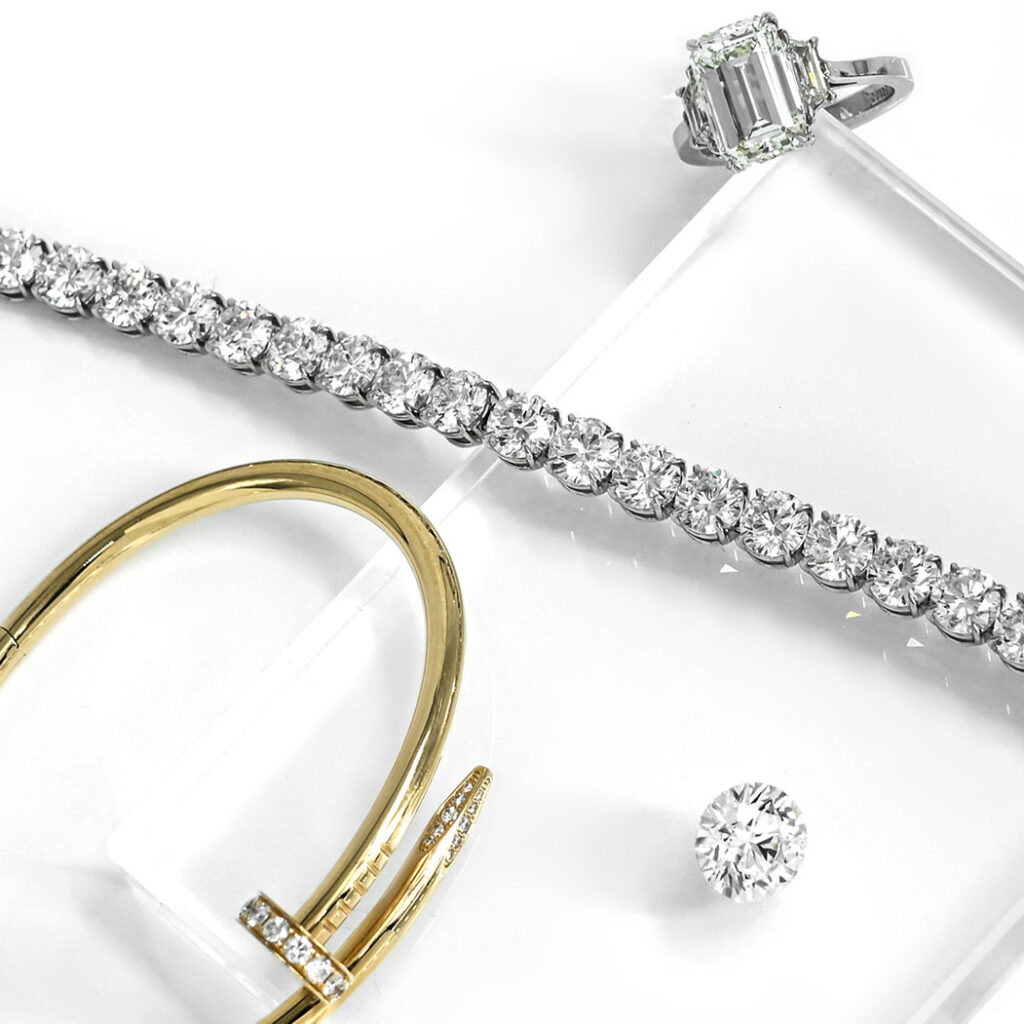
A name on the clasp doesn’t automatically mean a piece is worth real money. Designer jewelry brands range from houses that produce solid gold pieces with decades of resale history to diffusion lines stamped with the same logo but made from gold-plated base metal. If you’re deciding whether to sell a piece, use it as collateral for a loan, or simply understand what you own, the brand name is only the starting point. What matters more is the metal, the specific collection, the documentation, and whether the piece has an active secondary market.
What “Designer Jewelry” Actually Means for Collateral Value
Lenders and buyers don’t value a piece because of the brand on the box. They value it because of a combination of three things: the intrinsic metal and stone content, the brand’s track record of holding resale demand, and whether the specific piece matches what collectors are actively buying right now. A 14-karat gold bangle from a well-known house and an unbranded 14-karat gold bangle of the same weight have nearly identical melt value. The brand premium shows up on top of that floor, and it varies enormously depending on the maker and the line.
This is why a designer jewelry loan is underwritten piece by piece rather than by brand name alone. Two bracelets from the same label can be worth very different amounts depending on karat, condition, and whether the design is one the market is still asking for.
How to Tell Solid Gold From Plated or Vermeil
The quickest way to separate a solid gold designer piece from a plated one is the hallmark. Under the National Stamping Act, incorporated into the FTC’s Guides for the Jewelry, Precious Metals, and Pewter Industries, any manufacturer that stamps a karat quality mark on a piece is legally required to also stamp its registered trademark next to it. That’s why a genuine solid gold piece typically carries two marks together: a karat stamp (10K, 14K, 18K) and a maker’s mark, not just a logo by itself.
Ten karat, or 41.7% pure gold, is the legal floor for anything sold and marked as “gold” jewelry in the United States. Anything below that has to be described differently. Separately, if a piece is marked “vermeil,” federal rules require it to be built on a sterling silver base, coated on every significant surface with gold of at least 10 karats, at a minimum thickness equal to 2.5 microns of fine gold. If a piece doesn’t meet that standard, it legally cannot use the word “vermeil” at all, which is a useful test when you’re trying to figure out what you’re actually holding.
What a hallmark does not tell you is whether the piece is genuine, undamaged, or has been altered since it left the maker. A quality stamp confirms a claim about metal content; it doesn’t authenticate the piece on its own. That’s a separate evaluation, and it’s one reason a trained specialist looking at the piece in person matters more than reading a stamp through a loupe at home.
Which Designer Jewelry Brands Actually Hold Their Value
Not all designer jewelry brands perform the same way on the secondary market, and the gap isn’t subtle. Houses like Cartier, Van Cleef & Arpels, and Bulgari have built decades of consistent demand around specific, recognizable collections rather than broad catalogs. That consistency is exactly what gives a piece staying power when it’s time to sell or use it as loan collateral.
Van Cleef & Arpels is a clear example of how pricing and demand move together. In April 2025, the house raised retail prices globally, averaging 4.8% in the U.S. and 5.1% in Europe across the Alhambra, Perlée, and Frivole collections, with individual Alhambra pieces rising as much as 14.3% in the U.S. depending on the material. When a maker can raise prices on existing designs by double digits and still sell them, that’s a signal the secondary market for those same designs is strong too. Brands without that kind of sustained retail pricing power tend to see their pre-owned pieces trade at steeper discounts.
At the other end, diffusion and “bridge” jewelry lines, the lower-priced collections some designer houses sell alongside their fine jewelry, are usually built from gold-plated brass or vermeil rather than solid karat gold. They carry the brand’s name but not its material value, and that distinction matters far more than the logo when a piece is being evaluated.
If you own pieces from Cartier, Boucheron, Buccellati, Graff, Verdura, or Kwiat, the same logic applies: the specific collection and metal content tell you far more about value than the name on the box.

Why Certain Collections Outperform the Rest of a Brand’s Catalog
Cartier’s Love bracelet and Van Cleef & Arpels’ Alhambra are useful examples of why some collections within the same house sell better than others. Both are long-running, instantly recognizable designs that the brand has kept in continuous production for decades, which means there’s always a buyer looking for that exact piece, in that exact form, at any given time. Compare that to a limited or seasonal piece from the same house: it may be beautifully made, but if the design was only produced for a short run or discontinued, finding a buyer who wants precisely that piece is harder, and that scarcity on the demand side (not the supply side) works against resale value rather than for it.
The lesson for owners is straightforward: a piece’s brand matters less than whether it belongs to a collection the brand has supported, marketed, and kept in demand year after year. That’s also why documentation and originality matter so much for these specific collections, since buyers comparing two otherwise identical pieces will pay more for the one they can verify.
Does the Original Box and Certificate Really Change the Value?
Yes, and it’s treated as a real discount in the trade, not a cosmetic preference. A designer piece sold or submitted for a loan without its original box, certificate, or purchase receipt is typically valued lower than an identical piece with full documentation, because the paperwork reduces the buyer’s or lender’s uncertainty about authenticity and provenance. If you own pieces you consider long-term assets, whether a Cartier Love bracelet, a Van Cleef Alhambra pendant, or a designer diamond ring, keeping the original packaging and papers together with the piece is one of the simplest things you can do to protect its value.
Is Costume or Vermeil Designer Jewelry Worth Anything as Collateral?
Generally, no, not in the way solid gold or gemstone pieces are. Gold-plated and vermeil jewelry, even when it carries a well-known designer’s name, has little to no scrap or collateral value because the gold is a thin surface layer over base metal or silver rather than gold throughout the piece. A loan or purchase offer on jewelry is built on the actual metal and stone content that’s there, not the brand printed on a tag. That doesn’t mean costume and vermeil pieces have no worth; some carry collector interest for their design alone. But if you’re hoping to use a piece as collateral, the first question to answer is whether it’s solid karat gold, platinum, or set with genuine stones, because that’s what sets the value floor.
The Gold Floor: A Worked Example
Here’s how that floor is actually calculated. Take a generic 20-gram, 18-karat gold designer bracelet, no brand premium included yet, just the metal. Eighteen karat gold is 75% pure. Using the gold spot price of $4,218.01 per ounce as of October 2, 2026, the math works out like this:
- 20 grams x 0.75 purity = 15 grams of fine gold
- 15 grams ÷ 31.1035 grams per troy ounce = 0.4823 troy ounces
- 0.4823 troy ounces x $4,218.01 = approximately $2,034.18 in melt value
That $2,034.18 is the floor, the amount the gold itself is worth before any brand, design, or collectability premium is added. A recognizable piece from a brand with strong secondary demand can be worth meaningfully more than that floor. A plated or vermeil piece of the same apparent size will be worth close to nothing beyond its silver or base metal content, because there’s no fine gold weight behind it. Since gold moves daily, it’s worth checking a live price source before assuming any number is still accurate.
What to Do With a Designer Piece You’re Not Wearing
Once you know what you actually have, karat gold versus plated, documented versus undocumented, part of an in-demand collection or not, you have two practical paths. If you need funds but want to keep the piece long-term, a loan secured by designer jewelry lets you access cash against its value without giving it up permanently. If you’d rather convert it outright, Diamond Banc’s designer jewelry buying process starts with the same piece-by-piece evaluation: metal content, hallmark, collection, and documentation, assessed by someone who works with these brands regularly rather than general pawn-shop experience. The same holds true for gold pieces without a designer name attached; if melt value is the main consideration, a gold and silver evaluation looks at the same fundamentals.
For a deeper look at getting the strongest possible offer on a designer piece, see our guide on selling designer jewelry for top dollar, and for more on how the loan side works without selling the piece outright, read how a designer jewelry loan is structured.
Diamond Banc evaluates pieces through local market directors and luxury-asset specialists at physical offices nationwide, with secure mail-in shipping available if there’s no location near you. Every valuation is transparent and specific to the piece in front of us, not a generic estimate based on the brand alone.
Like what you’re reading?
Add us in Google — more like this is on the wayRelated Posts
 Instagram
 Facebook
 Tiktok
 YouTube