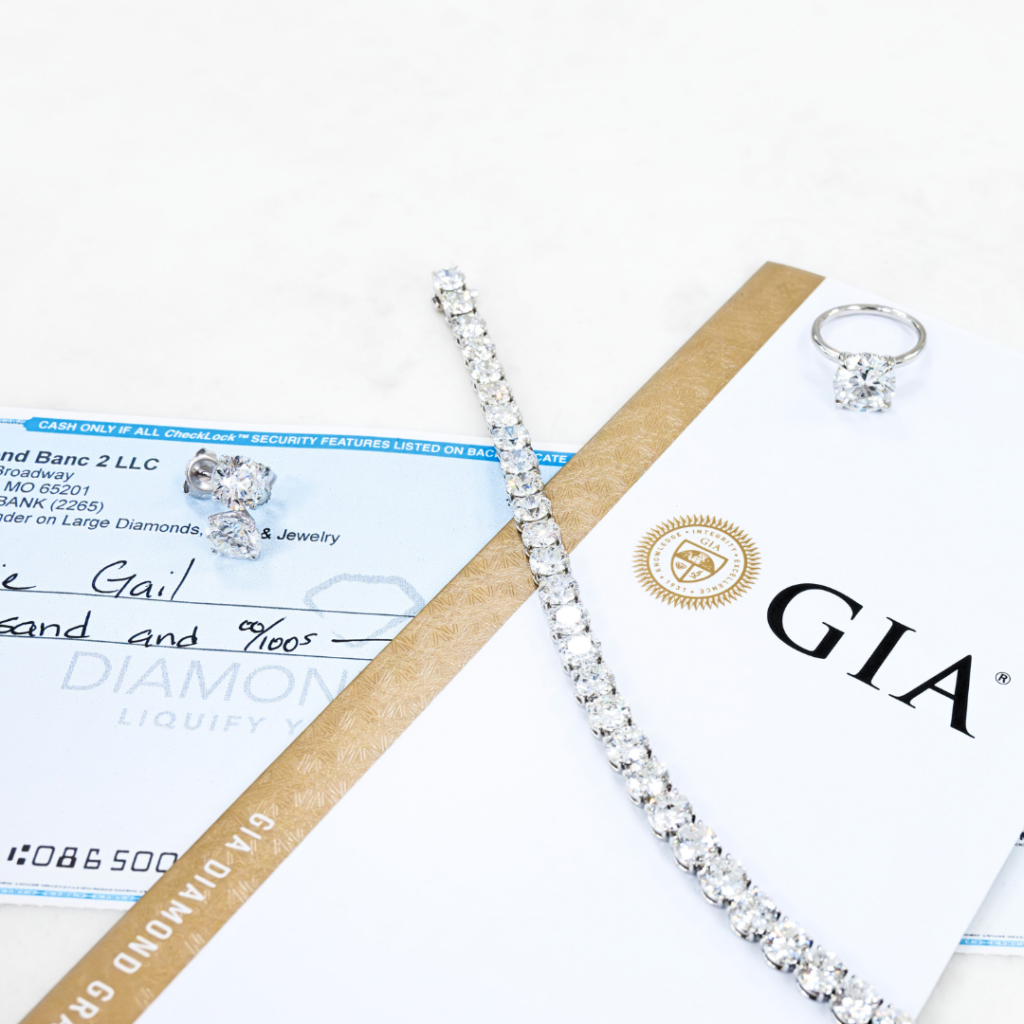
If you’ve searched for a lab grown diamond value calculator, you’ve probably noticed something frustrating: nothing gives you a straight answer. That’s not a technology gap. It’s because lab-grown diamond value isn’t a fixed formula the way it once seemed to be. Carat weight times a stable price-per-carat worked reasonably well for natural diamonds for decades. For lab-grown stones, the per-carat number itself keeps falling, often by double digits every few months, so any “calculator” built today is already out of date by the time you use it.
This post explains what’s actually driving lab-grown diamond prices down, what that means for the piece you own right now, and where real value (resale or collateral) still exists for a diamond or watch.
Why There’s No Real Lab-Grown Diamond Price Calculator
A calculator implies a stable input: a price per carat that holds steady long enough to be useful. Lab-grown diamonds don’t have that right now. Midstream wholesale prices for loose lab-grown diamonds fell 14% year over year in the first quarter of 2026, then another 13% year over year in the second quarter, with the wholesale index now down 96% since tracking began in 2018. That’s not a one-time correction. It’s a continuing slide, which means any number you plug into a calculator this month will likely be too high by next quarter.
Natural diamonds have their own pricing softness, but they’re graded on a scale (cut, color, clarity, carat) that lenders and buyers have used consistently for generations, and rarity keeps a floor under well-made stones. Lab-grown diamonds are manufactured on demand. Supply simply expands to meet orders, so scarcity, the thing that anchors long-term value, isn’t part of the equation.
The Wholesale Collapse Behind the Number
To see how far prices have moved, look at a specific, verifiable example. In the first quarter of 2026, a 3-carat, D-color, VVS-clarity lab-grown round diamond traded at wholesale for just $126 per carat, 30% cheaper than the same specification a year earlier. Using that figure, here’s the math for a stone that size:
- 3 carats x $126 per carat = $378 current wholesale value
A $378 wholesale value for a 3-carat stone is the kind of number that surprises owners who paid several thousand dollars for the same specification a few years ago. It isn’t a mistake or a lowball. It reflects where the wholesale market actually sits as of early 2026. Industry tracking has also shown that 3-carat lab-grown rounds specifically have been the weakest category in the entire market, which matters if that’s the size and shape you own.
The decline isn’t slowing down gradually, either. Prices are down roughly 90% since Lightbox, De Beers’ own lab-grown jewelry brand, launched in 2018 at an $800-per-carat price point. De Beers closed that business entirely in 2025, concluding there wasn’t a viable long-term case for lab-grown jewelry at the scale it had hoped for. When the world’s largest diamond mining company exits the lab-grown category rather than compete in it, that’s a meaningful signal about where the price floor has settled.
Lab-Grown vs. Natural: What the Same Stone Brings Today
The gap between lab-grown and natural value has widened dramatically, not narrowed. A decade ago, lab-grown diamonds sold for roughly 10% less than a comparable natural stone. Today, lab-grown diamonds sell for roughly 10% of the price of a comparable natural diamond of the same specification, a shift of an entirely different magnitude than a modest discount.
You can see this directly in a side-by-side comparison. CNBC found a nearly colorless, VVS, excellent-cut lab-grown diamond listed for about $450 on an online marketplace in September 2026, while a natural stone with the same specifications ran $2,800 to $3,200. Natural diamonds have also lost value over the past five years, more than half of it by some measures, but they’re still worth several times what a chemically identical lab-grown stone commands, because natural diamonds carry the rarity that lab-grown stones, by design, don’t.
That same reporting noted the lab-grown diamond market is still growing fast in total size, projected to climb from about $29.46 billion in 2025 to nearly $92 billion by 2034. That growth is driven by unit volume, more stones being produced and sold, not by rising per-stone prices. More supply chasing the same demand is part of why individual stone values keep dropping even as the overall market expands.

Does the GIA or IGI Certificate Still Matter?
A certificate used to be the anchor of a diamond’s value conversation. That’s changed for lab-grown stones specifically. As of October 1, 2025, GIA stopped issuing individual color and clarity grades for lab-grown diamonds, replacing the familiar 4Cs report with a simplified “Premium” or “Standard” designation, or no report at all for stones that don’t meet the Standard threshold. Natural diamonds are unaffected and still receive full 4Cs grading.
That change matters more than it sounds like. A pre-2025 GIA report, or a current IGI report that still lists specific grades, gives you and a lender something precise to evaluate. A “Premium” or “Standard” label doesn’t tell you whether a stone is VVS or SI, or D-color or J-color, within that bucket. It also costs less to obtain: GIA’s new Laboratory-Grown Diamond Quality Assessment runs $15 per carat with a $15 minimum, versus the old full-grading report that started at $60 for the smallest stones, which itself reflects how much less scrutiny (and value) the industry now assigns to grading a lab-grown stone precisely.
Federal Trade Commission rules also require that any lab-grown diamond be described with a clear qualifier like “laboratory-grown” immediately before the word “diamond,” because the word “diamond” alone is understood to mean a natural, mined stone. That labeling requirement exists precisely because the two are treated as different products in the market, not just different price points on the same shelf. If you want a deeper look at how grading reports translate into actual value, our guide to why diamond certifications add value walks through what a lender or buyer actually looks for on a report.
Can You Use a Lab-Grown Diamond as Loan Collateral?
This is the question most owners actually want answered: can a lab-grown diamond or lab-grown engagement ring be used as collateral for a loan? In practice, the compressed and still-falling wholesale value makes this difficult. A loan amount is based on what an item could realistically be sold for if needed, and with lab-grown wholesale prices still dropping every quarter, there’s very little stable value to lend against. Some jewelers and lenders decline to make offers on lab-grown stones at all, simply because the number keeps moving and the stone’s own replacement cost (what a brand-new equivalent costs today) keeps getting cheaper, which pulls secondhand offers down with it.
If your ring or pendant also includes gold, platinum, or other components with their own standalone value, or if the piece includes a natural center stone or natural melee diamonds, those elements can still factor into a conversation about a loan. Diamond Banc issues loans secured by natural diamonds and fine jewelry, as well as Rolex and other luxury watches, with local market directors who evaluate a piece on its actual, current specifications rather than what it originally cost. If you’re deciding between options, our team can walk you through what your diamond is worth based on today’s secondary-market pricing, whether you’re exploring a sale or a jewelry-secured loan through our loans program.
Have Lab-Grown Prices Hit Bottom?
It’s reasonable to ask whether the worst is over. The data doesn’t support that yet. Declines have slowed somewhat, the roughly 28% annual drop in 3-carat rounds in early 2026 was an improvement over the 40%-plus annual declines seen a year earlier, but slower decline is still decline, not stabilization. Wholesale prices have fallen in every tracked period since 2018, and nothing in current reporting points to a floor forming soon. Treat any lab-grown diamond you own as likely to be worth less next year than it is today, not more.
If you’re holding a lab-grown stone and wondering whether to sell now or wait, waiting has a real cost: the wholesale benchmark it’s priced against keeps sliding. By contrast, a natural diamond ring or a Rolex typically holds a more stable, model- and specification-specific value over time, which is part of why those categories support a meaningful resale value or loan amount in ways a lab-grown stone currently can’t. If you’d like to understand how a lab report translates into an actual number before you sell, our guide on understanding your diamond lab report explains what graders and buyers look for line by line.
What to Do With a Lab-Grown Diamond You Own
If you’re deciding what to do next, here’s the practical takeaway: a lab-grown diamond’s value today is tied almost entirely to current wholesale replacement cost, not to what you paid, not to sentimental or retail value, and not to a fixed per-carat formula. If your piece also includes natural stones, gold, platinum, or a luxury watch, those components deserve a separate, specific look. Diamond Banc’s specialists can evaluate the natural diamonds, metals, and watches in a piece and explain, in plain terms, what each part is actually worth in today’s market, whether you’re looking to sell or looking to use an item you already own as collateral for a loan. You can start by exploring our diamond buyers program or reviewing how our specialists approach how Diamond Banc determines value for an offer before you bring a piece in.
Like what you’re reading?
Add us in Google — more like this is on the wayRelated Posts
 Instagram
 Facebook
 Tiktok
 YouTube