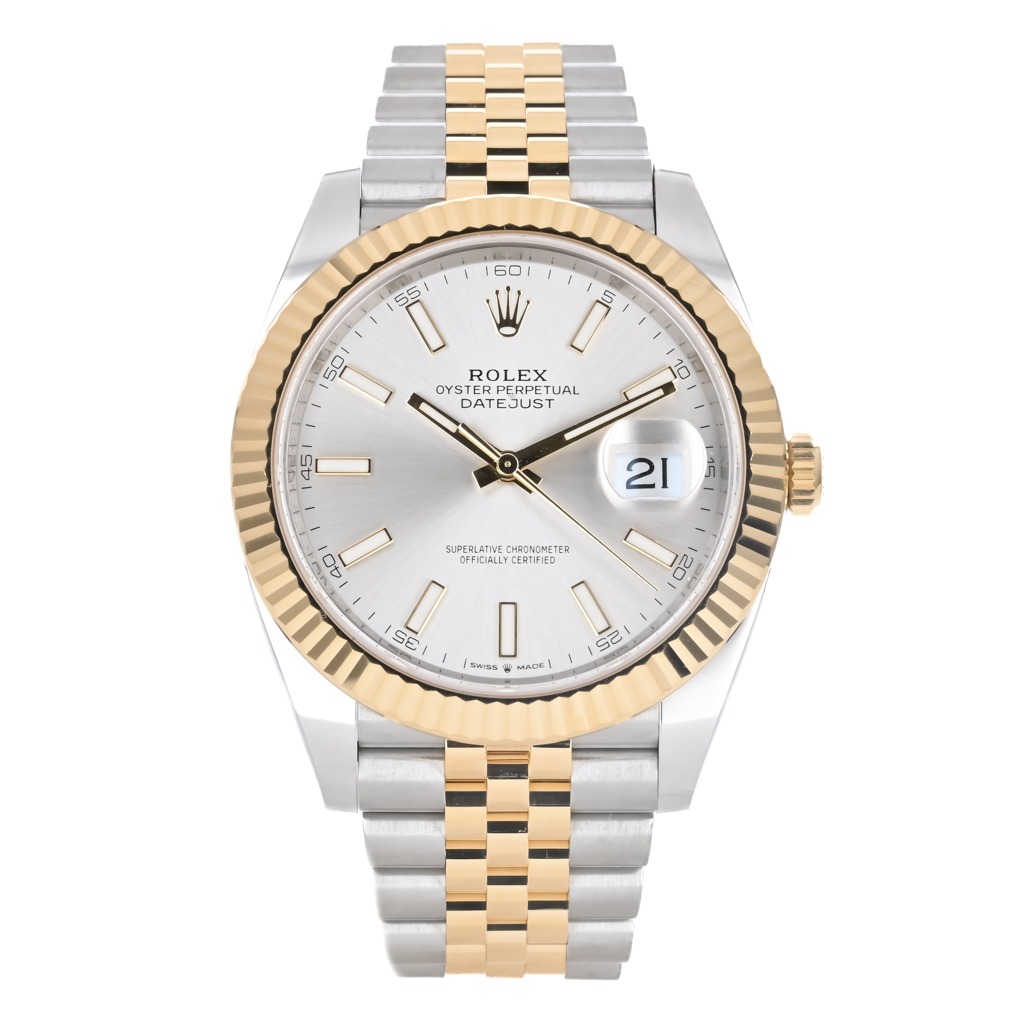
If you’re trying to figure out what your two-tone Rolex is worth as collateral, the first thing to understand is that a two-tone Rolex loan isn’t priced the way a bar of gold is priced. A two-tone Datejust, Submariner, or GMT-Master II has far less actual gold in it than most owners assume, yet it still commands a loan value well above a comparable steel model. That gap between metal content and market value is exactly what a lender has to account for, and it’s the reason a two-tone Rolex loan requires a different kind of appraisal than a solid gold piece or a stainless steel one.
Here’s how the mixed-metal construction actually works, what it means for how your watch is priced, and what to check before you use one as collateral.
What “Two-Tone” Actually Means on a Rolex
Rolex calls its two-tone construction “Rolesor,” and the name is literal: it’s Oystersteel paired with 18K gold, but only in specific places. On almost every two-tone Rolex, the gold is limited to the bezel, the winding crown, and the center links of the bracelet. The case middle and the outer bracelet links, which make up most of the watch’s visible surface and nearly all of its weight, remain steel.
That construction means a two-tone watch contains a modest fraction of the gold you’d find in a full gold model of the same reference, not half of it. It’s also why the gold portions wear differently than the steel: gold is a softer metal than steel, so the bezel and center bracelet links tend to pick up fine scratches and surface wear sooner than the steel case and outer links do. A lender evaluating a two-tone piece is looking closely at that bezel and those center links, because their condition says more about overall wear than the steel does.
Why Two-Tone Doesn’t Cost (or Appraise) at Half the Price of Solid Gold
If a two-tone watch has only a small amount of gold compared to a full gold model, you’d expect it to be priced much closer to the steel version. It isn’t. As of 2026, a steel Datejust 41 (reference 126300) retails in the neighborhood of $11,500 to $12,500, while the two-tone Yellow Rolesor version (reference 126333) runs roughly $15,500 to $18,900, a premium far larger than the weight of the added gold would justify on its own.
That premium exists because the price, and the loan value, is driven by brand recognition, reference demand, bracelet style, and dial configuration, not by grams of gold. This is the single biggest misconception owners bring to a two-tone Rolex loan: they assume the appraisal starts with melting down the gold and working up from there. It doesn’t.
To see just how small a role the raw metal plays, consider the gold content directly. A commonly cited estimate for the combined bezel, crown, and center bracelet links on a two-tone Datejust is around 20 grams of 18K gold. Using the live 18K gold price, that gold is worth about $1,996 in melt value. Compare that to the thousands of dollars of difference between the steel and two-tone retail prices above, and it’s clear that reference, condition, and current secondary-market demand, not gold weight, are what set the collateral value on a two-tone Rolex.
Because gold prices move daily, always check a live benchmark rather than relying on a fixed number. You can see the current figure on the Kitco live gold price chart, broken out by karat and by gram or ounce.
Two-Tone Across the Rolex Catalog
Two-tone construction isn’t a single look. It shows up differently depending on the model:
- Datejust: The most common two-tone Rolex, available with black dials, jubilee bracelets, and in some configurations, diamond-set bezels. A black dial two-tone Datejust on a jubilee bracelet is one of the most frequently requested configurations for both loans and sales, and it tends to hold value well because of how recognizable and widely produced it is. A diamond bezel on a two-tone Datejust is appraised as two separate components: the Rolesor case and bracelet, and the diamonds themselves, which are valued on their own merits rather than folded into a single metal estimate.
- Submariner: Two-tone Submariners come only in Oystersteel paired with yellow gold. After Rolex discontinued the white gold “Cookie Monster” Submariner in 2026, the current catalog leaves just two precious-metal configurations: full 18K yellow gold and two-tone yellow Rolesor. There is no white-gold or two-tone white-gold Submariner in current production, and the blue ceramic bezel option is only offered on two-tone and full-gold references, never on a steel-only Submariner. That narrowing of options is worth knowing if you’re trying to place a submariner two tone black dial in the context of what Rolex still makes versus what’s been pulled from the lineup.
- GMT-Master II: Rolex’s two-tone GMT, nicknamed the “Root Beer” (reference 126711CHNR), actually pairs steel with Everose gold rather than yellow gold, a reminder that two-tone spans more than one gold alloy depending on the reference. If you’re weighing a two-tone GMT against a steel GMT-Master II like the Batman, the metal composition is one of the first things a specialist will confirm before pricing.
- Yacht-Master: Offered in two-tone across several bracelet and bezel combinations, with the same principle applying: the gold is concentrated in the bezel and center links, and value tracks reference and demand rather than raw gold weight.
- Ladies’ models: Two-tone construction is especially common on women’s Datejust and Oyster Perpetual references, often with the same jubilee bracelet and black dial combinations seen on men’s models, just in smaller case sizes.
There Is No Two-Tone Day-Date
If you’re searching for a two-tone Day-Date or a “two-tone Presidential,” stop looking: it doesn’t exist as a production watch. The Day-Date has been offered exclusively in gold or platinum since it debuted in 1956, and Rolex has never made a steel or two-tone version for sale. A small handful of steel Day-Date prototypes were produced decades ago as graduation prizes for watchmaking students in Geneva, never sold commercially, and they have no bearing on ordinary collecting or lending. If you come across a watch marketed as a two-tone Day-Date or two-tone Presidential, treat it as an authenticity red flag before you consider it as collateral for anything.
Vintage Two-Tone: What Changes
Vintage two-tone Rolex models, particularly older Datejust references from the 1970s through 1990s, are appraised with the same gold-versus-reference logic, but condition carries more weight. Because the gold bezel and center links are the first parts to show wear, a vintage two-tone piece with a replaced or heavily polished bezel will typically appraise lower than one with its original, lightly worn gold components intact. Original bracelets, clasps, and dial condition matter just as much as the metal itself.
How a Lender Actually Calculates a Two-Tone Rolex Loan
A reliable appraisal on a two-tone Rolex has to separate three things: the steel and gold components by weight and current gold pricing, the reference’s standing in the current secondary market, and the watch’s condition, with particular attention to the gold bezel and center links. Diamond Banc approaches a two-tone Rolex loan with model and reference-specific valuation rather than a flat per-gram estimate, using current secondary-market pricing and a transparent valuation process so you can see how the number was reached. Because the process involves local market directors and specialists who work with Rolex day in and day out, the appraisal reflects how that specific reference, metal combination, and bracelet style are actually trading right now, not a generic gold-weight calculation.
If you’d rather see the mechanics of the loan itself first, our guide to Rolex equity loans walks through how loan-to-value and payout work before you bring a watch in.
What to Do With a Two-Tone Rolex: Loan or Pawn
Once you know roughly what your watch is worth, the decision is usually between a short-term option and a full sale. A pawn arrangement on a two-tone Rolex gets you cash quickly with the watch held as collateral and returned once the loan is repaid, which suits anyone who expects to reclaim the watch. A Rolex-secured loan works the same way but is generally the term people search for when they mean exactly this: using the watch’s equity without giving it up permanently. If you’ve decided you don’t want the watch back, selling outright is the other option, and you can start by checking what your Rolex could sell for instead of using it as collateral.
Either way, start with a straightforward check of what your Rolex is worth before committing to a path, since that number changes depending on whether you’re looking at a loan, a pawn, or an outright sale.
Questions to Ask Before You Commit
- Is the gold actually 18K? Rolex uses 18K gold (75% pure) on every Rolesor component, the bezel, crown, and center links alike, so there’s no variation in fineness to check across models.
- Has the bezel or bracelet been replaced? A replaced gold bezel or center links, especially on a vintage piece, should be disclosed and will factor into the appraisal.
- Does the reference still exist in production? Knowing whether your configuration (like a white-gold Submariner) has been discontinued helps set expectations: discontinued configurations sometimes carry a collector premium, while others simply reflect an older catalog.
- Are there added diamonds? A diamond bezel is priced separately from the metal and needs its own assessment.
A two-tone Rolex carries real, specific value, but it’s tied to the reference, the bracelet, the dial, and the condition of the gold components far more than to how many grams of gold are actually on the watch. Getting an appraisal from someone who prices Rolex references for a living, rather than treating the watch as a generic gold item, is what keeps the number accurate.
Like what you’re reading?
Add us in Google — more like this is on the wayRelated Posts
 Instagram
 Facebook
 Tiktok
 YouTube