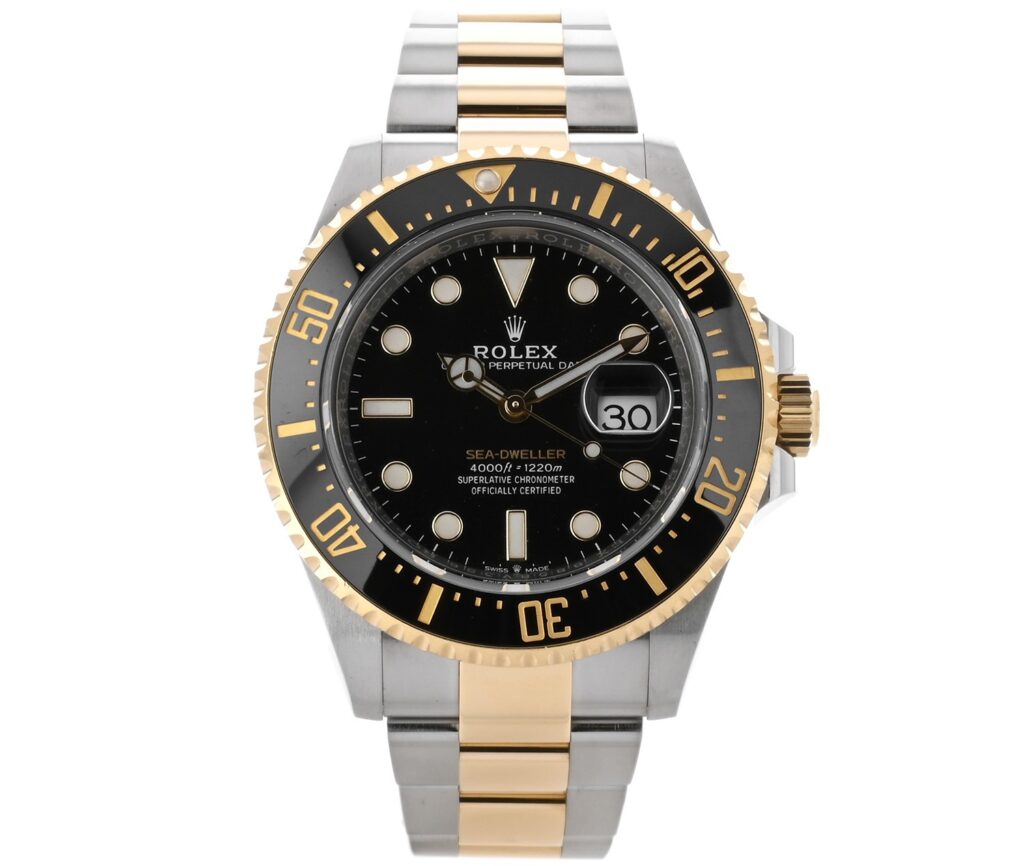
Anyone comparing the Rolex Sea-Dweller vs Submariner usually assumes the difference is just a few millimeters of case diameter. It isn’t. The two watches share a family resemblance and, in current form, the same movement architecture, but they were engineered for different jobs, carry different depth ratings, and have followed different reference histories that matter a great deal if you’re trying to figure out what your particular watch is worth today.
This guide covers the full picture: how the Sea-Dweller came to exist, every major reference and what changed in each one, how the current Sea-Dweller and Submariner compare spec for spec, and what that means for value whether you’re holding onto the watch, selling it, or using it as collateral for a loan.
Sea-Dweller vs Submariner: What Actually Separates Them
The Submariner was Rolex’s original dive watch, introduced in the 1950s and refined over decades into the brand’s best-known sports model. The Sea-Dweller came later, in 1967, built for a narrower and more extreme purpose: prolonged, saturation-diving missions where professional divers lived and worked at depth for days at a time, decompressing slowly inside pressurized chambers.
That purpose shows up in the spec sheet. The current Rolex Submariner and Submariner Date run 41mm cases rated to 300 metres. The current Sea-Dweller is a larger 43mm case rated to 1,220 metres, roughly four times the Submariner’s depth capability, and it carries an automatic helium escape valve the Submariner doesn’t have. That valve is the real dividing line between the two watches, not the size difference alone.
Both are currently built only in Oystersteel, or in the Sea-Dweller’s case steel-and-yellow-gold combinations Rolex has offered since 2019. Neither model is available in solid gold the way a Day-Date or Daytona is, which keeps both squarely in the “tool watch” category even as their prices have climbed well past what that phrase usually implies.
Rolex Sea-Dweller History and References
The Sea-Dweller’s origin is tied directly to its signature feature. Rolex filed the patent for the helium escape valve in November 1967, and the first reference, the 1665, was developed that same year but didn’t reach the public until 1971, likely because the patent wasn’t granted until June 1970. Rolex added its “triple lock” system, three independently sealed zones in the case, to the Sea-Dweller in 1970, which is part of why the watch could handle depths no Submariner of the era could approach.
From there, the references track a fairly clear progression:
- Reference 1665 (1971-1977): The original Sea-Dweller, rated to 610 metres at launch, using the Caliber 1575 movement.
- Reference 16660, the “Triple Six” (1978-1988): The first Sea-Dweller with a sapphire crystal and a larger helium valve, moving to Caliber 3035 and raising the beat rate from 19,800 to 28,800 vibrations per hour. This is also when Rolex pushed the depth rating from 610 metres to 1,220 metres.
- Reference 16600 (1988-2008): A 40mm steel case, no Cyclops lens over the date, Caliber 3135, and the same 1,220m rating. This is the Sea-Dweller that would have been current in 2005, and it’s one of the most commonly seen pre-owned Sea-Dwellers on the market today precisely because it had a 20-year production run.
- Reference 116600, the “Sea-Dweller 4000” (2014-2017): Reintroduced after a brief gap in the lineup at the classic 40mm size with no Cyclops lens. It stayed in production for only about three years, one of the shortest runs of any modern Rolex, before being replaced.
- Reference 126600 (2017-present): Launched for the Sea-Dweller’s 50th anniversary, this is the first Sea-Dweller to carry a Cyclops lens over the date. The case grew to 43mm and the movement became Caliber 3235, with a 70-hour power reserve.
That last jump, from the no-date-magnifier 40mm watch to a 43mm Cyclops-equipped one, is a meaningful design break, and collectors treat it that way. A short-production reference like the 116600 is viewed differently in the secondary market than the current 126600 simply because fewer were made and the no-Cyclops dial reads as a deliberate, temporary design choice rather than the brand’s long-term direction. If you’re trying to value a specific watch, getting the reference number right matters more than knowing the model name.
Movement, Depth Rating and the Helium Escape Valve
The current Submariner Date and the current Sea-Dweller share the same automatic Caliber 3235, rated for roughly 70 hours of power reserve and accurate to -2/+2 seconds per day once cased. The no-date Submariner uses a related but distinct movement, Caliber 3230. So from a timekeeping standpoint, a current Sea-Dweller and a current Submariner Date perform identically. The difference is entirely in what the case is built to withstand.
The helium escape valve is the part that confuses most owners who aren’t divers. It exists to solve a specific problem: during saturation dives, helium molecules in the breathing mixture are small enough to seep into the watch case under pressure. If a diver ascends too quickly, that trapped gas expands faster than it can escape through the case seals, which can pop the crystal off the watch. The valve releases that pressure automatically on ascent.
If you’ll never dive to depths where helium is a factor, the valve does nothing functional for you day to day. It’s a sealed, generally maintenance-free component, not a feature you interact with or need to monitor. Its relevance to most owners is really about what it represents: the Sea-Dweller is the more over-engineered, purpose-built watch of the two, and that engineering is part of what the reference commands in the market, not something that changes how the watch wears on a wrist that never leaves dry land.
Rolex Sea-Dweller Value and Price Today
A current production Oystersteel Sea-Dweller lists at $14,550 through an authorized Rolex retailer as of 2026, compared to an $11,350 authorized-dealer price for the current Submariner Date reference 126610. That roughly $3,200 gap reflects the Sea-Dweller’s larger case, higher depth rating, and lower production volume relative to the Submariner, which remains Rolex’s highest-demand sports model by a wide margin.
Demand shows up most clearly on the secondary market. As of early October 2026, the Submariner Date 126610 was trading at an estimated $13,732 on the secondary market, well above its $11,350 retail price, reflecting the ongoing allocation shortages that have kept steel sports Rolex models trading above list for years. Because that figure moves daily, treat any snapshot as a reference point rather than a fixed number, and check a live tracker before assuming a specific price.
Does the Sea-Dweller hold value the way a Submariner does? In general, yes, both are steel sports Rolex references that have historically retained value well compared to dress watches or gold pieces, but the Sea-Dweller’s smaller production numbers and less universal name recognition mean its resale strength depends more heavily on reference and condition specifics than the Submariner’s does. A 16600 in honest, well-maintained condition and a 126600 with box and papers are different propositions in the eyes of a buyer, even though both say “Sea-Dweller” on the dial. That’s exactly why a model-specific, reference-specific appraisal matters more here than a generic “Rolex value” estimate, something Diamond Banc’s specialists price against current secondary-market data rather than list price alone.
Servicing, Hidden Risks and What They Mean for Collateral Value
Rolex backs new watches with a five-year guarantee from the date of purchase and recommends a full service roughly every 10 years, depending on the model and how the watch is actually used. That 10-year figure is a general guideline, not a fixed schedule. A vintage Sea-Dweller that’s been worn hard, or one with an unknown service history, may need attention every five to seven years instead, and a watch that’s clearly overdue for service will factor into any condition assessment, whether you’re selling it or using it as collateral.
There’s a risk specific to the Sea-Dweller that’s easy to overlook: you cannot verify a used watch’s actual depth capability or helium valve condition by looking at it. A case can appear pristine while its seals have degraded, or a prior repair could have used a non-original gasket. None of that is visible without a professional pressure test. If you’re planning to rely on a Sea-Dweller’s full performance rating, or on its appraised value for a loan, that’s worth confirming rather than assuming.
The other risk is simpler: reference confusion. A seller or owner who assumes their 40mm no-Cyclops Sea-Dweller is “the same as” the current 43mm model will misjudge its value in either direction. Before you sell a Rolex or use one as collateral, get the exact reference number identified correctly, since that single detail changes the comparable set a valuation is built on.
Which One Should You Own, Sell, or Use as Collateral
If you already own a Sea-Dweller or Submariner and are weighing your options, the practical differences come down to liquidity and documentation rather than which watch is “better.” Submariners move faster in the secondary market simply because more buyers recognize the name and more comparable sales exist to price against. Sea-Dwellers, especially well-documented examples of shorter-run references like the 116600, can bring strong interest from buyers specifically looking for that reference, but the buyer pool is narrower.
For either watch, the same three decisions apply. You can sell a Rolex outright for a lump sum based on current market value. You can use it as collateral for a Rolex-secured loan, which lets you access funds against the watch’s value without giving it up permanently. Or, if you’re uncertain which route fits your situation, a consignment or seller’s agent arrangement through Diamond Banc lets a specialist handle the sale while you retain more control over the final price.
Whichever direction you’re considering, start with an accurate, reference-specific valuation rather than a general price range pulled from the model name alone. Diamond Banc’s local market directors price Sea-Dwellers and Submariners against current secondary-market data, not retail list prices, and the process works the same whether you bring the watch to a physical office or ship it in securely from anywhere in the country. You can get a Rolex valuation started, review options for a luxury watch loan, or look specifically at what a Submariner is bringing in the current market before deciding what to do next.
Like what you’re reading?
Add us in Google — more like this is on the wayRelated Posts



 Instagram
 Facebook
 Tiktok
 YouTube