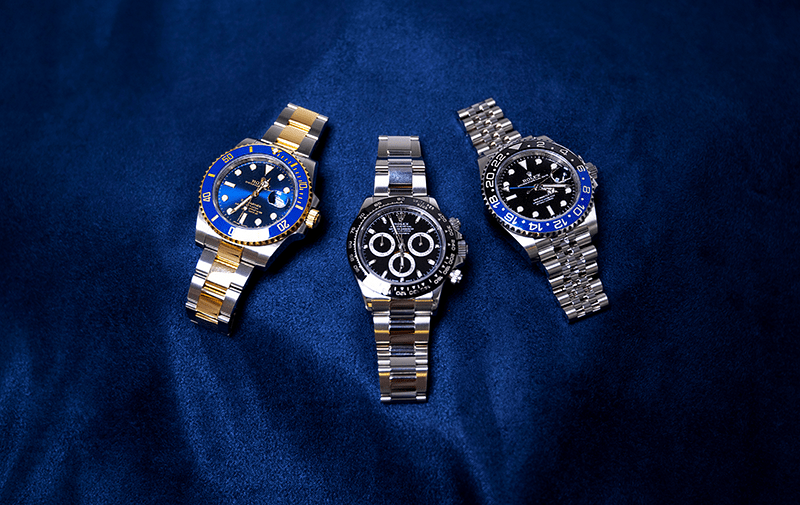
If you’ve ever held a Rolex up to the light and noticed the date window bulging out at you like a tiny magnifying glass, you’ve met the Cyclops. It’s one of the most recognizable details on any Rolex, and one of the most misunderstood. Along with the rehaut engraving inside the crystal and the dots stamped beneath the crown logo, the Rolex Cyclops is part of a small set of details that tell you a lot about a watch’s age, originality, and condition, if you know what you’re looking at.
This guide walks through what each of these features actually does, how to check whether yours looks right, and why it matters if you’re ever having the watch appraised, insured, or offered as collateral.
What the Rolex Cyclops Lens Actually Does
The Cyclops is a small convex lens fixed over the date window on the crystal. Its only job is to magnify the date so it’s legible at a glance. Rolex introduced the feature in 1953, and the company’s own heritage materials tie its invention to Hans Wilsdorf’s interest in what he called “optical magnification” for the brand’s tropical-rated cases, a detail documented in Rolex’s own historical correspondence from that year. Two years later, in 1955, Rolex published a public notice warning that the lens was patent-protected in Switzerland and abroad, and that it intended to pursue anyone who copied it.
The lens itself has changed construction over the decades. Early versions were molded directly into acrylic crystals. Once Rolex moved to sapphire crystals, the Cyclops became a separate piece of sapphire glued on top, and since 2005 it has carried anti-reflective coating on both sides to cut glare under bright light.
As for how much it actually magnifies: Rolex used to list a 2.5x figure on its own materials, but that spec has quietly disappeared from current Rolex marketing, which is why you’ll see enthusiasts argue about the exact number today. The honest answer is that Rolex no longer publishes one, so treat “2.5x” as a commonly repeated reference point rather than a current factory spec.
Rolex Cyclops Real vs Fake: What to Check
This is one of the most common questions owners ask, and the good news is you can check several things yourself without tools:
- Centering: On a genuine Rolex, the date sits dead center under the lens, magnified enough to read without tilting the watch at an angle. If the date looks off to one side, too small, or only partially magnified, that’s worth a closer look.
- Clarity and dome: The lens should be clear, evenly domed, and free of bubbles, haze, or a flat, pasted-on appearance. A lens that looks glued on crookedly or sits noticeably proud or sunken relative to the crystal is a red flag.
- Glare behavior: On any Rolex made since 2005, the anti-reflective coating should visibly reduce glare compared to the surrounding crystal. If the lens reflects just as much light as the rest of the crystal, that’s inconsistent with a genuine modern Cyclops.
None of these checks is a substitute for a full authentication. The Cyclops is one detail among many a trained eye reviews, alongside the movement, case markings, and papers. If you’re trying to confirm authenticity before a sale or want to know what your Rolex is actually worth, that’s a job for a specialist who evaluates the whole watch, not just one lens.
Why Some Rolex Models Don’t Have a Cyclops
The Cyclops only exists because a date window exists underneath it. Several well-known Rolex models skip the date complication entirely, which means there’s nothing for a Cyclops to magnify. The Explorer and the Milgauss, for example, were built without a date window from the start, in keeping with their simpler, tool-watch dial layouts. The Daytona’s dial is built around three chronograph subdials, and the classic Daytona configuration leaves no room for a date display either. If your Rolex doesn’t have a Cyclops, the first question isn’t whether something is wrong with it; it’s whether the model was ever designed with a date window at all.
The Rehaut: The Engraving Hiding Inside the Crystal
The rehaut is the inner, sloped ring between the dial and the crystal, and it’s easy to miss because you usually have to tilt the watch to catch the light on it. Starting around 2005, Rolex began engraving the watch’s serial number on the rehaut, running in parallel with the older case-back-engraved serial for a few years before phasing the case engraving out almost entirely by roughly 2008 to 2010. On models from that transition window, you may find the serial in both places; on anything made after, the rehaut is where it lives.
A genuine rehaut engraving should be crisp, evenly spaced, and consistent in font with the rest of your watch’s markings. A serial that looks shallow, uneven, or inconsistent with the model’s known production era is a reason to have the watch looked at before you rely on it for an appraisal or a loan.
Where Your Serial Number Is, and What It Can’t Tell You
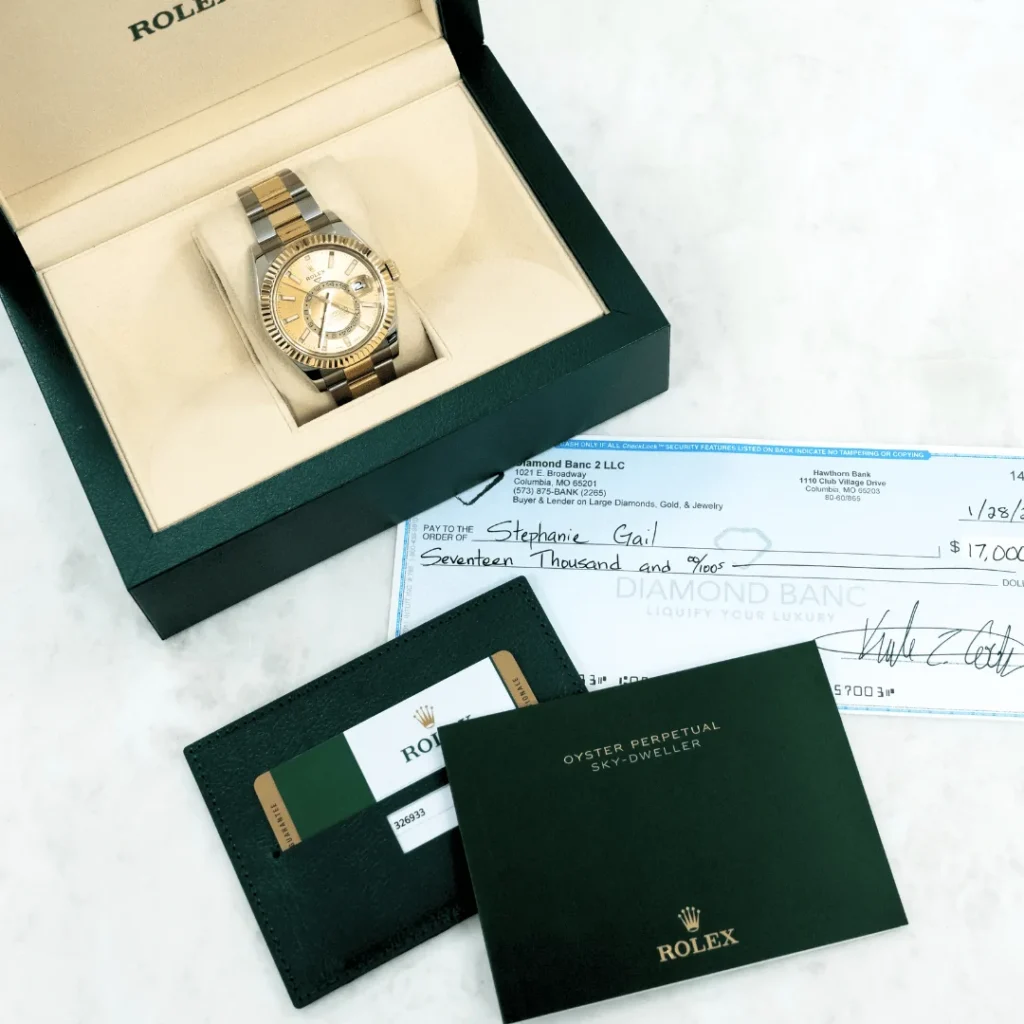
Here’s the part that trips people up: Rolex serial numbers used to run sequentially, which let owners and dealers estimate a production year just from the number. That stopped in 2009, when Rolex switched to randomized, “scrambled” alphanumeric serials that no longer correspond to any production sequence. That means for any Rolex made from 2009 forward, the serial number alone can’t tell you when it was made. The only reliable way to date these watches is the original warranty card, stamped and dated by an authorized retailer at the time of sale. If you’ve lost that card, dating the watch precisely gets much harder, which matters more than people expect when a watch is being appraised.
Twinlock, Triplock, and the Dots Under the Crown
Flip your attention to the crown, and you’ll find another small detail that tells a story: the dots engraved beneath the Rolex coronet. Rolex’s screw-down Oyster crown goes back to a 1926 patent. In 1953, Rolex introduced the Twinlock crown, adding a second sealed zone for better water resistance. In 1970, Rolex went further with the Triplock crown, which added a third sealed zone and was first fitted to the Sea-Dweller to handle depths where an unsealed crown could work loose under pressure.
You can usually tell which crown your watch has just by looking: three dots beneath the coronet mean Triplock, while a dash or one to two dots typically mean Twinlock. The dot size can also hint at the crown’s metal, since steel, gold, and platinum crowns are marked slightly differently.
Does a Triplock Crown Mean Better Water Resistance?
Not by itself, and this is a detail worth getting right. The crown type tells you how the crown seals against the case, not what the whole watch is rated for. The Daytona and the Deepsea both use Triplock crowns, yet their depth ratings differ by thousands of meters, because the actual water-resistance rating comes from the combination of case, crystal, caseback, and gaskets working together, not the crown alone. If you see a Triplock crown on a watch, it confirms a design choice; it doesn’t tell you the watch’s depth rating on its own.
Do These Details Affect What Your Watch Is Worth?
Yes, but indirectly. None of these features by themselves make a watch more or less valuable. What matters is whether they’re original, intact, and consistent with the model and era they’re supposed to belong to. A Cyclops lens that’s been swapped for a generic replacement, a rehaut engraving that looks tampered with, or a crown that doesn’t match the watch’s documented history are all things a specialist checks before putting a number on a watch, because they speak to whether the watch is unmolested and correctly matched to its papers.
This is where working with someone who evaluates Rolex watches specifically, rather than jewelry or watches in general, makes a real difference. A reference-specific appraisal accounts for the model, the production era, and current secondary-market pricing, not just a generic “luxury watch” estimate. If you’re deciding whether to sell your Rolex outright or would rather keep the watch and use it as collateral for a Rolex-secured loan, that evaluation is the starting point either way.
Servicing and Guarantee Risks Worth Knowing Before You Touch Anything
A few decision points are easy to overlook until they cost you something:
- The factory guarantee is fragile. Rolex’s own guarantee terms state that the five-year international warranty is voided if non-Rolex components are added or substituted, or if work is performed by anyone other than Rolex or an authorized service center. A crown, crystal, or rehaut-area repair done at a general watch or jewelry shop, even a well-intentioned one, can void a guarantee that a future buyer or lender would otherwise rely on.
- Service won’t normally alter these details, but who performs it matters. Rolex recommends a full service roughly every ten years depending on the model and how the watch is worn. A proper Rolex service shouldn’t change your Cyclops, rehaut engraving, or crown type, since the point of authorized service is to restore the watch to factory spec, not modify it. The risk comes from unauthorized shops substituting parts rather than restoring original ones.
- A lost warranty card is a real problem for post-2009 watches. Since the serial number can no longer be decoded to a production year, the card is your only solid proof of when the watch was purchased and serviced. If you still have it, keep it with the watch; if you don’t, factor that into how you plan to sell or finance the piece.
Getting an Original Watch Evaluated
Small details like the Cyclops, the rehaut, and the crown dots aren’t decoration. They’re a quick, visible way to check whether a Rolex is original and consistent with its stated age, which is exactly what a lender or buyer wants to confirm before putting a number on the watch. If your Rolex checks out and you’re weighing your options, Diamond Banc’s specialists can give you a model- and reference-specific valuation, whether you want to sell outright, pawn your Rolex for short-term cash, or use it as collateral for a loan while you keep the watch. The process is the same either way: a transparent look at the actual watch in front of you, not a generic estimate.
If you’re curious how authenticity questions play out on specific, well-known Rolex references, our breakdown of aftermarket modifications and how they affect a Rolex’s originality covers a related set of details worth understanding before you sell or finance a watch that’s been altered after it left the factory.
Like what you’re reading?
Add us in Google — more like this is on the wayRelated Posts

 Instagram
 Facebook
 Tiktok
 YouTube