A Rolex watch pawn shop loan works by using your watch as collateral: the shop appraises it, offers you a loan that’s a percentage of its resale value, holds the watch in secured storage, and returns it to you once you repay the loan plus interest. If you don’t repay within the agreed term, the shop keeps the watch and can sell it.
That’s the mechanic in one sentence. But if you’re actually about to walk into a pawn shop with a Rolex on your wrist, the details matter a lot more than the summary — how the shop arrives at its number, what the loan will cost you, how long you have, and what happens to your watch while it sits in someone else’s safe. Here’s what to know before you go.
Yes — most pawn shops will buy or loan against watches, including Rolex, as long as they can verify authenticity and estimate resale value. General pawn shops handle everything from tools to jewelry, so a Rolex is just one more category they’re equipped to assess, though not always with the same depth of expertise as a watch specialist. Here’s how that applies specifically to a Rolex.
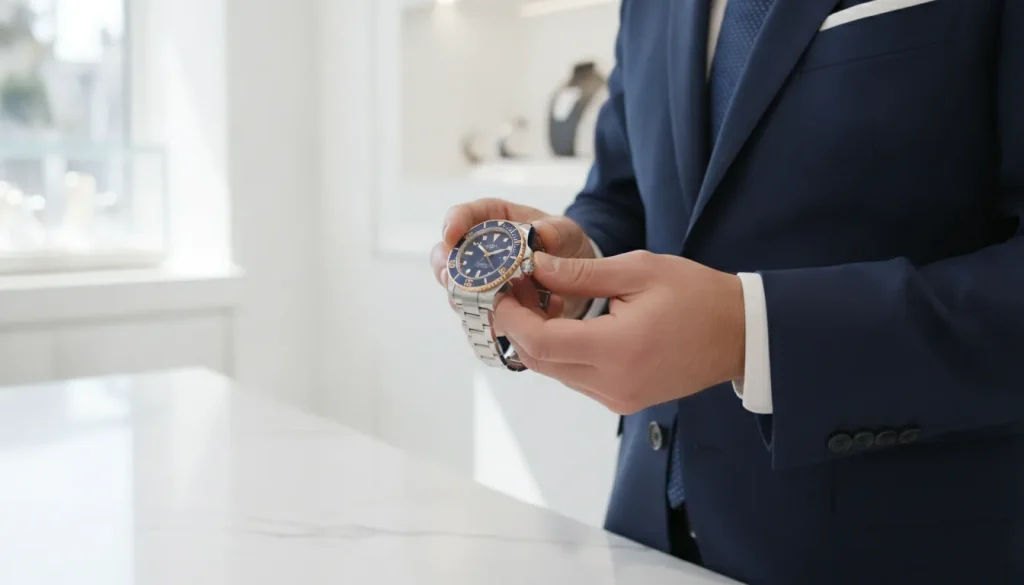
How a Rolex Watch Pawn Shop Values Your Watch
Most pawn shops don’t lend against the retail price of a Rolex, or even its current resale value on the open market. They lend against what they could realistically get for it quickly if you never came back — which is usually a conservative, wholesale-style number. A general pawn shop that also handles power tools, guns, and electronics typically has limited in-house expertise in luxury watches, so it tends to lend cautiously to protect itself from a model or reference it doesn’t fully understand.
The factors that move the number are fairly consistent across the industry: model and reference, materials (steel vs. two-tone vs. solid gold), condition, originality of parts, whether you have the box and papers, and how in-demand that specific configuration is right now. A well-documented Submariner or Daytona in excellent condition will get a meaningfully stronger offer than the same model missing papers or showing heavy wear.
Typical Loan-to-Value Ranges and Interest Rates
Pawn loans are regulated at the state level, and both loan-to-value ratios and interest rates vary widely depending on where you live and which shop you use. As a general rule of thumb, interest rates on pawn loans can range from roughly 12% up to 240% APR or more, depending on how a given state caps or restricts pawnbroker lending. For a fuller breakdown of how these loans are structured and priced, see our pawn shop loan definition and rates guide. On a lower-value item that spread might not matter much in dollar terms, but on a Rolex — where loan amounts can run into the thousands — the difference between a well-priced loan and an expensive one adds up fast over a multi-month term.
Payouts also vary significantly by watch type and condition. A steel sport model like a Submariner or GMT-Master in excellent condition with box and papers will typically draw a stronger loan offer than a vintage or heavily worn piece missing documentation, and a solid gold or two-tone reference can shift the number in either direction depending on current demand for that specific configuration. Ask the shop to walk you through how they arrived at your specific offer rather than accepting a single flat number.
Before you agree to anything, ask for the total finance charge in dollars, not just the monthly rate, and calculate what you’d owe if you used the full redemption period.
How Long Do You Have to Repay?
Redemption periods are also state-regulated and commonly run somewhere between 30 and 90 days, sometimes with the option to renew or extend by paying accrued interest. According to the National Pawnbrokers Association, roughly 85% of pawn customers repay and reclaim their items, which is a useful reminder that a pawn loan is meant to be temporary financing, not a backdoor sale. Ask specifically: what’s the initial term, can it be extended, and what does an extension cost?
Storage, Insurance, and Security
Your Rolex will sit in the shop’s safe or vault for the entire loan term, so it’s fair to ask how it’s stored and whether it’s insured while in their possession. A shop that specializes in general merchandise may store a watch alongside guitars, tools, and electronics rather than in watch-specific, climate-controlled conditions. It’s a reasonable question to ask directly, and a legitimate operation should be able to answer it without hesitation.
What Happens If You Can’t Repay
If the loan isn’t repaid or renewed by the end of the term, the pawnbroker takes ownership of the watch and can sell it — typically to whoever walks through the door next, at whatever price the shop sets. This is the core risk of any pawn transaction: you’re not just financing against your watch, you’re accepting that you could lose it permanently if your timeline slips.
Questions Worth Asking Before You Pawn a Rolex Anywhere
- How did you arrive at this loan amount, and what percentage of resale value does it represent?
- What is the interest rate, expressed as an APR, and what would I owe in total at the end of the term?
- How long is the loan term, and can it be renewed?
- How and where is my watch stored, and is it insured?
- What happens, step by step, if I don’t repay on time?
- Do you have experience specifically with Rolex, or luxury watches generally?
If a shop can’t answer these clearly and in writing, that’s worth treating as a signal, not just an inconvenience.
A Specialty Alternative to the General Pawn Shop
General pawn shops exist because they serve a real need, but they’re built to handle everything from chainsaws to jewelry, which limits how deep their watch expertise — and their lending capacity — can go. Diamond Banc works differently: it’s a specialty lender focused exclusively on luxury watches, diamonds, and fine jewelry, which typically translates into higher loan-to-value offers, terms built specifically around how Rolex values actually move, and dedicated, insured storage for your watch during the loan. See how the two approaches compare in more detail in our guide to pawning a Rolex the smart way, or go straight to start a Rolex loan with Diamond Banc to see what your watch could be worth as collateral.
Is pawning a Rolex at a pawn shop a good idea?
It can be, if you understand the terms and are confident you’ll repay within the redemption period. The tradeoff is that general pawn shops often lend conservatively against luxury watches and may not offer the highest possible loan-to-value compared with a lender that specializes in watches.
How much will a pawn shop loan me for a Rolex?
It depends heavily on the shop, but general pawn shops typically lend a percentage of what they could quickly resell the watch for, which is often well below its true market value. Specialty lenders with deep watch market knowledge can frequently offer significantly more against the same watch.
What happens to my Rolex if I don’t repay the loan?
If you don’t repay or renew within the agreed term, the pawnbroker takes ownership of the watch and can sell it to recover their loan amount. You lose any further claim to the item once the redemption period expires.
Can I get my Rolex back early if I repay sooner?
Yes. Most pawn loans allow early repayment, and doing so typically reduces the total interest owed compared with waiting until the end of the term.
Like what you’re reading?
Add us in Google — more like this is on the wayRelated Posts
 Instagram
 Facebook
 Tiktok
 YouTube