An 11 carat diamond is rare enough that there’s no shelf price for it, no catalog listing, and no simple per-carat chart that applies the way one might for a quarter-carat accent stone. If you’re trying to work out 11 carat diamond cost because you own one and want to know what it’s actually worth, the honest answer is that it depends on a short list of specific variables, and at this size those variables swing value by hundreds of thousands of dollars rather than a few hundred.
Carat Weight Is a Measure of Mass, Not a Price Tag
A carat is a unit of weight equal to 200 milligrams, not a measure of size or value, which is easy to forget when a diamond’s carat weight is the number everyone asks about first. All else equal, a heavier diamond does cost more because larger, gem-quality rough is rarer and more in demand. But “all else equal” rarely holds once you’re talking about an 11-carat stone. Two diamonds of identical weight can carry very different price tags depending on their clarity, color, and cut, which is exactly why two 11-carat diamonds can sell for wildly different amounts even though the headline number, the carat weight, is the same on both certificates.
That’s the core problem with any generic “diamond cost per carat” table: it’s built from the bulk of the market, which trades in stones under two carats. Once you’re past 10 carats, you’re not looking at a market segment anymore, you’re looking at a specific, individually priced object.
Why Diamond Cost Per Carat Climbs Instead of Staying Flat
If you’ve ever compared the cost of a .75 carat diamond to a 1.25 carat diamond and noticed the second one costs far more than proportionally bigger, that’s not a pricing error, it’s how the market works. Pricing is not linear with weight: a 2-carat diamond of comparable quality to a 1-carat stone typically costs three to four times as much rather than twice as much, because gem-quality rough large enough to cut a 2-carat stone is exponentially scarcer than rough suited to a 1-carat stone. The same logic compounds again between 2 carats and 5 carats, and again between 5 carats and 11. This is also why whole-carat thresholds matter more than the eye can see. A diamond just under a full carat and one just over it look identical, but the one crossing into the next weight bracket is traded as a different, more desirable category, so its total price jumps disproportionately at that line. The same stair-step effect repeats at 1.5 carats, 2 carats, 3 carats, and so on, all the way up to the size range where an 11 carat diamond sits: a size bracket so thin that each stone is effectively priced on its own merits rather than against a chart.
Fluorescence, Type IIa Purity, and Certification
Three factors specific to large, high-quality diamonds move price more than most owners expect.
Fluorescence. A landmark GIA study of trade pricing found that higher-color (D to H) diamonds with very strong blue fluorescence were listed for up to 15% less than comparable non-fluorescent stones, while lower-color diamonds with the same strong fluorescence actually carried up to a 4% premium. Fluorescence never changes the color grade GIA assigns on the report; the price effect comes entirely from how buyers in the trade perceive and price it. If your 11-carat stone’s GIA report notes strong blue fluorescence and a high color grade, that single line item is likely shaping its value more than any other detail on the page.
Type IIa status. Type IIa diamonds, chemically the purest diamonds with no measurable nitrogen or boron, make up a tiny slice of all mined stones, and that proportion rises sharply among the largest diamonds along with a higher incidence of top color grades. But Type IIa status alone doesn’t set a price; it has to be paired with strong color and clarity. Auction-house guidance puts a high-quality 10-carat Type IIa diamond generally in the $500,000 to $1,000,000-plus range, with D-color, internally flawless examples commanding the top of that band. One Graff ring set with a 10.45-carat Type IIa diamond sold for $740,000, a useful real-world anchor for what a stone of comparable quality near 11 carats can command.
Certification. A current, legible GIA report matters more at this size than at any other. It’s what confirms the color, clarity, cut, and fluorescence a buyer is actually pricing, and it removes the guesswork that otherwise suppresses what anyone is willing to offer for an uncertified large stone. Before relying on any online estimate for an 11-carat diamond, it’s worth reviewing how diamond grading reports translate into real market value, since the report is the document every buyer and lender will work from.
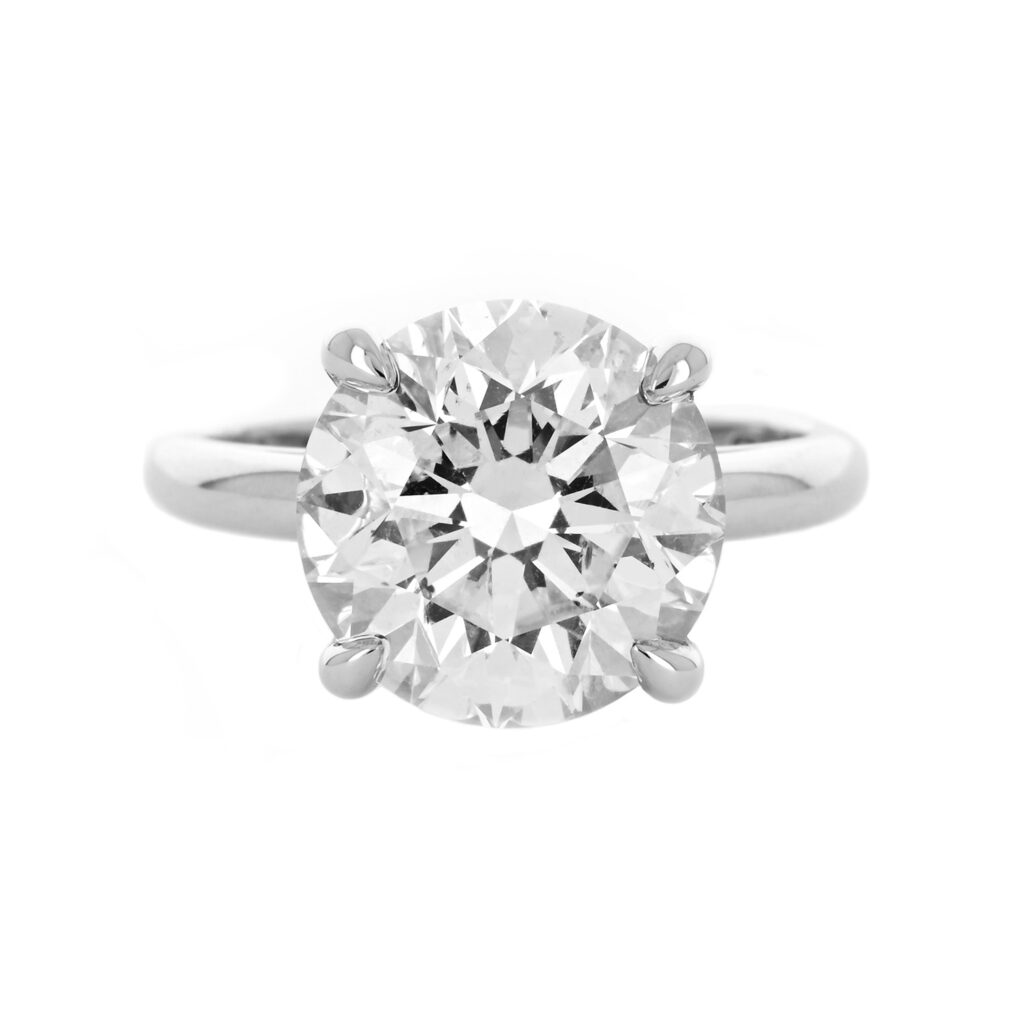
A Worked Example: Pricing an 11 Carat Diamond Against a Real Sale
Using the Graff 10.45-carat Type IIa diamond that sold for $740,000 as a benchmark, that works out to roughly $70,813 per carat. Applying that same per-carat rate to an 11-carat stone of comparable color, clarity, cut, and fluorescence would put it at roughly $778,947.
That number is illustrative only, not an offer or an appraisal of any specific stone. Change the color grade by one step, add strong blue fluorescence, or drop from Internally Flawless to VS2, and the per-carat rate moves substantially. It also doesn’t apply at all if your diamond is a natural fancy color rather than colorless; fancy-color diamonds trade in an entirely different pricing universe than colorless stones of similar weight, and a generic per-carat benchmark built on colorless, GIA-certified stones simply doesn’t translate to a blue, pink, or yellow diamond of the same size.
Why Recutting a Large Diamond Can Cost You More Than It Gains
It’s tempting to think that improving a large diamond’s clarity grade through recutting will always raise its value, since clarity is one of the 4Cs that drives price. But recutting removes material, and removing material lowers carat weight. In a stone this large, where price climbs disproportionately with every fraction of a carat, the weight lost in a recut can outweigh the value gained from the clarity improvement, leaving the stone worth less overall even though it graded higher afterward. Before authorizing any work on an 11-carat diamond, it’s worth getting a specific valuation on the stone exactly as it is, rather than assuming a clarity upgrade pays for itself.
What a Retail Replacement Estimate Misses
A retail replacement figure, the kind used for insurance purposes, reflects what it would cost to buy a similar diamond from a jeweler at full retail markup. It is not what a buyer or lender will pay for your stone, and the gap between those two numbers widens as carat weight rises, because retail markups compound on top of an already rare, already expensive stone. If you’re trying to understand what your diamond is actually worth to sell, rather than what it would cost to replace, you need a valuation based on current secondary-market pricing for a stone of its specific grade, not a retail comparison. That’s the starting point Diamond Banc’s diamond valuation process is built around: model-specific, grade-specific pricing rather than a chart.
Turning Your Diamond Into Cash or Collateral
Once you know roughly where your 11-carat diamond sits, there are two practical paths. You can sell it outright to a diamond buyer who prices stones individually rather than against a generic chart, or you can use it as collateral for a jewelry-secured loan and keep the stone while accessing funds against it. Diamond Banc handles both through local physical offices and secure mail-in shipping for owners who aren’t near a location, with human specialists who evaluate the stone’s specific color, clarity, cut, and fluorescence rather than running it through a flat per-carat formula.
Getting a Real Number for Your Stone
Before you act on any estimate, confirm three things: that your GIA report is current and legible, that it specifically notes fluorescence intensity (not just color and clarity), and that any secondary-market comparison you’re using is for a stone of genuinely comparable grade, not just comparable weight. A carat size chart is a reasonable starting point for a half-carat stone; it tells you almost nothing reliable for an 11-carat one. The same is true of a quick online diamond evaluation tool: useful for a rough sense of a small stone’s range, not a substitute for a specific review of your exact diamond’s 4Cs. For a stone this rare, the only number worth acting on is one tied to your specific report, not a formula.
Like what you’re reading?
Add us in Google — more like this is on the wayRelated Posts
 Instagram
 Facebook
 Tiktok
 YouTube