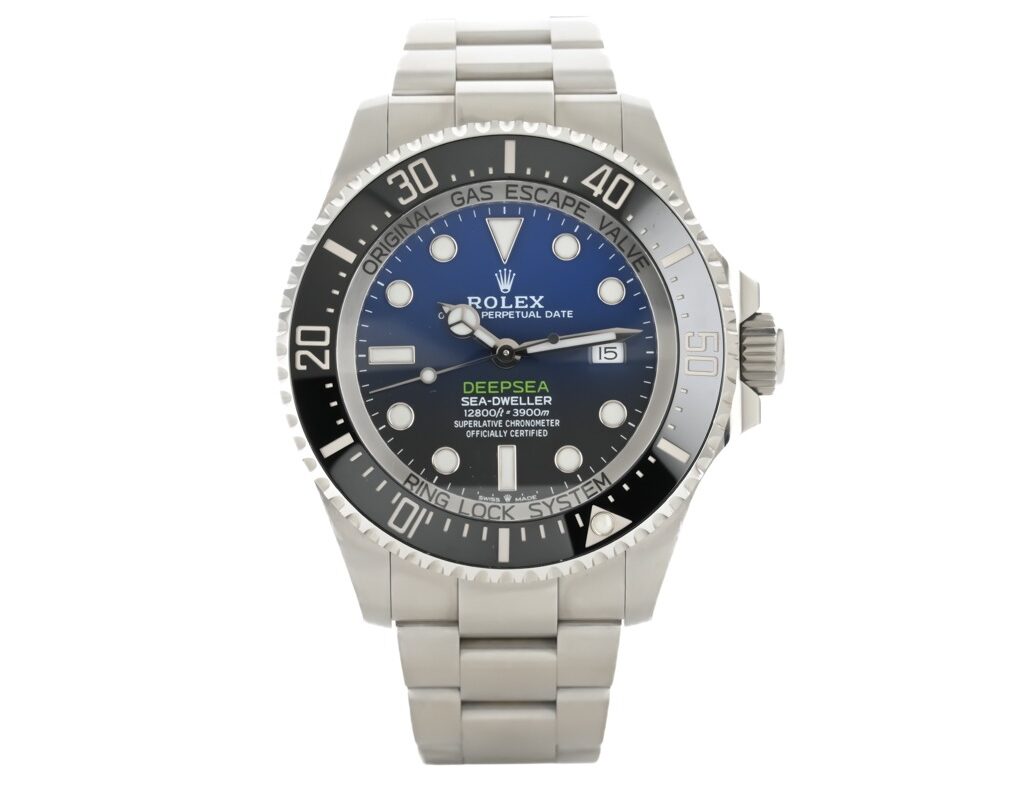
The Rolex Deepsea Challenge is the deepest-rated watch Rolex has ever put into regular production: a 50mm case built to withstand pressure at 11,000 metres below the surface. It looks like a Sea-Dweller that has been through a growth spurt, but the engineering and the ownership questions underneath it are different enough that it deserves its own explanation, especially if you’re trying to figure out what the watch is actually worth or what it costs to keep running.
What Separates the Deepsea Challenge From a Standard Deepsea
The most significant difference isn’t the depth number, it’s the material. The Deepsea Challenge (ref. 126067) is Rolex’s first watch made entirely of titanium, using a proprietary grade-5 alloy called RLX titanium for the case, bezel, caseback, crown and bracelet. Rolex developed this alloy specifically for this model; it isn’t used anywhere else in the current lineup.
That matters because titanium is lighter than the steel used on the standard Sea-Dweller and Deepsea, which is how Rolex managed to build a 50mm case, far larger than the Deepsea’s 44mm, without it becoming unwearable. The watch still uses the Ringlock system, the architecture that gives the regular Deepsea its extreme depth rating: a nitrogen-alloyed steel compression ring sandwiched between a titanium case and a sapphire crystal, plus a helium escape valve on the case side. If you’ve assumed a watch rated nearly three times deeper than the standard Deepsea would drop that valve as unnecessary, it doesn’t. Rolex kept it, which tells you the Ringlock geometry, not the valve, is doing the structural work.
Inside is the automatic Calibre 3230, the same architecture found across several current Oyster Perpetual models, certified as a Superlative Chronometer to a tolerance of -2/+2 seconds a day with roughly 70 hours of power reserve. There’s nothing exotic about the movement itself; the engineering story here is entirely in the case.
The James Cameron Connection, and What’s Actually the Same
The Deepsea Challenge takes its name and its story from a real dive. In 2012, filmmaker James Cameron piloted a submersible solo to the bottom of the Mariana Trench, and Rolex built an experimental watch for the expedition. That prototype was rated to 12,000 metres and made of 904L stainless steel, not titanium, and it was mounted to the outside of the submersible’s robotic arm rather than worn.
Ten years later, in 2022, Rolex released the production Deepsea Challenge as a watch inspired by that dive, not a replica of it. The retail version is rated 1,000 metres shallower than the prototype, and it’s made of a completely different material. What carries over is the name, the oversized case concept, and the commemoration: the caseback is engraved with “Mariana Trench” along with the dates of the two deepest manned dives in history, the 1960 Trieste expedition and Cameron’s 2012 descent. Rolex has said the production watch, despite its larger 50mm case, ends up roughly 30% lighter than that 2012 steel prototype, which is the real engineering payoff of switching to titanium.
During testing, each production watch is pressure-tested well beyond its rated depth, to a simulated 13,750 metres, a 25% safety margin developed with the French diving and offshore engineering firm Comex. That margin is standard practice for Rolex’s professional dive watches, not something unique to this model, but it’s worth knowing the 11,000m rating on the dial isn’t the ceiling of what the case has been tested to survive.
What It Costs Today vs. 2022, and Why the Gap Matters
Current U.S. retail for the Deepsea Challenge is $29,100 as of 2026, up from its launch price of $26,000 in November 2022. An increase of roughly 12% over three to four years is in line with how Rolex has adjusted pricing across much of its catalog in that period, not a sign of anything unusual happening with this specific reference.
The more interesting number is what the watch does once it leaves an authorized dealer. On the secondary market, the 126067 has been trading at roughly $38,869 as of June 2026, a premium of about 33.6% over retail. For comparison, the average premium across in-production Rolex models generally sits closer to 13.9%. That gap is real, and it’s the number people point to when they call this an unusually strong performer for a watch that’s still being made in current production rather than discontinued.
Is the Premium Something You Can Count On?
This is the part worth slowing down on if you’re weighing a decision around the watch rather than just admiring the spec sheet. The Deepsea Challenge has only existed on the secondary market since late November 2022, which is a short track record by Rolex standards. Market data puts its one-year price performance among the least predictable of all watches tracked, less stable than 97% of the field, and attributes that largely to the fact that it’s still in active production. Supply keeps increasing as Rolex continues manufacturing it, and unlike a discontinued reference with a fixed number of pieces ever made, there’s no scarcity ceiling locking the premium in place.
None of that means the 33.6% premium is fake or about to evaporate tomorrow. It means the watch’s secondary-market strength today reflects strong current demand against available supply, a balance that can shift as more pieces reach the market over time. Anyone treating that premium as a fixed, permanent feature of owning this watch is reading more certainty into the number than the data supports.
Service, Titanium, and What Condition Does to Value
Every new Rolex, including the Deepsea Challenge, comes with a five-year international guarantee, and Rolex recommends a full service roughly every 10 years depending on how the watch is actually worn and used. That service isn’t covered once the warranty period lapses; it’s a cost the owner carries, and for a watch this mechanically straightforward (the movement itself is shared with other current models), routine maintenance isn’t the expensive part.
The case is. Because RLX titanium is a Rolex-proprietary alloy introduced specifically for this reference in 2022, an independent watchmaker without Rolex’s materials and finishing processes may not be equipped to service the case, bezel, or bracelet correctly, and using genuine replacement parts outside an authorized service center isn’t straightforward. For a watch where the case material is the headline feature, that’s not a minor detail: a case that’s been opened or repaired incorrectly, or a watch missing box, papers, or a documented service history, will show up in any serious appraisal. If you’re having the watch evaluated, whether for sale or for a loan, having that documentation on hand is what lets a model-specific Rolex valuation reflect what the watch is actually worth rather than a conservative estimate made without it.
Deciding What To Do With It
If you’re weighing whether to sell a Deepsea Challenge or use it as collateral, the facts above change the calculus a little from how you might think about a more established reference. The secondary-market premium is genuinely strong, among the highest of any current-production Rolex, but it’s also one of the least predictable, which is a reason to get a current, model-specific number rather than relying on a figure you saw months ago. Diamond Banc’s specialists work with reference-specific pricing rather than generic watch categories, which matters for a model this unusual.
If liquidity is the goal but you’d rather keep the watch, loans on Rolex watches let you use the Deepsea Challenge’s value without giving up ownership, with funding based on its current market standing rather than what it cost new. If you’ve decided to part with it outright, you can sell a Rolex through a process built around luxury watches specifically, not general pawn-shop assumptions about what a piece like this is worth. Either way, having service records and a full set on hand before you start the conversation will get you a faster, more accurate number.
For more on how the Deepsea Challenge fits alongside the rest of the family, including what separates it from the standard Deepsea and the history behind the line’s distinctive dial treatments, the related reading below covers the lineage in more depth than fits here.
Like what you’re reading?
Add us in Google — more like this is on the wayRelated Posts
 Instagram
 Facebook
 Tiktok
 YouTube