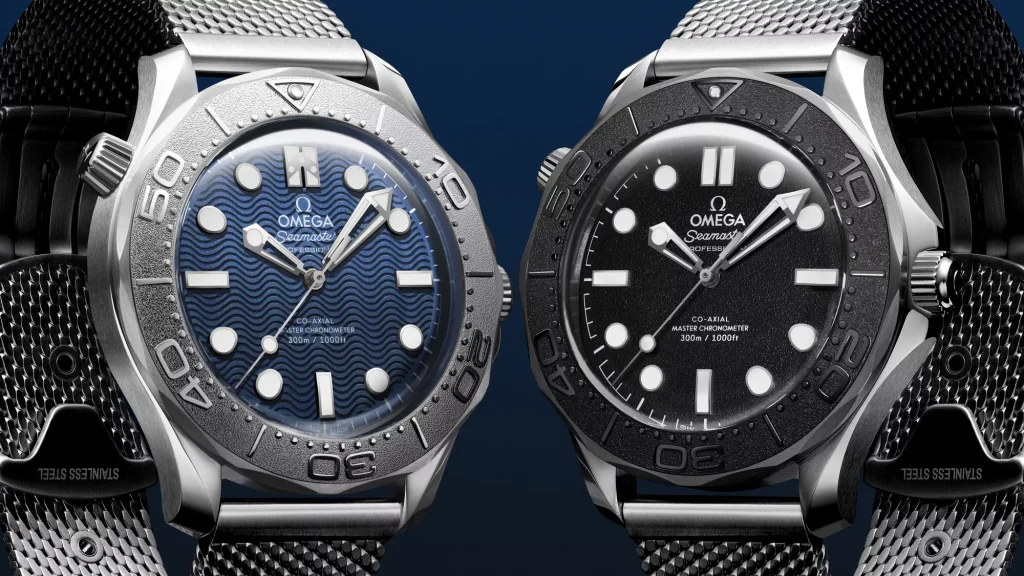
If you own an Omega Seamaster Diver 300M James Bond 007 edition, the brand just gave the model line its biggest moment in years. On October 5, 2026, which Omega marked as Global James Bond Day, the company unveiled a new six-watch Seamaster Diver 300M collection that combines James Bond and Spectre identities for the first time in its 30-year 007 partnership. For anyone who already owns a 007-branded Seamaster, or is weighing whether to sell one or use it as collateral, the announcement raises a practical question: does a new Bond watch actually change what your watch is worth?
What Omega Announced on October 5, 2026
The new collection is built around six 42mm Seamaster Diver 300M watches, all running Omega’s Calibre 8806 movement. Two of them are non-limited stainless-steel models, one carrying James Bond branding and one carrying Spectre branding, and both are priced at $8,600 before tax, available individually through Omega boutiques and online. The other four watches form two 77-piece limited-edition sets, each pairing a steel watch with a platinum-gold companion piece, priced at roughly $89,800 per set.
This is also notable for what it isn’t: Omega hadn’t released a Spectre-branded watch since the Seamaster 300 Spectre Limited Edition in 2015, and this is the first time Bond and Spectre identities have shared a single collection. For a brand that has built an entire sub-category of collector interest around its 007 partnership, pairing the hero and the villain in one release is a deliberate way to generate attention across both sides of that fan base.
Does This Change What Your Current 007 Seamaster Is Worth?
It’s tempting to assume that any new James Bond Omega release automatically lifts every older 007 Seamaster in circulation. It doesn’t work quite that way. A current Seamaster Diver 300M “007 Edition” in titanium (reference 210.90.42.20.01.001) lists for $11,300 new, with a NATO-strap version at $10,000, and the earlier James Bond 60th Anniversary Seamaster carries a retail price around $9,400. These are the new-watch numbers Omega and its authorized dealers quote today, and they haven’t moved because of the October announcement.
What matters more for resale or collateral purposes is the secondary market, and that’s where the picture gets more specific. Market-tracking data shows the full Seamaster line carrying an average value retention of about -33.7% against original retail as of October 2026, meaning a typical Seamaster trades for roughly two-thirds of what it cost new. For the James Bond 60th Anniversary reference specifically, that same data shows a $9,400 retail price against a $7,109 pre-owned market price. A new Bond-themed release can generate media coverage and renewed collector interest, but it doesn’t rewrite those underlying numbers for a reference that was already established on the secondary market. If you’re trying to understand what your own watch is worth, the reference number and its condition matter far more than whether Omega put out a new Bond watch last month.
Limited Sets vs Standard Editions: Why the Difference Matters
Not every piece in the new collection behaves the same way on the resale or collateral side, and that distinction is worth understanding before you assume a limited edition automatically holds value better than a standard one. The two 77-piece sets are sold exclusively as complete pairs: the platinum-gold watch in each set is never offered on its own. That’s an important detail if you ever consider using a Bond-themed set as collateral or selling it down the road. If a set like this is split up, the remaining single piece becomes an incomplete set rather than a true limited edition, which can affect how a lender or buyer values it compared to the full pair as Omega originally sold it.
This is a useful lesson for anyone holding an older Bond-themed limited edition too. A reference number alone doesn’t tell the whole story. What was originally sold as a set, a numbered edition, or a solo piece changes how it should be evaluated, and a model/reference-specific valuation is the only way to get that right rather than relying on a general sense that “it’s a Bond watch, so it’s worth more.”
Service History and Loan Value
Omega’s own guidance recommends a complete service every 5 to 8 years, along with a water-resistance check once a year, and any service performed at an authorized Omega service center comes with a 24-month warranty. That service window is a range, not a fixed date, because actual wear and water exposure vary. A Seamaster that’s regularly worn in and around water, which is the whole point of a dive watch, may need gasket or water-resistance checks sooner than the long end of that window implies.
Service history matters because it’s one of the first things a lender or buyer checks when evaluating a dive watch. A documented service record supports a stronger valuation; a watch with unknown service history, or one overdue for a water-resistance check, typically gets priced more conservatively, independent of how recently Omega released a new Bond edition.
A Worked Example: Turning a 007 Seamaster Into Cash
To see how these numbers translate into an actual loan offer, consider an illustrative example using a published reference’s current market price. If a James Bond 60th Anniversary Seamaster is valued around its tracked market price of $7,109, a representative 50% advance rate against that figure would produce a loan amount of about $3,554.50. That’s not Diamond Banc’s published rate, just a simple illustration of how a retail-versus-market price gap on a specific reference turns into a collateral value. The actual number on your own watch depends on its reference, condition, documentation, and service history, which is why a model/reference-specific valuation from a specialist who tracks current secondary-market pricing matters more than a general sense of what “a Bond Omega” is worth.
Selling or Using Your Seamaster as Collateral
If you’re deciding what to do with a Seamaster Diver 300M James Bond edition you already own, you have two practical paths. You can sell it outright, or you can use it as collateral through a watch-secured loan and keep ownership while getting access to cash. Diamond Banc’s team works with Omega watches directly, applying current secondary-market pricing rather than treating every Seamaster as interchangeable. If keeping the watch matters to you, a loan secured by the watch itself lets you access a portion of its value without giving it up.
Owners who also have Rolex pieces in their collection, or who are weighing which brand tends to hold value better for their situation, may find it useful to compare the two head-to-head before deciding whether to sell a Rolex or an Omega. Either way, working with specialists who evaluate Rolex and Omega references daily, rather than a general pawn-shop approach, tends to produce a more accurate number than guessing based on a brand’s latest headline release.
Where to Go From Here
Omega’s October 2026 Bond and Spectre collection is a genuine milestone for the Seamaster line, but it’s a marketing and collector event first, not an automatic repricing of every 007-branded watch already in circulation. If you’re holding an older James Bond Seamaster and wondering what it’s actually worth today, the answer comes from the specific reference, its condition, its service history, and whether it was originally sold as a numbered set or an individual piece, not from the existence of a new release. For a closer look at how Omega pricing compares across models and cities, see this breakdown of where to sell Omega, Cartier, and Rolex watches. And if it’s time to turn your watch into cash, whether through an outright sale or a loan that lets you keep it, Diamond Banc’s team can walk you through a transparent, reference-specific valuation before you decide anything.
Like what you’re reading?
Add us in Google — more like this is on the wayRelated Posts
 Instagram
 Facebook
 Tiktok
 YouTube