Is Rolex or Omega the Better Watch Investment? Here’s the Data
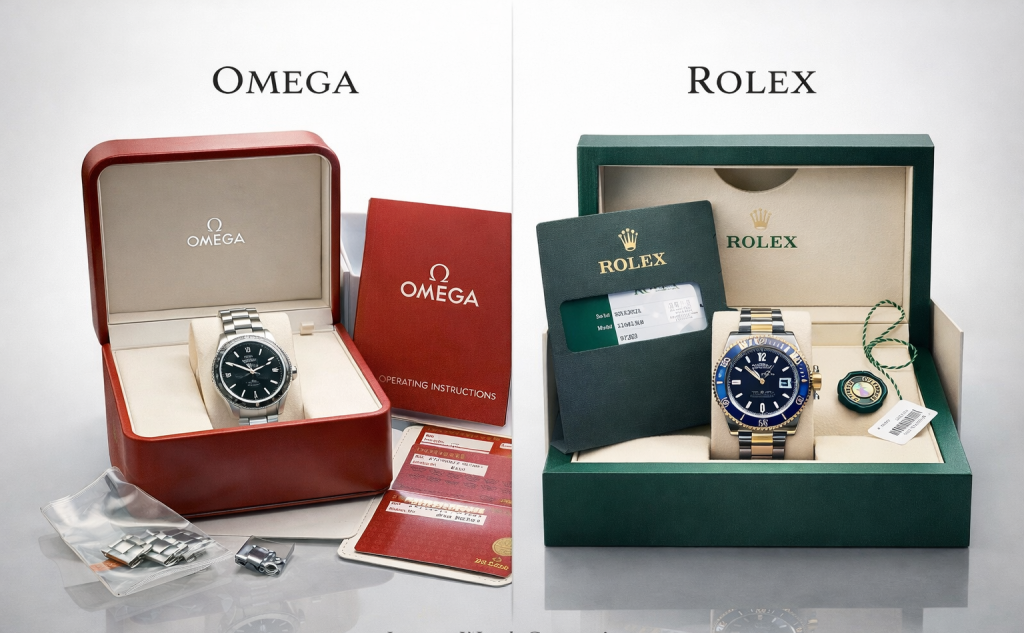
Rolex consistently outperforms Omega in resale value and investment potential. Popular Rolex sport models often trade at or above retail, while Omega watches typically depreciate 20-40% from retail on the secondary market. Both brands offer quality craftsmanship, but collectors focused on long-term value should understand these market dynamics before purchasing.
Luxury watches can serve as both functional timepieces and financial assets. For collectors evaluating Rolex vs. Omega as an investment, the decision extends beyond aesthetics and brand preference. Market data reveals significant differences in how these two Swiss brands perform on the secondary market, and understanding these patterns can help you make a more informed purchase.
At Diamond Banc, we evaluate and purchase luxury watches daily. Our experts track real-world resale values and provide competitive offers on both Rolex and Omega timepieces. This article shares what we’ve learned from years of market experience.
Recent auction results only reinforce this gap — see our breakdown of what today’s record-setting watch auctions could mean for your collection’s value.
Does Rolex or Omega Hold Value Better?
Rolex watches hold their value significantly better than Omega on the secondary market. Rolex sport models like the Submariner, Daytona, and GMT-Master II frequently sell at or above their original retail prices, while Omega watches typically trade below retail. This difference stems from Rolex’s controlled supply, stronger brand recognition, and higher collector demand.
| Factor | Rolex | Omega |
| Average secondary market performance | At or above retail (sport models) | 38% below retail (in-production models) |
| Brand recognition | 100% international recognition | ~70% international recognition |
| Production strategy | Limited supply, long waitlists | Higher volume, broader availability |
| Collector demand | Extremely high, scarcity-driven | Moderate, value-focused buyers |
According to WatchCharts data from 2025, in-production Omega watches trade approximately 38% below their retail price on average. The Omega Speedmaster Professional Moonwatch, one of Omega’s most popular models, trades around 32% below its $9,000 retail price.
By comparison, popular Rolex steel sport models often carry premiums on the secondary market due to long authorized dealer waitlists.
How Much Do Omega Watches Depreciate?
Omega watches generally depreciate 20-40% from the retail price when sold on the secondary market. Popular models like the Speedmaster Moonwatch Professional and Seamaster Diver 300M tend to lose 20-30% from retail, while less sought-after collections can depreciate more significantly.
| Omega Collection | Typical Depreciation from Retail |
| Speedmaster Moonwatch Professional | 20-32% |
| Seamaster Diver 300M | 25-40% (retains 60-75% of value) |
| Aqua Terra | 30-40% |
| De Ville | 30-40% |
| Constellation | 30-40% |
| Limited editions / vintage | Varies; some appreciate |
Buying pre-owned is often the smarter financial move for Omega collectors. Since new watches experience the steepest depreciation immediately after purchase, entering the market at pre-owned prices allows buyers to avoid that initial loss.
Why Does Rolex Retain Value Better Than Omega?
Rolex’s superior value retention comes from three primary factors: controlled production, brand prestige, and consistent collector demand. The company produces fewer watches than market demand requires, creating waitlists at authorized dealers that can stretch for years on popular models.
Key factors driving Rolex’s value retention:
- Controlled production: Rolex limits supply, creating scarcity that supports secondary market premiums
- Brand recognition: 100% international recognition vs. Omega’s ~70%, translating directly into pricing power
- Design consistency: Submariner, Datejust, and Daytona have remained visually recognizable for decades
- Collector focus: Fewer model variations concentrate demand on core references
- Cultural status: Rolex is widely perceived as a financial asset, not just a timepiece
Omega frequently introduces new variations and sub-models, which can dilute collector focus. As of late 2024, Omega offered over 20 different versions of the Speedmaster Professional Moonwatch alone.
Wondering what your luxury watch is worth? Get a free Rolex or Omega quote from Diamond Banc’s expert team.
Which Rolex Models Are the Best Investments?
Professional sport models represent Rolex’s strongest investment performers. The Submariner, GMT-Master II, and Cosmograph Daytona consistently trade at or above retail prices due to limited availability and sustained collector demand.
| Model | Investment Strength | Why It Performs |
| Submariner | Excellent | Benchmark dive watch; timeless design; both date and no-date variants hold value |
| Cosmograph Daytona | Excellent | Most sought-after chronograph; steel versions carry substantial premiums; multi-year waitlists |
| GMT-Master II | Excellent | “Pepsi” and “Batman” bezels highly desirable; discontinued references appreciate significantly |
| Datejust | Strong | Best-selling collection; steel holds value well; precious metal adds intrinsic value |
| Day-Date | Strong | “President” watch; only available in precious metals; strong brand prestige |
Discontinued references across all these collections tend to appreciate over time as supply decreases and collector interest grows. For a deeper dive into current Rolex market performance across the board, see our complete guide to whether Rolex watches are still a good investment.
Which Omega Models Hold Value Best?
The Omega Speedmaster Professional Moonwatch offers the strongest investment potential within the Omega catalog. Its connection to the 1969 Moon landing and continued NASA association give it historical significance that supports collector demand.
| Model | Value Retention | Notes |
| Speedmaster Professional Moonwatch | Best in class | Moon landing heritage; vintage references and limited editions command premiums |
| Speedmaster “Ed White” Reissue | Above average | Lemania 321 movement recreation; sometimes trades at or above retail |
| Seamaster Diver 300M | Above average | James Bond association; retains 60-75% of retail value |
| Snoopy Limited Editions | Variable | Scarcity-driven; can appreciate significantly if collector interest holds |
| Planet Ocean | Average | Solid diver but follows standard Omega depreciation |
Standard production models follow typical depreciation patterns. Limited editions and vintage references with historical significance offer the best opportunity for appreciation, but predicting which will perform well requires market knowledge.
Should You Buy Rolex or Omega for Investment?
The right choice depends on whether you prioritize investment performance or horological value at a more accessible price. Both brands produce excellent watches with strong heritage, but they serve different buyer priorities.
| Priority | Choose Rolex | Choose Omega |
| Resale value | ✓ Stronger value retention | Lower priority |
| Investment safety | ✓ Proven track record | Higher risk |
| Price accessibility | Premium pricing | ✓ More accessible entry points |
| Movement technology | Proven, serviceable calibers | ✓ Advanced Co-Axial, Master Chronometer |
| Availability | Waitlists on popular models | ✓ Readily available |
| Pre-owned strategy | May pay premiums | ✓ Significant savings vs. retail |
Choose Rolex if:
- Resale value is your primary concern
- You want a universally recognized luxury asset
- You’re willing to navigate waitlists or pay secondary market premiums
Choose Omega if:
- You prioritize value for money and advanced movement technology
- You plan to buy pre-owned to avoid initial depreciation
- You want a high-quality Swiss timepiece without scarcity-driven pricing
Diamond Banc can help you understand the current market value of any luxury watch. Whether you’re looking to sell your Rolex, access liquidity through a watch equity loan, or simply want to know what your Rolex is worth, our experts provide accurate valuations based on real market data.
Frequently Asked Questions
Certain Omega watches can appreciate, particularly vintage Speedmaster references, limited editions like the Snoopy models, and historically significant pieces. Standard production models typically depreciate, but buying pre-owned at market prices can preserve your investment if the model gains collector interest over time.
Rolex watches can be sold at any time, but holding through market fluctuations typically yields better results. Sport models often appreciate over 5-10 years, especially discontinued references. Diamond Banc evaluates watches based on current market conditions and can provide a quote regardless of when you purchased them.
For Rolex, steel sport models often outperform precious metal variants in percentage terms due to higher demand. Omega gold and platinum models retain intrinsic metal value but typically follow standard depreciation patterns. The specific model matters more than material alone.
Buying pre-owned eliminates the initial depreciation hit that new watches experience. For Omega, this strategy is particularly effective since new watches depreciate 20-40% immediately. Pre-owned Rolex sport models may carry premiums, but you avoid authorized dealer waitlists.
Original box, warranty card, purchase receipt, and service records can increase resale value by 15-20% compared to watches without provenance. Complete sets are more desirable to collectors and command higher offers from buyers like Diamond Banc.
 Instagram
 Facebook
 Tiktok
 YouTube