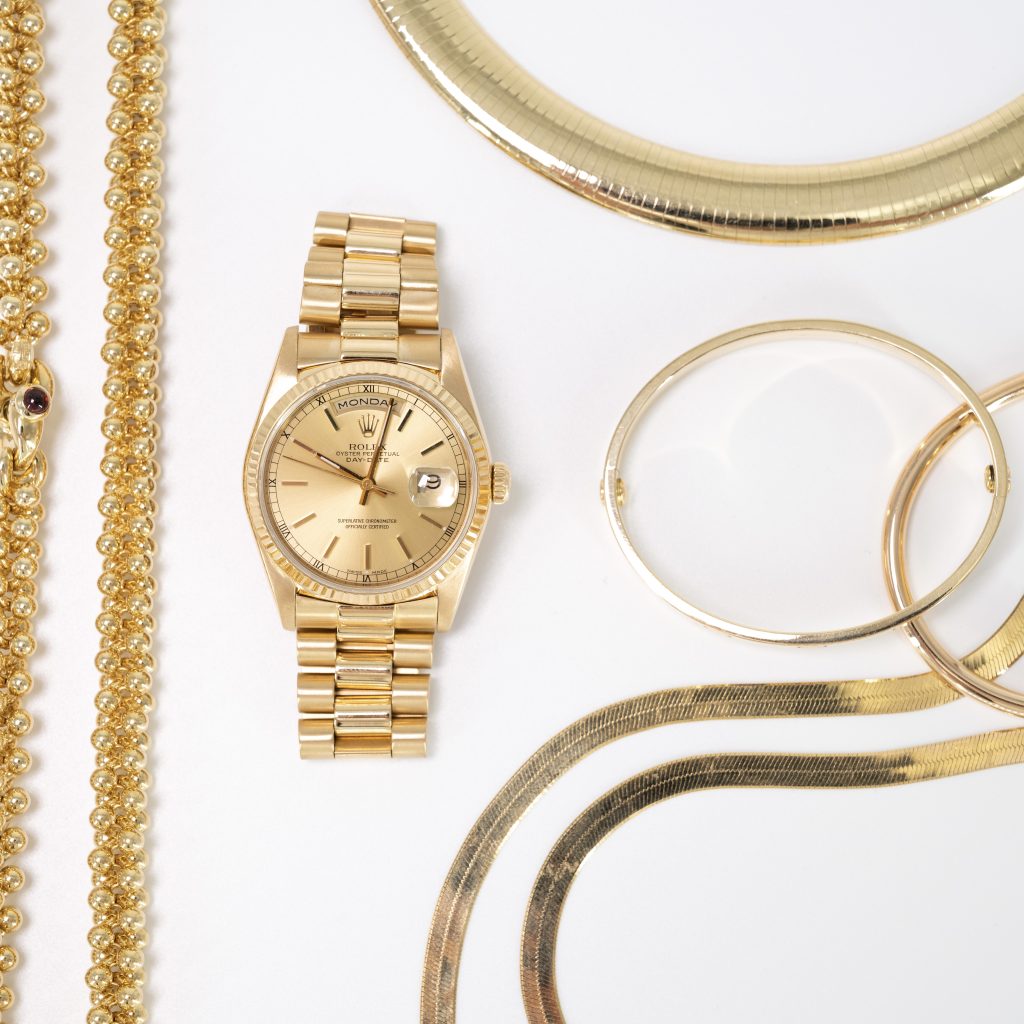
Gold is one of the few assets that holds recognized value almost anywhere in the world, which is exactly why it works so well as collateral or as something to sell outright. But not all gold is valued the same way, and understanding what you own is the first step to getting a fair result, whether you’re selling it or using it to secure a loan. Here’s what you need to know about gold before you make a decision.
Purity: Why Karat Matters More Than You Think
Gold in its pure form (24 karat) is soft, so most jewelry and many coins are alloyed with other metals like copper, silver, or zinc to add durability. The karat stamp on your piece tells you what percentage of it is actually gold:
- 24k: approximately 99.9% pure gold (see our guide to 24K gold jewelry value)
- 18k: approximately 75% gold
- 14k: approximately 58.3% gold
- 10k: approximately 41.7% gold
Look for a small stamp, often near the clasp on a necklace or inside a ring band, reading “24K,” “18K,” “14K,” “10K,” or a numeric equivalent like “750” (18k) or “585” (14k). If you can’t find a stamp, or the piece is old enough that the marking has worn away, that’s a normal reason to have it professionally tested rather than guessed at. Acid testing and electronic testing are both standard, non-damaging ways to confirm purity.
Those stamps are regulated, too. Under federal law, a karat marking must be accurate to within three parts per thousand, or seven parts per thousand if the piece contains solder, as noted in the FTC’s Jewelry Guides. The same guides define gold-filled and gold-plated items, which is why markings like “GF,” “1/20 14K GF,” or “GP” matter so much. A gold-filled piece must carry a layer of at least 10 karat gold equal to at least 1/20th of the item’s total metal weight, and an item marked gold plated needs a coating only 0.175 microns thick. Either way, their melt value is a small fraction of a solid gold piece of the same size.
Weight: Grams, Pennyweights, and Troy Ounces
Gold is weighed differently than most household items. In the jewelry and precious metals trade, weight is typically expressed in grams or troy ounces, and sometimes in pennyweights (dwt) for jewelry specifically. One troy ounce equals 31.103 grams, or 20 pennyweights (one pennyweight is 1.555 grams), according to NIST Handbook 44. The everyday avoirdupois ounce is only 28.350 grams, so a troy ounce is roughly 10% heavier, and this distinction matters because gold’s market price is quoted per troy ounce. If you’re trying to estimate what a piece might be worth, you need an accurate weight in the correct unit before purity and market price can be applied to it.
Current Market Value: The Number That Changes Daily
The price of gold moves throughout each trading day based on global markets. That means the value of your gold today may not be the same as it was last week or will be next month. In 2026 alone, gold reached an all-time intraday high of $5,595.47 per troy ounce on January 29, was down roughly 7% for the year by late June according to the World Gold Council, and traded near $4,300 in late September (CNBC). For a recent example of how quickly it can move, see our coverage of gold’s 3.8% one-week jump to $4,520. The spot price, set twice each business day as the LBMA Gold Price, is a starting point, but it only reflects pure, unrefined gold. The actual value of your specific piece factors in:
- Purity (karat) and confirmed weight
- Current secondary-market pricing at the time of the transaction
- Craftsmanship, brand, or collectibility, if applicable (a designer piece or notable maker can carry value beyond melt value)
- Condition, though for gold content specifically, this matters less than it does for gemstones or watches
To see how the math works, take a 10-gram 14k chain with gold at $4,300 per troy ounce. Multiply the weight by the purity (10 × 0.583 = 5.83 grams of pure gold), convert to troy ounces (5.83 ÷ 31.103 ≈ 0.1874), then multiply by the spot price (0.1874 × $4,300 ≈ $806). That figure is the chain’s melt value, meaning the value of its pure gold content. Offers on scrap gold are typically a percentage of melt value, since refining carries a cost, while a designer or collectible piece can be worth more than melt.
This is one of the most misunderstood parts of gold valuation: two pieces with identical purity and weight can still be worth different amounts if one has recognized designer or brand value on top of its gold content.
How to Assess Your Own Gold Before You Decide Anything
Before you sell a piece or use it as collateral, it helps to do a basic self-assessment:
- Find the karat stamp. Check clasps, bands, and the inside of rings or bracelets.
- Weigh it, if you have a reliable scale. A kitchen or postal scale that measures in grams is a reasonable starting point, though a jeweler’s scale is more precise.
- Separate gold from non-gold materials. Gemstones, pearls, and other embedded materials don’t factor into gold weight and are valued separately.
- Keep any papers, boxes, or purchase receipts. These don’t change the gold content, but they can support brand or provenance value if the piece is a designer item.
- Don’t rely on scrap gold calculators alone. Online tools can give you a rough melt-value estimate, but they don’t account for brand value, craftsmanship, or the actual condition of a piece, and a professional evaluation will always be more accurate.
Selling Gold vs. Using It as Collateral
Once you know roughly what you’re working with, the next decision is whether to sell the gold outright or use it as collateral for a loan. Selling makes sense if you no longer want the piece and want to convert it to cash permanently. A gold-backed loan makes sense if you want access to funds now but plan to keep and eventually reclaim the item. Diamond Banc offers both paths, with human luxury-asset specialists who provide a transparent valuation process rather than a quick guess, and the option to work through a local office or ship your item securely if there isn’t one near you.
This matters more with gold jewelry that has meaning attached to it, an heirloom piece, a designer item, or something tied to a milestone. A loan lets you access the value without giving up ownership, while a sale is final. Neither option is inherently better; it depends on what you need and how attached you are to the piece itself.
What Makes Gold Different From Other Valuables You Might Own
Unlike a luxury watch or a diamond, gold’s core value is tied to a measurable commodity: its purity and weight. That gives it a more predictable valuation floor than items where brand, rarity, or condition drive most of the price. If you also own other valuables, like a Rolex or fine diamonds, it’s worth understanding that those are assessed very differently, with model-specific and market-specific factors playing a much larger role. If gold is just one piece of what you’re considering selling or using as collateral, it can help to look at how each type of asset is evaluated on its own terms.
For more on what to know before you buy or sell gold specifically, see What to Know Before Buying Gold.
Getting a Reliable Answer
The only way to know what your gold is actually worth is to have it properly weighed and tested by someone who works with precious metals regularly. A local market director or specialist can confirm purity, weigh the piece accurately, and apply current market pricing to give you a real number, not an estimate. Whether you decide to sell it or use it to secure a loan, that clarity is what lets you make the decision with confidence instead of guesswork. For a deeper walkthrough, see our complete guide to selling gold jewelry, coins, and bullion.
Like what you’re reading?
Add us in Google — more like this is on the wayRelated Posts


 Instagram
 Facebook
 Tiktok
 YouTube