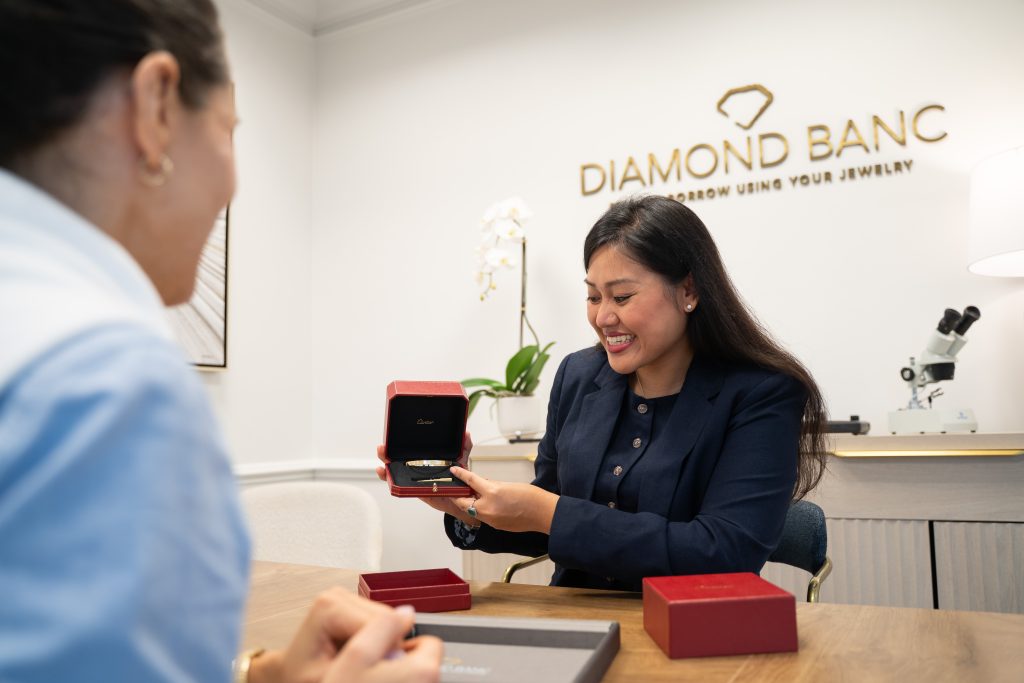
If you live in Del Mar, Rancho Santa Fe, or Carlsbad and you’re trying to decide what to do with a diamond ring that’s been in the family for decades, a drawer of gold jewelry you no longer wear, or a Rolex that’s spent more time in a safe than on a wrist, the nearest Diamond Banc office isn’t in your town. It’s a short drive away in La Jolla. That’s not a problem: these three North County communities are served by the same office, and the decision in front of you, sell outright, use the piece as collateral, or hold onto it a while longer, deserves the same careful answer whether you’re calling from a Rancho Santa Fe estate or a Carlsbad neighborhood near the coast.
No Office in Del Mar, Rancho Santa Fe, or Carlsbad, but Close by in La Jolla
Diamond Banc’s San Diego-area office sits at 4275 Executive Square, Suite 200, in La Jolla, reachable at (858) 391-4047. For Del Mar residents that’s a drive of roughly 15 minutes down the coast; from Rancho Santa Fe it’s a bit further inland and east; from Carlsbad it’s the longest trip of the three, but still well inside an hour each way on I-5. If a trip to La Jolla isn’t convenient, Diamond Banc also arranges secure mail-in shipping for Rolex watches and fine jewelry, so an item never has to leave your hands until it’s insured in transit and verified at the office. That matters for people juggling a commute from North County: you can get a model-specific valuation and a decision without rearranging your week.
What California Law Requires Before You Sell Jewelry or Gold
Every jewelry and gold buyer operating in California, whether in La Jolla, Del Mar, or anywhere else in the state, is a licensed secondhand dealer under state law, and that status comes with obligations that apply to you as the seller too. California requires that your identification be recorded at the time of sale and that the transaction be reported electronically to the state no later than the next business day, with that record kept on file for three years. That’s not a Diamond Banc policy, it’s state law, and it’s the same whether you sell a necklace in Rancho Santa Fe or a gold chain in Carlsbad. The practical effect is that a cash sale of jewelry or gold is never truly instant: there’s a brief, routine reporting window built into the process, and it creates a paper trail tied to your name. If privacy or speed matters more to you than converting an item to cash outright, that’s one of the reasons people in this part of San Diego County look at a fine jewelry loan instead of a sale, since using a piece as collateral follows a different process than a reportable purchase.
Is This a Good Time to Sell Gold Jewelry?
Gold has had an unusually volatile year. It touched an all-time intraday high near $5,590 an ounce in late January 2026, then pulled back to roughly the mid-$3,500s to mid-$3,600s per ounce by late November 2026, a drawdown of about a third from the peak. You can check the live gold spot price before making a decision, since it moves daily and any number printed here will be stale within hours. What that swing means practically: gold jewelry you inherited or stopped wearing is still worth meaningfully more today than it would have been a few years ago, even after the pullback from January’s record, but the gap between “today’s price” and “January’s price” is large enough that timing matters if you’re watching the market closely. For most people with a single piece or two, waiting for a specific number isn’t realistic; what matters more is getting an accurate read on your item’s actual gold content, which is the next question.
Solid Gold or Plated? How to Tell Before You Decide
Before you assume a piece is worth melt value, check the markings. Under federal rules on how jewelry can be marketed, an item can only be called “gold” without qualification if it’s at least 10 karat, or 41.7% gold by weight; anything below that can’t legally be sold as gold, full stop. Gold-filled pieces are different: they’re allowed to use terms like “gold filled” or “1/20 14K G.F.” only if the bonded gold layer is at least 1/20 of the total metal weight and at least 10 karat fineness itself. In practice, this means a stamp like “14K” or “GF” paired with a jeweler’s trademark tells you a lot, but an unmarked piece, or one where the stamp is worn smooth, tells you nothing reliable. Rancho Santa Fe and Del Mar estates often include older pieces from jewelers that no longer exist, with stamps too faded to read confidently. Rather than guessing, it’s worth having ambiguous pieces checked before you price them in your head as solid gold, since the difference between 14K and gold-filled can be the difference between a meaningful payout and a modest one. Diamond Banc’s team handles this kind of verification routinely when you sell gold in San Diego.

Serviced or Not: What a Rolex’s Maintenance History Means for Its Value
Rolex itself recommends servicing a watch roughly every 10 years, though the exact interval depends on the model and how the watch has actually been worn. A Rolex that’s well past that window can show reduced accuracy or compromised water resistance, and that condition shows up in how the piece is valued, whether you’re selling it or using it as collateral. A watch with documented recent service, or one that’s clearly running well and keeping water resistance, is simply a stronger asset than one that’s sat untouched for 15 or 20 years. If the watch is newer, the paperwork matters just as much as the mechanics: a new Rolex bought from an authorized jeweler carries a five-year international guarantee, but that guarantee is only valid if the original guarantee card was completed at purchase and travels with the watch. If you still have that card, bring it. If you don’t, it doesn’t disqualify the watch, but it’s one more reason a model-specific, in-person look matters more than a quick online estimate. Whether the plan is to sell a Rolex or keep it and use it as collateral through a Rolex-secured loan, the service history is part of the conversation from the start.
Why Rancho Santa Fe Owners Often Choose a Loan Over an Outright Sale
Rancho Santa Fe’s real estate market is among the most expensive in San Diego County, and it’s common for a single household there to own more than one significant watch or several generations of fine jewelry rather than a single piece. That concentration of value changes the calculus. Selling outright converts an asset to cash permanently and triggers the reporting process described above. A collateral loan does something different: it lets you access funds against the appraised value of a Rolex, a diamond piece, or gold jewelry while you keep ownership and get the item back once the loan is repaid. For someone who’s asset-rich but doesn’t want to liquidate a watch or a family piece just to cover a short-term need, that structure is often the more sensible one. It’s also why people compare a sale against a loan in the first place rather than assuming a sale is automatically the better outcome; the right answer depends on whether you want the item back and how urgently you need funds. Diamond Banc’s local market directors walk through both paths side by side, with the same model-specific valuation underlying either decision, so you’re comparing real numbers rather than guessing.
Getting Started From Del Mar, Rancho Santa Fe, or Carlsbad
None of these three towns has to feel like it’s being served from a distance. The La Jolla office handles walk-ins from all over North County, and mail-in shipping covers anyone who’d rather not make the drive at all. If you’re starting with jewelry rather than a watch, the same office handles both routes: you can sell jewelry in San Diego outright, or bring a piece in to discuss a loan instead. Either way, the valuation is the same conversation, with current secondary-market pricing and a human specialist rather than a generic online quote. Before you go further, it’s worth reading through how to think about whether selling makes sense at all for pieces with sentimental weight, a question covered in more depth in Diamond Banc’s piece on whether to sell diamonds, fine jewelry, and luxury watches, and for readers weighing a loan specifically, the overview on working with a fine jewelry lender walks through what to expect from that process. Whichever direction you’re leaning, bringing the piece in person, with any paperwork, service records, or guarantee cards you still have, gets you a faster and more accurate answer than trying to estimate its value from home.
Like what you’re reading?
Add us in Google — more like this is on the wayRelated Posts
 Instagram
 Facebook
 Tiktok
 YouTube