The Rolex Explorer I vs Explorer II question comes up more than almost any other in the Rolex catalog, because the two watches share a name, a steel case and an expedition story, then go in completely different directions. One is a 36 or 40mm time-only watch that most people would call the purest Rolex sports model. The other is a 42mm tool watch with a date, a fixed 24-hour bezel and a bright orange hand that can follow a second time zone. If you already own one of them, knowing exactly how they differ also tells you a lot about how a buyer will look at your watch.
Rolex Explorer I vs Explorer II at a Glance
| Explorer (often called Explorer I) | Explorer II | |
|---|---|---|
| Current references | 124270 (36mm steel), 124273 (36mm yellow Rolesor), 224270 (40mm steel) | 226570 (42mm steel) |
| Introduced | 1953 | 1971 |
| What it shows | Hours, minutes, seconds | Hours, minutes, seconds, date, 24-hour hand |
| Bezel | Smooth, polished | Fixed steel bezel engraved with 24 hours |
| Dial | Black, with 3, 6 and 9 numerals | Black or white (“Polar”) |
| Movement | Calibre 3230 | Calibre 3285 |
| Power reserve | About 70 hours | About 70 hours |
| Water resistance | 100 metres | 100 metres |
| US list price (2026) | $7,900 (124270), $8,350 (224270), $14,600 (124273) | $10,600, either dial |
Rolex itself never calls the watch “Explorer I”; on Rolex’s US site it is simply the Explorer. Collectors added the “I” once the Explorer II existed, and both names point to the same line. The list prices above are Rolex’s published US prices as of October 2026.
Two Watches Built for Two Different Problems
The Explorer dates to 1953, the year of the first confirmed ascent of Everest, and Rolex built it around the idea of a watch that stays legible and running in cold, altitude and rough handling. Its whole design follows from that. A black dial, large luminous 3, 6 and 9 numerals, and nothing else to read. No date, no rotating bezel, no second time zone. The appeal of the Explorer has always been that it does one job with nothing in the way.
The Explorer II arrived in 1971 with a narrower brief. It was aimed at cave explorers and polar researchers, people who can go days without seeing the sun and lose track of whether it is 3 a.m. or 3 p.m. The answer was a 24-hour hand read against a fixed 24-hour bezel, so the wearer always knows whether it is day or night. The original reference 1655, nicknamed “Freccione” for its large orange arrow hand, was a slow seller at the time. From the 16550 of the mid-1980s onward, the 24-hour hand could also follow a second time zone, according to Monochrome Watches’ history of the Explorer II, which made it a practical travel watch as well.
That is the core difference: the Explorer is the simplest watch Rolex makes in the sports range, and the Explorer II is a working instrument with more on the dial. Neither is an upgrade of the other.
Case Size and How Each One Wears
Size is where most people decide. The Explorer has moved around more than any other Rolex sports model. It was 36mm for decades, grew to 39mm with the 214270 in 2010, then went back to 36mm with the 124270 in 2021. In 2023 Rolex added the 40mm 224270, so for the first time the Explorer comes in two sizes at once.
The Explorer II has only gone one way. The 1655 measured 39mm, the 16550 and 16570 measured 40mm, and the 216570 of 2011 jumped to 42mm, where the current 226570 stays. Because the Explorer II carries a wide engraved bezel, its dial looks smaller than the case number suggests, but it still wears like a substantial tool watch.
- Smaller or dress-leaning wrist: the 36mm 124270 is the classic proportion and the one most collectors think of first.
- Want the Explorer look with more presence: the 40mm 224270 sits between the two.
- Want a sports watch that reads as one across the room: the 42mm 226570, especially in the white Polar dial.
Older references follow the same pattern. A 39mm 214270 Explorer and a 40mm 16570 Explorer II are close in diameter but still look like very different watches because of the bezel and dial.
Dial, Bezel and Complications
Put the two side by side and the difference is obvious in seconds. The Explorer’s dial is black, with luminous 3, 6 and 9 Arabic numerals and baton markers. On the current references those numerals are filled with lume, a change that first appeared on the later “Mk2” 214270 dials around 2016. The two-tone 124273 keeps the same black dial with gold hands and markers.
The Explorer II adds three things the Explorer does not have:
- A date at 3 o’clock under a Cyclops magnifier.
- A 24-hour hand in orange, a nod to the 1655 that returned with the 216570 in 2011 after the thinner red hands of the 16550 and 16570.
- A fixed 24-hour bezel in brushed steel. It does not rotate, which is the main practical difference from a GMT-Master II: you read a second time zone from the hand, not by turning the bezel.
The Explorer II is also the only one of the two offered with a white dial. The “Polar” white dial has been part of the line since the 16550, and on the current 226570 it has recently sold above the black dial on the secondary market even though Rolex charges the same price for both.
Movements: Calibre 3230 vs Calibre 3285
Both current watches run on Rolex’s newest generation of movements, and on paper they perform the same. The Explorer’s calibre 3230 has a 70-hour power reserve and beats at 28,800 vibrations per hour; the Explorer II’s calibre 3285 offers the same roughly 70 hours and the same beat rate. Both carry Rolex’s Superlative Chronometer certification and are water resistant to 100 metres.
The difference is what the movement has to do. The 3230 is time-only. The 3285 is a GMT movement with a date, the same family Rolex uses in the GMT-Master II, so the Explorer II is a more complicated watch and slightly thicker as a result. Neither movement is a reason to choose one watch over the other. Pick on size, dial and whether you will use the 24-hour hand.
Service is similar for both. A routine overhaul is the same kind of job, though the Explorer II’s extra date and 24-hour functions add parts to check. Our guide to what a Rolex service costs covers intervals and typical pricing.
Explorer I vs Explorer II: Which Holds Value Better?
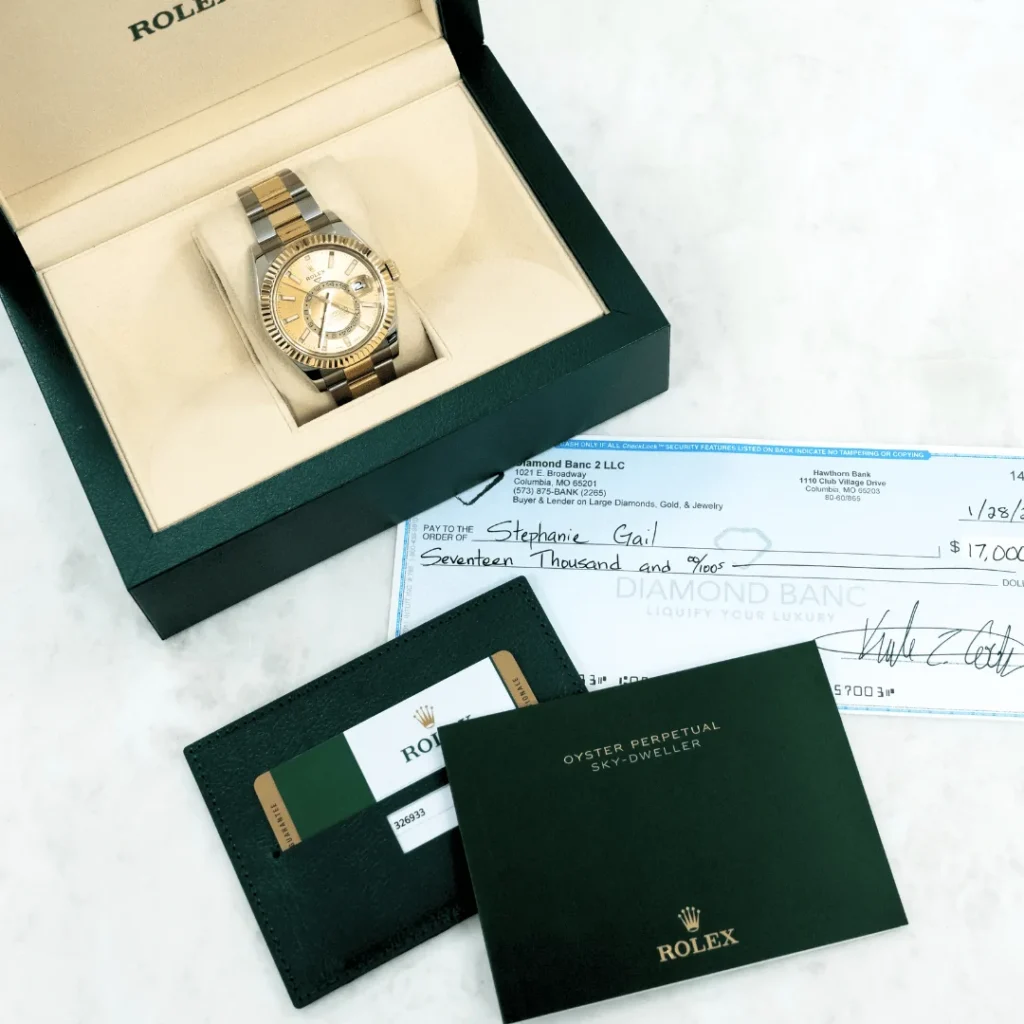
Both hold their value well, and the gap between them on the secondary market is roughly the gap in their list prices. Based on recorded dealer sales for August and September 2026, a 36mm 124270 Explorer mostly sold for about $8,200 to $9,700 against its $7,900 list price, and a 226570 Explorer II for about $10,600 to $11,800 in black and about $12,000 to $13,500 in Polar against its $10,600 list price. Those are retail-side sale prices, not buyer offers, and an offer to buy a watch is lower because it accounts for authentication, reconditioning and the time it takes to sell.
A few patterns are worth knowing if you own either one:
- The two-tone Explorer is the exception. The 124273 in yellow Rolesor has recently sold well below its $14,600 list price, unlike the steel models.
- The Polar dial leads on the current Explorer II, but the premium on the older 216570 has been inconsistent.
- Vintage is its own market. An original 1016 Explorer or 1655 Explorer II is valued on dial, originality and documentation, and the best examples sell far above any modern reference.
- Completeness matters on both. Box, papers, an unpolished case and a full bracelet move a watch within its range more than the model name does.
For the full reference-by-reference breakdown, including the 14270, 114270, 214270, 16570 and 216570, see our Rolex Explorer and Explorer II value guide.
Which One Is Right for You?
Strip away the history and the choice comes down to four questions.
- Do you need a date? If you check the date on your watch, only the Explorer II has one.
- Do you travel across time zones? The Explorer II’s 24-hour hand tracks home time while the main hands show local time. The Explorer cannot.
- What size do you actually wear? Under about 40mm, the Explorer is the natural fit. If you like a larger watch, the 42mm Explorer II or the 40mm Explorer.
- Do you want simple or distinctive? The Explorer disappears under a cuff and goes with everything. The Explorer II, with its orange hand and engraved bezel, is the one people notice.
Some collectors own both for exactly this reason: they do not overlap. The Explorer is the everyday watch, and the Explorer II is the travel and weekend watch.
How to Tell Which Explorer You Own
If you have inherited an Explorer or bought one years ago, the quickest check is the dial and bezel. A smooth bezel with no date means an Explorer; an engraved 24-hour bezel with a date and a fourth hand means an Explorer II. The exact reference number is engraved on the case between the lugs at 12 o’clock and is printed on the warranty card, and it is the reference, not the model name, that sets value.
Explorers are also among the most copied Rolex models. The shape and finish of the 3, 6 and 9 numerals and the correct style of 24-hour hand for each Explorer II reference are details a specialist checks first. Our guide on how to spot a fake Rolex covers the broader checklist.
Frequently Asked Questions
Is the Explorer II just a bigger Explorer?
No. It has a different movement, a date, a 24-hour hand and a fixed 24-hour bezel. The two share a name and an expedition heritage, but they are separate watches designed for different uses.
Is the Explorer II a GMT watch?
In practice, yes. Its 24-hour hand can show a second time zone. Unlike the GMT-Master II, its bezel is fixed, so it tracks two time zones rather than three.
Which is more expensive, the Explorer I or Explorer II?
The steel Explorer II lists at $10,600 in the US in 2026, against $7,900 for the 36mm Explorer and $8,350 for the 40mm. The two-tone 124273 Explorer is the most expensive at $14,600 but has recently sold well under that on the secondary market.
Should I get the 36mm or 40mm Explorer?
They are the same watch in two proportions, both on calibre 3230. The 36mm is the historic size; the 40mm wears closer to a modern sports watch. Try both on, because the difference is larger on the wrist than the numbers suggest.
Selling or Using Your Explorer as Collateral
Whichever Explorer you own, the reference, dial and condition decide what it is worth today, not the model line as a whole. Diamond Banc’s watch specialists identify the exact reference, check originality and condition, and make an offer based on current market data. Start on our Rolex Explorer selling page, or read our guide to the best place to sell a Rolex to compare your options first.
If you would rather keep the watch, you can use it as collateral for a Rolex-secured loan instead and get it back when the loan is repaid.
Like what you’re reading?
Add us in Google — more like this is on the wayRelated Posts
 Instagram
 Facebook
 Tiktok
 YouTube