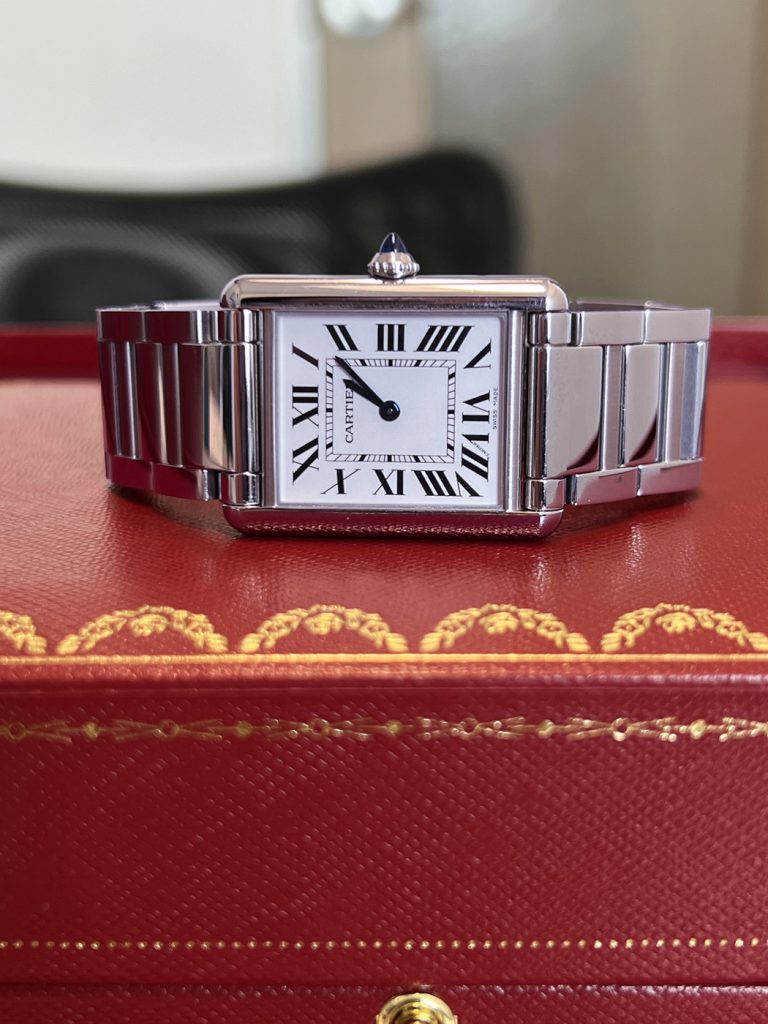
On October 16, 2026, Meghan Markle was photographed wearing Princess Diana’s gold Cartier Tank watch alongside Prince Harry at a charity engagement in Nottingham, their first joint official appearance since the couple returned to the UK this summer. The photos moved quickly through fashion and royal-watcher coverage, and they raise a question that comes up any time a famous piece resurfaces in public: does having belonged to someone famous, Princess Diana included, actually change what a Cartier watch is worth? The honest answer is yes, but only under specific conditions, and the Meghan Markle Cartier Diana story is a useful case study in exactly which conditions matter.
What happened in Nottingham, and why it’s not a new watch
The watch itself isn’t new to Meghan’s wardrobe. It’s Diana’s gold Cartier Tank Française, a piece she’s been photographed wearing publicly since it first appeared on her in a Time 100 portrait published in October 2020. What made the Nottingham appearance notable wasn’t the watch, it was the occasion: the first public outing with Harry since the couple’s return to the UK, which is why outlets covering royal fashion flagged it again. Resurfacing at a high-visibility event is often what triggers a fresh wave of interest, and demand, in similar pieces, even when the piece itself hasn’t changed hands or changed in condition.
Tank Française, not Tank Louis Cartier: the ownership chain
It’s worth being precise about which watch this is, because Cartier’s Tank line has several distinct models that get conflated in casual coverage. The Tank Louis Cartier has a solid, integrated curved case and no visible lugs; the Tank Française has a more angular case with a steel or gold bracelet built from articulated links that flow directly into the case. Diana’s watch, and the one Meghan wears, is the gold Tank Française.
The ownership history is not a simple gift from mother to daughter-in-law. According to reporting on the family’s division of Diana’s belongings after her death, Prince William originally chose his mother’s gold Cartier Tank while Harry took her sapphire engagement ring (the ring that later became Meghan’s own). The brothers swapped in 2010, as William prepared to propose to Kate Middleton, and Harry ended up with the watch, which he later gave to Meghan. Diana herself had worn the gold Tank Française publicly for weeks in 1996 after finalizing her divorce, including during a visit to the White House, so the piece carries documented history stretching back three decades before it reached Meghan.
There is also a second, unrelated Cartier Tank Française in Meghan’s life worth separating from the heirloom: she bought her own Tank Française years before meeting Harry, telling Hello! in 2015 that she purchased it to mark her own career success. That watch has no royal provenance at all; it’s simply the same model, bought at retail, by someone who later became famous. The distinction matters because it shows how quickly “a Cartier Tank Meghan Markle owns” can mean two very different things in terms of documented history and, eventually, value.
What a Cartier Tank Française costs new today
For context on where a modern Tank Française sits in Cartier’s current lineup, a new small steel Tank Française with a quartz movement retails for $4,450, while the medium steel model with an integrated bracelet runs $5,700, as of October 2026. Those prices reflect a broader move: Cartier raised U.S. watch prices across the board on May 21, 2026, with most models increasing between 2.5% and 7%, and precious-metal pieces seeing the largest dollar increases. A gold Tank Française like Diana’s, bought new today, would sit meaningfully above the steel pricing just described, since gold models absorbed the steeper end of that increase.
That baseline retail price is the floor, not the ceiling. It’s what an unremarkable Tank Française costs with no history attached. The Meghan Markle Cartier Diana watch, and pieces like it, show how far above that floor documented history can push a value.
Does celebrity provenance actually add value? The Jackie Kennedy precedent
The clearest publicly documented example of what provenance does to a Cartier Tank’s price isn’t Diana’s watch; it’s Jacqueline Kennedy Onassis’s. In 2017, a 1962 Cartier Tank Ordinaire with no notable history was, on its own merits in the vintage watch market, worth under $3,000 according to Christie’s International Head of Watches. Once that same watch was proven to be Jackie Kennedy’s personal Cartier, inscribed and documented, Christie’s set a pre-sale estimate of $60,000 to $120,000, purely on the strength of verified celebrity ownership.
The watch sold for far more than even that estimate. It realized $379,500 at Christie’s after just three minutes of bidding, with Kim Kardashian placing the winning bid. Set against the under-$3,000 baseline value of an equivalent watch without that history, the final price represents roughly a 126-fold increase, moving from under $3,000 to $379,500 purely on the strength of documented provenance. That’s an extreme case, but it’s a real, auditable data point, not a hypothetical, and it’s the clearest public benchmark for how far verified ownership can move a Cartier Tank’s value.
Documented provenance versus family story: what actually counts
Here’s the distinction that matters most, and it’s the one casual coverage of the Meghan Markle Cartier Diana story tends to skip: family provenance and documented provenance are not the same thing. Diana’s Tank Française has an extraordinary advantage most heirloom pieces lack: decades of photographic record showing exactly who wore it, when, and at what public moments, plus a traceable chain of custody from Diana to William to Harry to Meghan. That’s closer to what auction houses mean by “documented provenance” than a family simply saying “this belonged to my grandmother.” The Jackie Kennedy Tank’s value jumped specifically because her ownership was provable with inscriptions and records, not asserted after the fact.
If you own a vintage Cartier piece with a family story attached, the practical lesson is this: anecdotal provenance (a relative’s word, an undated photo) adds little on its own. Provenance that can be verified, through inscriptions, dated receipts, insurance appraisals from the time of ownership, or a documented photographic record, is what a lender or auction house can actually underwrite. It’s worth gathering whatever paperwork exists before you ever have the piece appraised.
Condition and service history matter too, separately from provenance. A Cartier watch’s standard warranty covers manufacturing defects for two years, extendable to as long as eight years through free Cartier Care registration, but that coverage applies only to watches serviced through a Cartier Boutique or authorized service center. A vintage Tank that’s had parts replaced or repairs done outside that authorized network, even if it runs perfectly, is typically appraised lower than an equivalent piece with original components and a documented service record. Cartier also recommends a full movement check every six years and new water-resistance seals every two years under normal wear, and a piece that’s been kept current on that schedule, with records to show it, will generally appraise better than one with an unknown or gapped service history.
What this means if you own a vintage Cartier
Few owners have a piece with Diana-level documentation, and that’s fine: most of what a lender or buyer needs is far more modest than a royal paper trail. What actually moves a valuation for a vintage or pre-owned Cartier Tank is model-specific, not just “it’s a Cartier”: the exact reference, the case metal, original versus replaced parts, and whatever ownership or service documentation you can produce. A Cartier Tank’s value varies significantly by reference and condition, which is why a generic online estimate rarely matches what a specialist appraisal returns.
If you’re holding a Cartier piece and weighing your options, whether to sell it outright or use it as collateral for short-term funding, that valuation work is the first step either way. Diamond Banc appraises Cartier watches model-by-model against current secondary-market pricing, with local market directors and luxury-watch specialists rather than general pawn-shop staff, through physical offices or secure nationwide mail-in service. You can get a transparent valuation and sell a Cartier watch for immediate funds, or, if you’d rather keep the piece, use it as collateral for a watch-secured loan and get it back once the loan is repaid. Either route starts with the same question the Jackie Kennedy and Diana examples both point to: what, specifically, can you document about this piece, and what is it actually worth once that documentation is accounted for.
Common questions about provenance and value
Is Meghan’s Nottingham watch the real heirloom or the one she bought herself in 2015? Based on the Cartier Tank Française she’s worn publicly since 2020, including at this event, it’s the heirloom that passed from Diana to William to Harry, not her own earlier purchase.
Would a similar vintage Cartier Tank be worth more for a loan today because of this story? A resurfacing story like this one can increase interest and demand for comparable vintage Tank models generally, but a loan valuation still comes down to the individual piece: its reference, condition, originality of parts, and any documentation you can provide, not the news cycle around someone else’s watch.
Does a missing box or papers disqualify a vintage Cartier from a loan or sale? No, but original documentation, boxes, and service records all support a stronger valuation, the same way documented ownership supported the Jackie Kennedy Tank’s final price far more than an undocumented, otherwise identical watch would have.
If you want a clearer sense of what your own piece could be worth before deciding whether to sell it or structure a loan around a Cartier watch, a model-specific appraisal is the only way to move past a rough online estimate and get a number you can actually act on.
Like what you’re reading?
Add us in Google — more like this is on the wayRelated Posts

 Instagram
 Facebook
 Tiktok
 YouTube