For decades, Pasadena residents with gold to sell have made the same drive: down the Arroyo Seco Parkway, the first freeway in the Western United States, to the downtown Los Angeles Jewelry District. The district, bounded roughly by Hill Street, Broadway, and 5th and 8th Streets, is packed with wholesalers, refiners, and storefront buyers, and it can be a good place to compare offers. It can also be overwhelming if you walk in without a plan.
Whether you sell downtown, in Pasadena, or anywhere else, this checklist will help you know what your gold is worth and recognize a fair offer when you hear one.
Know the Spot Price Before You Leave Home
Every gold offer starts with the spot price, the market price for one troy ounce of pure gold. On October 26, 2026, spot gold was about $4,016 per ounce, roughly 2.9% below where it stood a year earlier. Prices move every trading day, so check spot the morning you plan to sell.
Do the Melt Math Yourself
You do not need a buyer to tell you what your gold contains. A troy ounce is 31.1 grams, and karat tells you the gold percentage. Using the late-October spot price, 10 grams of gold contains roughly:
- 10K (41.7% gold): about $540 in gold content
- 14K (58.5% gold): about $755 in gold content
- 18K (75% gold): about $968 in gold content
No buyer pays 100% of melt, because refining and handling cost money. But once you know the melt value, you can ask every buyer the same question: what percentage of melt are you paying? A buyer who will not answer clearly is telling you something.

Expect to Show ID, and Be Wary of Anyone Who Doesn’t Ask
California regulates secondhand dealers closely. Licensed buyers must record the seller’s identity and thumbprint and report qualifying jewelry purchases to the state’s CAPSS database no later than the next business day, according to the California Attorney General’s office. Coins, monetized bullion, and commercial-grade ingots are treated differently. Bring a valid government-issued ID, and think twice about any buyer who is happy to pay cash for jewelry without asking for one.
Questions to Ask Any Gold Buyer, Downtown or in Pasadena
- Will you weigh and test my gold in front of me?
- What spot price and what percentage of melt is your offer based on?
- Will you remove and price diamonds and gemstones separately, or are they included in the gold weight?
- Do you pay more than melt for signed pieces?
- Is the offer good if I take a day to think about it?
The Biggest Money Leak: Selling Designer Gold by Weight
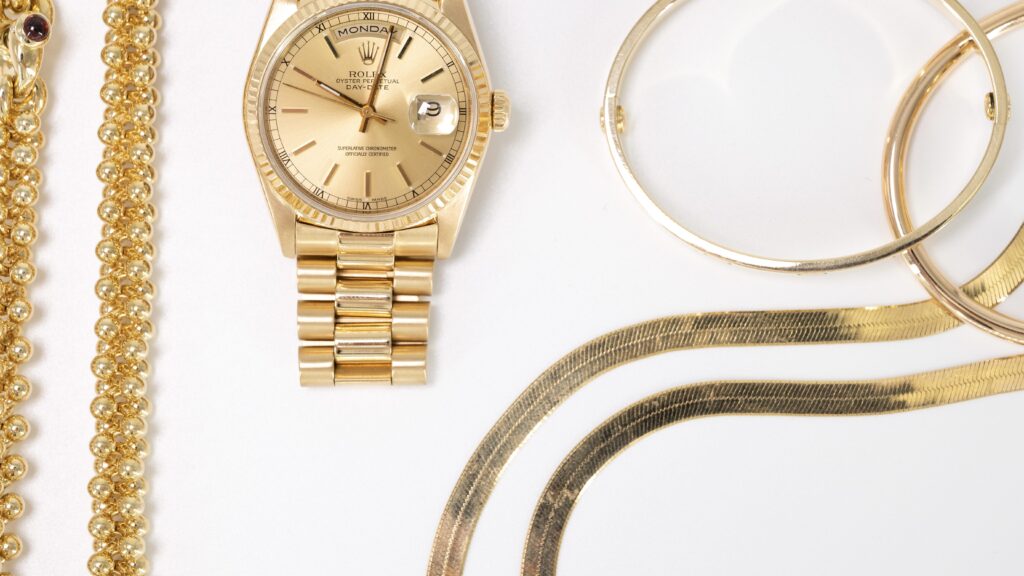
Many storefront gold buyers, downtown and elsewhere, run a high-volume melt business. That works for broken chains and single earrings. It does not work for a Cartier Love bracelet, a Van Cleef & Arpels Alhambra necklace, a David Yurman cable bracelet, or signed Italian gold, all of which can sell on the secondary market for well above their gold content. Before you put a signed piece on a scale, have it evaluated by someone who buys designer jewelry in Pasadena on its brand value. Stones deserve the same care: a diamond in an old ring should be graded and priced as a diamond, not melted down with the setting.
When the Drive Downtown Makes Sense, and When It Doesn’t
The Jewelry District’s advantage is density: you can collect several quotes in one afternoon. If you have a large amount of unsigned scrap gold and the time to shop it around, that can be worth the trip. If your gold includes signed pieces, diamonds, or a mix of items you are not sure about, it usually makes more sense to start with one private, itemized evaluation that separates melt value from brand and stone value, and then compare that number with anything you hear downtown.
Diamond Banc’s Pasadena office on Colorado Boulevard offers exactly that kind of evaluation for gold and silver, and you are welcome to get other quotes first. For a deeper look at how bullion, coins, and jewelry are priced differently, see our complete guide to selling gold jewelry.
Visit us at 680 E. Colorado Blvd., Suite 2023, call (626) 887-8741, or book a private appointment.
Like what you’re reading?
Add us in Google — more like this is on the wayRelated Posts
 Instagram
 Facebook
 Tiktok
 YouTube