Are you buying a new piece of diamond jewelry or selling a piece you no longer wear? A diamond lab report is an important document to help you understand the quality of your piece. This helps you get the best price when buying and selling a diamond. A diamond grading report not only provides you with a blueprint of your diamond’s properties and characteristics but also verifies the diamond’s authenticity.
There are many different diamond grading laboratories around the world, but not all laboratories are created equal. As a consumer, it is important to understand the differences between the labs. One institute may have different results from a report than another issued by a different lab on the same diamond. Diamond Banc of Kansas City can help educate a customer on exactly what kind of diamond jewelry you have.
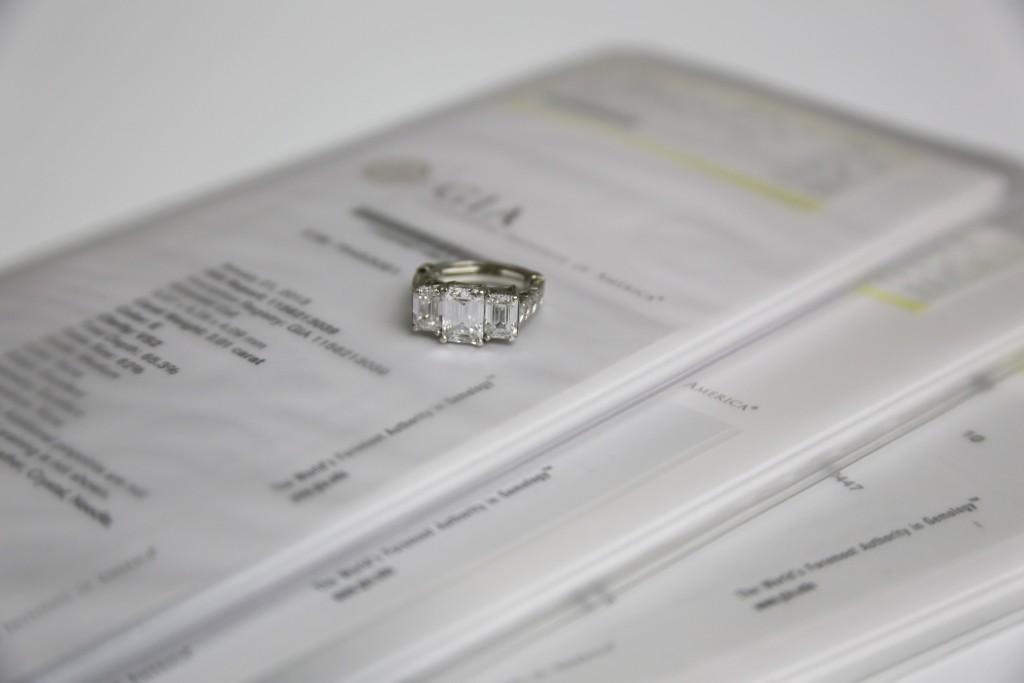
The Gemological Institute of America
The Gemological Institute of America (GIA) is the world’s undisputed authority on diamonds. And, they provide dealers and the public with lab reports. Headquartered in Carlsbad, CA, the GIA is a nonprofit. Therefore, it supplies consumers with unbiased, conservative, and consistent grading. So, this is why it is the most trusted and widely used service. Other diamond grading labs are for-profit and more liberal in their grading. This leads consumers to believe they have a rarer and more valuable diamond. When in reality, the consumer paid a higher price than warranted.
Let’s look at several examples.
GIA vs. IGI Diamond Lab Report
The International Gemological Institute is the second most well-known lab in the world. Based out of Antwerp, Belgium, the IGI has more lax grading standards than the GIA. Typically, clarity and color grades can be off by 1 or more ratings if the same diamond were to be graded by GIA standards.
Recently, a customer brought an engagement ring into Diamond Banc to sell. The ring had an IGI diamond lab report that stated the center diamond was a 0.93CT “G” color grade, “I1” clarity and “good cut” grade. Diamond Banc has jewelry experts who are actually certified diamond graders through GIA. After purchasing the ring from the customer, the center diamond was sent to GIA to be graded at their lab. The diamond came back 0.93CT “G” color grade, but “I2” clarity grade. The clarity grade was lower in the GIA lab report than in the IGI report, which makes a big difference in the value of the stone. And this, in turn, can make it harder to resell.
GIA vs. EGL Diamond Lab Report
The European Gemological Laboratory has a large global presence, with several offices in Europe. EGL is known within the industry as being very lenient, and most diamond dealers try not to use EGL. This is due to the color and clarity grades tend to be 2-3 grades higher than if the diamond were graded by GIA standards. Again, this leads the consumer to believe they have a better quality diamond. And in turn, the consumer usually overpays for that diamond.
Diamond Banc had a customer bring in a three-stone ring. The center stone was GIA certified, but the two side diamonds were EGL certified. Both side diamonds were graded 1.01CT “Fancy Intense Yellow” color and “VS2” clarity. However, Diamond Banc’s jewelry expert examined this ring and noticed more brownish hues in the side diamonds. After explaining the lab differences to the client, the client understood and knew that the value of the ring would be less than she originally thought. After Diamond Banc purchased the ring, the two side diamonds were sent to GIA to be certified. One diamond was “Fancy Deep Brownish Yellow” color and “VS1” clarity and the other diamond was “Fancy Deep Brownish Yellow” color and “SI1” clarity. So, this makes a big difference in the value of the diamond because Fancy Yellow diamonds are much rarer and more valuable than Fancy Brown diamonds.
Diamond Banc of Kansas City Will Help You Understand the Quality of Your Diamond
Customers who have a GIA diamond lab report on a diamond will ensure the seller and buyer are on the same page in regards to diamond quality. Also, Diamond Banc shows clients comparable GIA-graded diamonds on the wholesale market in order to determine the diamond’s true liquidation value. So, if you are interested in selling your diamond, start the online process with Diamond Banc today. Our diamond experts can explain the true value of your diamond and fund you the same day!
Like what you’re reading?
Add us in Google — more like this is on the wayRelated Posts

 Instagram
 Facebook
 Tiktok
 YouTube