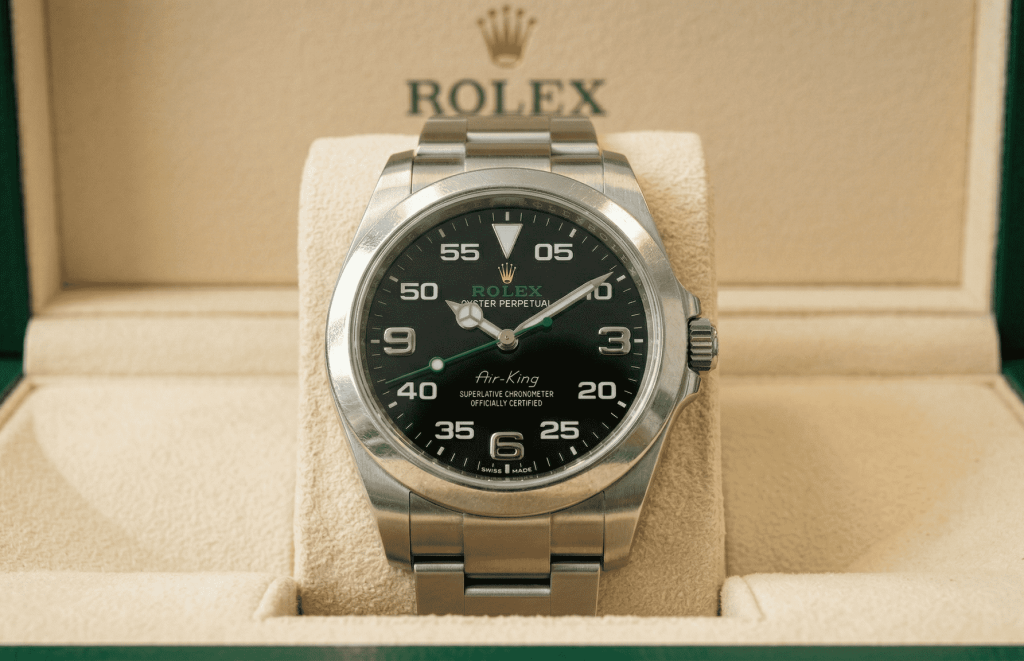
If you own a Rolex Air-King 126900, or you’re trying to figure out how it compares to the version that came before it, the short answer is that this is a different watch than it looks like at first glance. The case, the movement, and even the watch’s technical relationship to another Rolex model all changed when Rolex updated the Air-King. None of that happened by accident, and all of it matters if you’re trying to understand what the Rolex Air-King 126900 is actually worth today.
What Changed Between the Air-King 116900 and the Current 126900
The Air-King you can buy today is not a cosmetic refresh of the model Rolex sold from 2016 to 2022. The outgoing reference, the 116900, shared its 40mm case, its Caliber 3131 movement, and its soft-iron antimagnetic inner cage with one other watch in Rolex’s lineup: the Milgauss. That wasn’t a coincidence. According to a detailed history of the reference, the 116900 and the Milgauss of that era were, structurally, the same watch wearing different dials and bezels.
When Rolex discontinued the Milgauss in 2023, the Air-King didn’t just lose its platform-mate. Rolex redrew the case entirely. The current 126900’s case was reworked with sharper lines, wider lugs, a narrower bezel, and a full crown guard, a profile that now reads closer to the GMT-Master II than to anything Milgauss-related. Inside, the watch moved to Rolex’s current-generation Caliber 3230 with the Chronergy escapement, which brings the power reserve to roughly 70 hours, a meaningful jump from the 48 hours the old 3131 delivered. In practical terms, that’s the difference between needing to reset the watch after a weekend off the wrist and not.
So if you’re holding a 116900, you own a watch that was mechanically identical to a now-discontinued model. If you’re holding a 126900, you own a watch built on Rolex’s newest architecture, with its own case design and no remaining structural tie to the Milgauss.
The Milgauss Connection, and Why It No Longer Applies
This is the question that brings most people to this page: does the Milgauss going out of production affect the Air-King’s value the way it affected the Milgauss’s? The honest answer is no, and understanding why matters more than the answer itself.
The Milgauss became collectible after discontinuation because it stopped being made at all. No new supply, finite existing supply, rising demand: that’s the formula behind scarcity-driven appreciation. The Air-King is the opposite situation. It wasn’t discontinued, it was redesigned, and it remains in current production and in dealer allocation pools today. A current-production watch that Rolex is still manufacturing and distributing does not behave like a retired reference. If you bought a 126900 expecting it to follow the Milgauss’s price trajectory simply because the two models used to share a case, that expectation isn’t supported by how the two situations actually differ.
What the Milgauss did leave behind is a technical legacy. The antimagnetic protection that defined the Milgauss was never exclusive to it after 2016; the Air-King inherited the same soft-iron cage in the 116900 generation. The 126900 doesn’t market antimagnetic resistance as its headline feature the way the Milgauss did, but the watch still carries Rolex’s standard practical shielding from magnetic interference, an engineering trait more than a branding one at this point.
Air-King History: Why an Aviation Watch From 1945 Still Matters Today
The Air-King name is older than almost anything else in Rolex’s current catalog. Rolex founder Hans Wilsdorf introduced a family of aviation-themed watches in 1945 called the Air-King, Air-Lion, Air-Tiger, and Air-Giant, honoring Royal Air Force pilots in the years after the Second World War. Three of those four names disappeared decades ago. The Air-King is the only one still in production, which makes the current 126900 the longest continuously evolving nameplate tied to that original idea, even though the watch itself has been reengineered many times since 1945.
That history doesn’t add a premium to a current-production watch the way a vintage reference’s history might. What it does is explain why Rolex has kept investing in the model instead of folding it into another line: the Air-King occupies a specific identity (simple dial, legibility, aviation lineage) that none of Rolex’s other current references fully replicate. Rolex has made similar long-term bets on other names, which is part of why the brand periodically revisits older concepts in new case designs and movements rather than retiring them outright.
Retail Availability and Secondary-Market Pricing in Late 2026
Unlike the Milgauss, which now trades above retail purely because it’s no longer made, the Air-King 126900 is still an active model that authorized dealers sell new. That changes how you should read its secondary-market pricing. As of current retail listings, Rolex’s suggested price for the black-dial Oystersteel reference, model M126900-0001, is $8,150 before taxes.
The pre-owned market has pushed slightly past that figure. Market-tracking data showed the 126900’s pre-owned price running at roughly $8,308 as of October 13, 2026, with 6.7% price volatility and more than 1,500 recorded sales over the prior year. That’s a modest premium over retail, consistent with a watch that’s in demand but not artificially scarce the way a discontinued model becomes. If you check that tracker again next month, expect the number to have moved; it’s a live benchmark, not a fixed figure, which is exactly why it’s worth checking directly rather than relying on a number printed once and left unchanged.
What this means practically: a 126900 isn’t going to behave like a speculative asset. Its value is closely tied to what Rolex charges for it new, plus or minus normal market demand, rather than to a shrinking supply curve. That’s a more stable, more predictable position to be in if you’re deciding whether to sell your Air-King or hold it.
Warranty, Service, and What It Means for the Watch’s Value
Every new Rolex, including the 126900, comes with Rolex’s own five-year international guarantee against manufacturing defects, activated and stamped at the point of purchase by an authorized retailer. That guarantee travels with the watch, not just the original owner, provided the paperwork is intact and transferred properly.
Rolex doesn’t put its watches on a fixed service schedule. The company recommends service at roughly the ten-year mark, adjusted for how the watch is actually worn and used, rather than a date stamped at the factory. A completed service carries its own two-year warranty on the parts and labor involved, separate from and running independently of the original five-year guarantee.
Here’s where this connects directly to a decision many owners eventually face: if you’re considering a Rolex-secured loan against an Air-King, the condition of that paperwork matters. A watch with its original warranty card, box, and purchase documentation is easier to value accurately and typically supports a stronger loan offer than the same watch presented without them. This isn’t about insurance, and it isn’t about whether the watch is still “under warranty” in a way that affects whether it functions. It’s about documentation standing: a complete set of papers gives an appraiser confidence in the watch’s authenticity and history, which shows up directly in the number they’re willing to offer.
What This Means If You’re Deciding What to Do With Your Air-King
If you own a 116900, you’re holding a watch that was mechanically tied to a model Rolex no longer makes, but that tie doesn’t automatically translate into Milgauss-style appreciation, since the Air-King itself was never discontinued. If you own a 126900, you’re holding Rolex’s current answer to the Air-King name: a new case, a newer movement with a longer power reserve, and a market price that tracks close to retail rather than running away from it.
Either way, the practical questions are the same. What is the watch actually worth today, with its specific reference number and condition taken into account? And does it make more sense to sell it outright or use it as collateral while you keep it? A model-specific appraisal, not a generic one, is the only way to answer either question with real numbers. Diamond Banc’s specialists evaluate Rolex references individually, with current secondary-market data behind each valuation, whether you’re exploring selling a Rolex outright or looking into loans on Rolex watches that let you access funds without giving up the piece. Local offices, nationwide shipping for mail-in transactions, and a straightforward valuation process mean you don’t have to guess at what a redesigned case, a new movement, or a missing warranty card actually does to your watch’s number.
Like what you’re reading?
Add us in Google — more like this is on the wayRelated Posts
 Instagram
 Facebook
 Tiktok
 YouTube