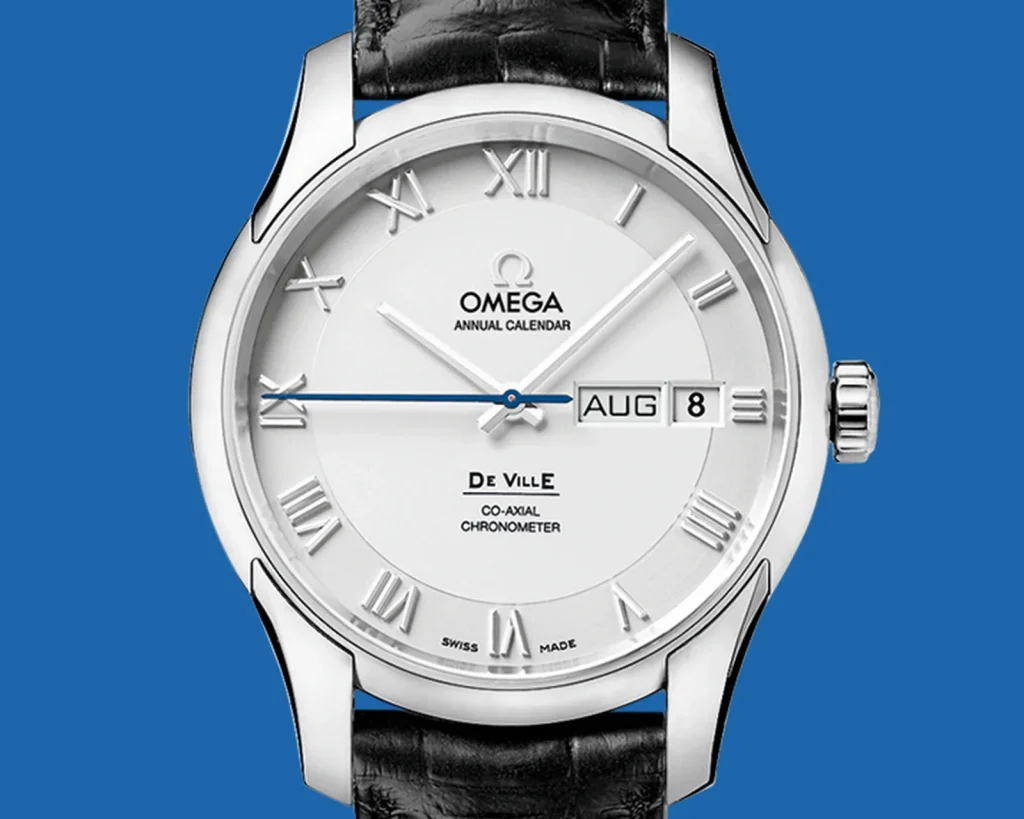
On October 13, 2026, watch enthusiasts noticed something unusual on Costco’s website: a members-only listing for the Omega De Ville Co-Axial Annual Calendar, reference 431.13.41.22.02.001, a watch Omega had already discontinued. The appearance of a discontinued Omega watch at Costco isn’t just a curiosity for bargain hunters. It’s a useful case study in what happens to a watch’s value, both on the resale market and as loan collateral, the moment a manufacturer stops making it.
Why This Omega Is Showing Up at Costco Instead of a Boutique
Omega boutiques and authorized dealers only sell what Omega is currently shipping. Once a reference is discontinued, any remaining retail stock has to move through other channels, including wholesale closeout buyers who resell to big-box retailers like Costco. That’s almost certainly what happened here: Costco is listing the watch online for members at $7,800, which is $2,000 below the model’s last known suggested retail price of $10,800. An authorized Omega retailer, Mayors still lists the same reference at the full $10,800, which confirms the retail price point this watch held before Omega stopped making it.
A $3,000 discount off the last authorized price is significant for a watch in this category, and it’s exactly the kind of gap that makes a discontinued piece worth a second look, whether you’re buying one, already own one, or are trying to figure out what yours is worth now.
Authenticity and Warranty: What You Actually Get
Because Costco is not an authorized Omega dealer, the watch does not come with Omega’s manufacturer warranty, though Costco backs the sale with its own satisfaction guarantee. That’s a real trade-off. A new Omega purchased through an authorized boutique typically carries a full manufacturer warranty, which is the baseline buyers expect and the reason the lack of one on a non-authorized sale matters. If you already own a discontinued Omega purchased this way, or any watch without an active manufacturer warranty, documentation becomes the thing that stands in for it: the original box, papers, purchase receipt, and any service records. Those documents matter just as much when you eventually decide to sell the watch or use it as collateral, because a lender or buyer has to verify authenticity and condition without a warranty card to lean on.
What “Discontinued” Actually Does to Value Over Time
Discontinuing a reference fixes the supply. No more of that exact watch will ever be produced, which is the basic mechanic behind scarcity. But scarcity alone doesn’t guarantee appreciation. Used examples of this same reference currently surface on collector forums priced between $4,000 and $6,000, well below both the Costco price and the old retail price. That’s a meaningful reality check: even a scarce, well-specified, discontinued watch can trade at roughly half its last retail price on the secondary market.
That pattern lines up with Omega’s broader market behavior. Across the brand, Omega’s overall value retention index sits at -30.3%, with an average secondary-market price around $4,000, as tracked in October 2026. In plain terms: most Omega watches lose roughly a third of their value after leaving retail, and the average used Omega trades well below four figures from where it started. A reference being discontinued doesn’t override that trend by itself. What tends to move the needle is a combination of scarcity, a genuinely desirable complication, and sustained collector interest, not discontinuation alone. Anyone assuming “discontinued equals automatically more valuable” is skipping a step.
The Annual Calendar Complication: Why It’s Worth Understanding
Part of what makes this particular Omega interesting is the complication itself. An annual calendar is a mechanical feature rarely found in watches priced below $10,000, sitting one step below a full perpetual calendar in complexity. A perpetual calendar accounts for leap years and never needs correcting; an annual calendar needs exactly one manual adjustment a year, at the end of February. The movement inside this reference, Omega’s in-house Caliber 8601, is a COSC-certified chronometer with a 55-hour power reserve, which is the kind of in-house engineering that typically commands a premium over simpler three-hand watches at a similar price point.
That complication is a large part of why the watch’s last retail price sat near $10,800 in the first place, and why a used example still fetching $4,000 to $6,000 is notable rather than disappointing. A simple time-and-date Omega discontinued at the same price point would likely see a steeper drop.
Servicing a Discontinued Omega and What It Does to Appraised Value
Discontinued doesn’t mean maintenance-free. Omega’s own customer service guidance recommends a water resistance check once a year and a complete service every 5 to 8 years, depending on use and environment. For a discontinued reference, that service schedule matters more, not less, because parts availability and documented condition carry more of the valuation weight once a factory warranty is off the table. A watch that’s overdue for service, or whose water resistance hasn’t been verified recently, typically faces a steeper condition-related discount during an appraisal than one with a documented, current service history. If you’re weighing whether to service a discontinued Omega before selling it or using it as collateral, a recent service record generally works in your favor at the appraisal table.
Does a Discontinued Omega Qualify for a Watch-Secured Loan?
This is the question that matters most if you already own one of these watches and need liquidity rather than a sale. The short answer: a discontinued model with no active manufacturer warranty can still qualify for a loan secured by the watch, but the math is different from a currently-produced piece. Without a factory warranty to lean on, valuation leans more heavily on model-specific market data, documentation, and physical condition. That’s where working with specialists who track Omega and Rolex pricing day to day, rather than a general pawn shop, makes a measurable difference in the number you’re offered.
Diamond Banc issues watch-secured loans based on current secondary-market pricing and reference-specific valuation rather than a flat percentage of the original retail price, which is the right framework for a watch like this one, where the gap between retail, Costco’s price, and the used market is wide. If you’d rather sell outright, Diamond Banc also buys Omega watches directly, with the same model-specific approach to pricing and the option to complete the transaction through a local office or secure mail-in shipping. For owners weighing Omega against Rolex as a long-term hold or as collateral, it’s worth reading how the two brands compare as watch investments before deciding which piece to use for a loan and which to keep.
What This Means If You Own a Discontinued Omega
If you own this reference, or any Omega that’s been pulled from current production, the Costco listing is a useful real-world benchmark rather than a reason to assume your watch has suddenly jumped in value. Compare your piece against three numbers: the last known authorized retail price, the discounted price a retailer like Costco is now asking, and what completed sales actually look like on the used market. For this reference, that’s $10,800, $7,800, and roughly $4,000 to $6,000, a spread that tells you more about realistic resale expectations than any single number would on its own.
Documentation, service history, and authentication matter more for discontinued pieces precisely because there’s no manufacturer warranty filling in the gaps. Owners who are unsure how their watch’s condition and paperwork affect an appraisal, whether for a sale or a loan, are better served getting a model-specific valuation than guessing based on a retail price that may no longer apply. For related reading on how a discontinued or hard-to-find watch holds up on the open market, see this look at selling an Omega watch for a sense of how specialists approach pricing on these pieces.
Like what you’re reading?
Add us in Google — more like this is on the wayRelated Posts

 Instagram
 Facebook
 Tiktok
 YouTube