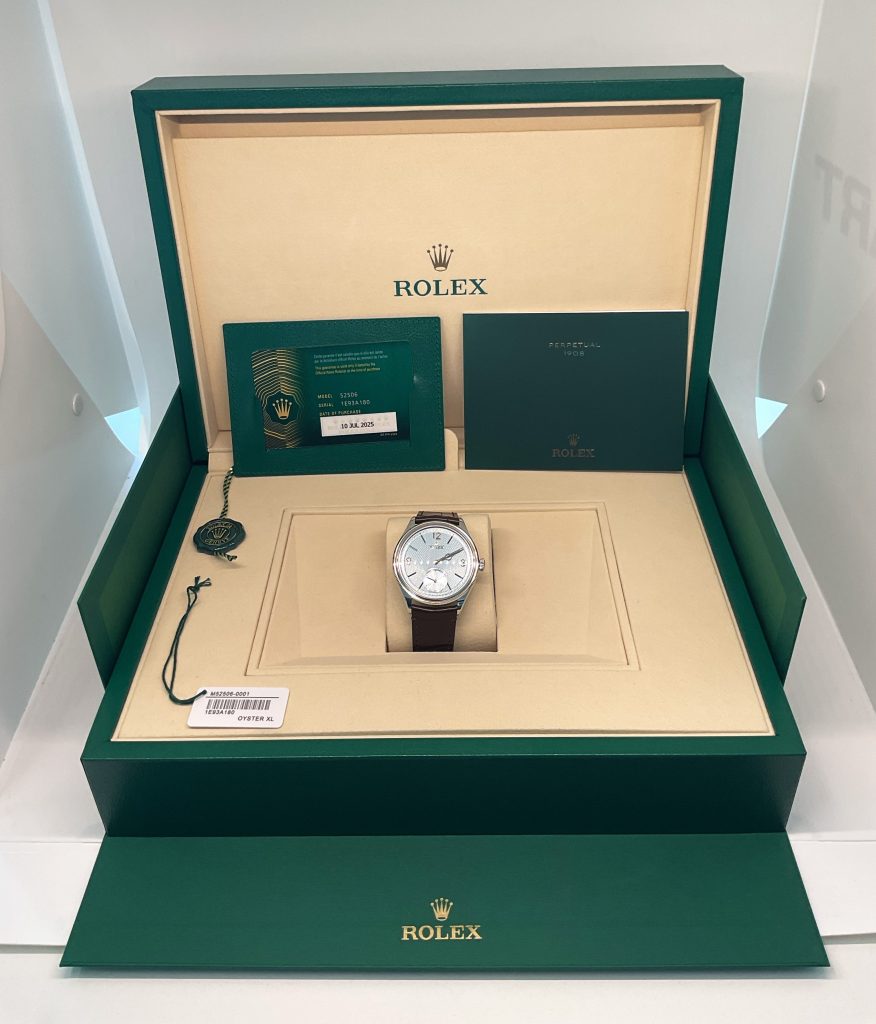
The Rolex 1908 is still a new enough watch that a lot of owners of the old Cellini line are asking the same question: is this the same watch under a new name, or something genuinely different? It matters for more than nostalgia. Whether you own a discontinued Cellini or are considering a current-production 1908, how the two lines relate affects what the watch is worth today and how it’s treated as collateral if you ever need liquidity against it.
What “1908” Means and Why Rolex Replaced the Cellini
Rolex introduced the Perpetual 1908 at Watches & Wonders in April 2023 as a new dress-watch collection, and in the same breath effectively retired the Cellini line it was built to replace. The name refers to 1908, the year Rolex registered its trademark, a deliberate nod to the brand’s own history rather than to any prior reference number. The last Cellini reference standing, the Cellini Moonphase 50535, had only been in production for six years before it was discontinued alongside the rest of the collection in 2023.
This wasn’t a simple rebrand. Rolex used the 1908 launch to reset what its dress-watch category looked like: a new case architecture, a new in-house movement built specifically for the line, and a pricing floor that sits well above where Cellini models used to start.
Cellini vs. 1908: What Actually Changed
The clearest technical difference is on the back of the watch. The 1908 gave Rolex a transparent sapphire exhibition caseback, a feature that, in the modern Rolex catalogue, only the 2005 Cellini Prince had carried before it. Rolex almost never lets you see its movements; the 1908 is one of the rare exceptions.
The case itself also changed. The platinum 1908 reference 52506 measures 39mm across and 9.5mm thick, with roughly a 47mm lug-to-lug, finished in 950 platinum with a domed, fluted bezel and a double anti-reflective sapphire crystal on both sides. It reads as slimmer and more classically proportioned than the outgoing Cellini cases.
The biggest structural change is what metals are offered. The Cellini came in steel, Rolesor (steel and gold), and solid gold, with pricing that started well under $20,000. The 1908 dropped the entry tiers entirely: it’s offered only in 18k yellow gold, 18k white gold, or 950 platinum, with no steel or two-tone version at all. That single decision is why the 1908 can’t be thought of as a direct price successor to the Cellini, it occupies a different, higher tier of Rolex’s lineup.
Rolex 1908 Price Guide by Metal and Reference
Because metal content makes up a real share of the 1908’s cost, price moves with the gold and platinum markets more than it does for steel sports models. As of 2026, published pricing at authorized retailers for U.S. buyers runs roughly $30,300 for the 18k white gold 52509, $33,600 for the platinum 52506, and $40,900 for the 18k yellow gold 52508 on the Settimo bracelet, with lower figures available on leather strap configurations. In the Netherlands, an authorized retailer lists the 18ct yellow gold 52508 on strap at €26,950, which answers the “rolex 1908 prijs” question directly for anyone shopping in euros, though the exact figure will shift with currency and gold prices.
Because these numbers change with bullion prices and dealer stock, treat any single figure here as a dated reference point rather than today’s price. For a running view of retail tariffs and current secondary-market asking prices, WatchCharts tracks Rolex 1908 pricing live across references and metals.
One detail worth noting if you’re comparing configurations: because the 1908 is sold only in precious metal, its retail price tracks gold and platinum spot prices more directly than a steel Datejust or Submariner ever will. With gold trading above $3,100 per troy ounce for much of 2026, a full gold-cased 1908 carries meaningfully more intrinsic metal value than the old Cellini ever did, which is part of why the line’s floor price sits so much higher.
Why the Ice-Blue Dial Only Comes on the Platinum 52506
The ice-blue, rice-grain guilloché dial is one of the most-asked-about details of the line, and it’s exclusive to the platinum reference 52506. Rolex reserves this particular dial color for a short list of models, using it only on the 1908, the Day-Date, and the Cosmograph Daytona. A yellow gold or white gold 1908 will never be offered with this dial; it’s tied specifically to the platinum case. That exclusivity matters for anyone thinking about rarity or future resale comparisons: an ice-blue 52506 isn’t a color option you can expect across the collection, it’s a platinum-only configuration by design.
Movement, Accuracy, and Durability
Every 1908 reference, regardless of metal, runs the same purpose-built Calibre 7140. It uses a Syloxi silicon hairspring, the Chronergy escapement, and Paraflex shock absorbers, with roughly 66 hours of power reserve. Rolex certifies it as a Superlative Chronometer, meaning it passes COSC testing and then Rolex’s own in-house standard of -2/+2 seconds per day, tighter than the official COSC tolerance most Swiss mechanical watches are held to. In practical terms, that’s a movement built for daily accuracy and long-term reliability, not a simplified dress-watch caliber.
Does the 1908 Hold Its Value?
The 1908 doesn’t behave like Rolex’s sports models. Because Rolex keeps production volume on the line deliberately low, secondary-market pricing on these gold dress watches has stayed close to retail rather than developing the waitlist premiums that push a steel Daytona or GMT-Master above sticker price. For an owner, that’s a mixed signal: it means you’re less likely to see a 1908 trade at a markup, but it also means the gold and platinum content underneath the watch is doing more of the value work than brand scarcity is. A 1908’s worth tracks the precious-metal market and condition more predictably than it tracks Rolex hype cycles, which is actually useful information if you’re trying to estimate what yours is worth today.
Warranty, Service, and a Real Risk With the Exhibition Caseback
Every new Rolex sold and card-activated by an Official Rolex Jeweler carries a five-year international guarantee covering proper functioning, and Rolex recommends a full service roughly every 10 years depending on how the watch is worn. The 1908’s exhibition caseback is where owners need to be careful. It’s a feature that naturally invites curiosity, but having that caseback opened by anyone other than an authorized Rolex Service Center voids the five-year warranty outright. If you own a 1908, treat the transparent back as something to admire, not something to let an unauthorized watchmaker open for a “quick look” or an off-brand battery-style service. There’s no battery in an automatic movement, but the principle holds: unauthorized case openings are the single easiest way to lose coverage on a watch this new.
If you’re unsure how a service interaction affects your own watch’s day-to-day function, something as basic as setting the time and date correctly is worth getting right before assuming anything mechanical needs attention at all.
If You Own a Discontinued Cellini: What Changes for Valuation
A Cellini is now a closed chapter in Rolex’s catalogue, not a watch with a current-production equivalent at a similar price. Because the Cellini line included steel and Rolesor models priced well under $20,000, and the 1908 starts in solid gold at a much higher floor, a Cellini shouldn’t be benchmarked against 1908 retail pricing at all. Its value is determined by its own reference, metal content, dial variant, condition, and how collectors are currently pricing a discontinued model, not by what a current 1908 costs new. That distinction matters most at the point of a transaction: a model-specific, reference-aware valuation will land on a very different number for a steel Cellini than for a gold 1908, even though both carry the same brand name on the dial.
This is also where expertise matters more than it seems to on the surface. A generalist appraisal that treats “Rolex dress watch” as one category will miss the gap between a discontinued Cellini and a current 1908 entirely. A model/reference-specific valuation looks at the actual reference number, metal, dial, and production status rather than assuming one number applies across the family.
Turning a 1908 or Cellini Into Cash or Collateral
Whether you’re holding a current-production 1908 or an older Cellini, the practical question eventually becomes what to do with it. Diamond Banc works with both situations directly: a current, reference-specific valuation is the starting point either way, since a Cellini and a 1908 are priced on entirely different scales. From there, owners generally choose one of two paths. If you want to sell a rolex outright, Diamond Banc’s watch specialists price it against current secondary-market data rather than a generic catalogue number. If you’d rather keep the watch and still access funds, a rolex loan uses the piece as collateral while you retain ownership, with the loan amount set by the same reference-specific appraisal process.
For owners who aren’t ready to decide between selling and financing, Diamond Banc also offers a seller’s agent and consignment option for Rolex pieces, giving a third route when the goal is maximizing return rather than speed. Local offices, nationwide transactions, and secure mail-in shipping mean the process works the same whether you’re bringing in a platinum 52506 with the ice-blue dial or a steel Cellini that’s been in the family for years, each gets evaluated on its own terms, by its own reference number, not as a generic “Rolex dress watch.”
Like what you’re reading?
Add us in Google — more like this is on the wayRelated Posts
 Instagram
 Facebook
 Tiktok
 YouTube