“Rolex holds its value” is true often enough to have become a cliché, and wrong often enough to cost owners money. Some references still trade above their retail price years after purchase. Others, particularly many solid gold and dress models, resell well below what their owners paid. If you are deciding whether to sell, keep or use your watch as collateral, the useful question is not whether a Rolex depreciates but how much your specific reference has.
First, Which Number Are You Comparing?
Most confusion about Rolex depreciation comes from comparing different prices. Three numbers matter:
- Retail price: what an authorized dealer charges for a new watch. Rolex raised U.S. retail prices by an average of roughly 7% in early 2026, with gold models taking the largest increases, according to Borro’s Q1 2026 watch market review.
- Secondary asking price: what pre-owned dealers and marketplaces list the watch for. Listings are a ceiling, not a guarantee.
- Buy price: what a dealer or buyer will actually pay you. It is lower than the asking price because it accounts for authentication, reconditioning, holding time and resale risk.
A watch can be “above retail” on asking price and still produce an offer below what you paid. When you measure depreciation, compare what you paid with a realistic buy price for your exact reference and condition.
Depreciation by Category
The broad pattern in today’s market looks like this.
| Category | Typical pattern | Recent market example (2026) |
|---|---|---|
| Steel sports, high demand | Strongest retention; some references trade above retail | Daytona 126500LN: about $19,500–$21,000 on the secondary market vs. about $16,900 retail (Borro) |
| Steel sports, tool models | Close to retail, and sometimes below it | Sea-Dweller 126600: most sales about $12,200–$14,600 vs. about $14,100 retail (EveryWatch) |
| Steel classic | Solid retention; configuration and dial drive the spread | Explorer 124270: most sales about $8,200–$9,700 (EveryWatch) |
| Two-tone (Rolesor) | Moderate; gold content supports value, but demand is narrower | Sea-Dweller 126603: most sales about $16,000–$20,000 (EveryWatch) |
| Solid gold and platinum | Highest values, but more exposed to demand swings and gold prices; generation matters | Sky-Dweller 18k yellow gold: 326938 about $44,000–$49,000 vs. the newer 336938 about $57,000–$73,000 (EveryWatch) |
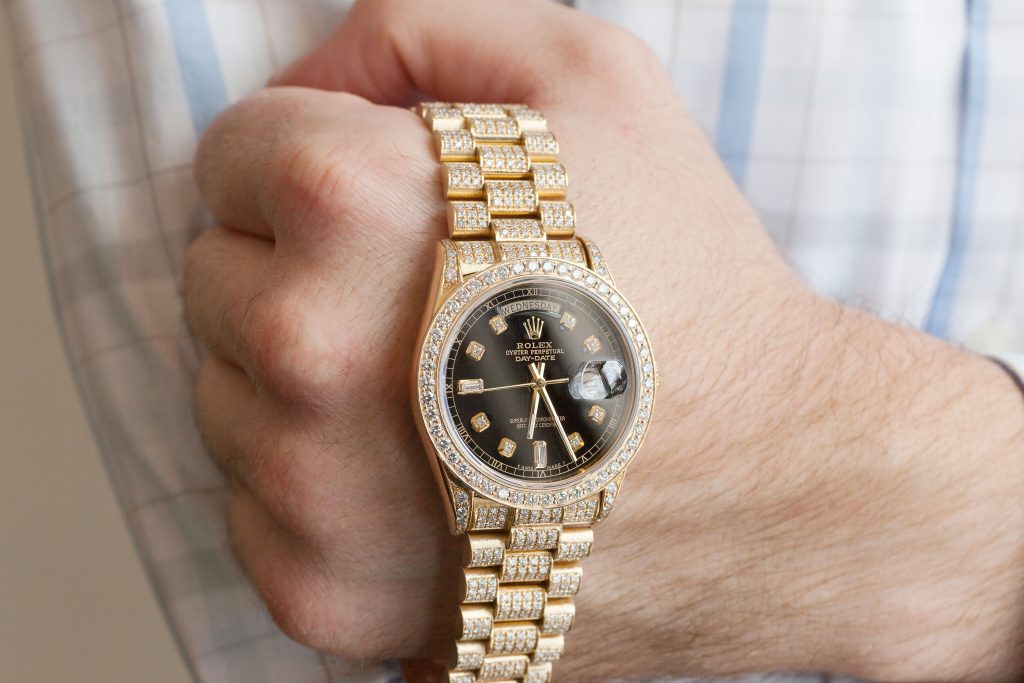
| Aftermarket diamonds | Steepest; non-factory settings usually lower value | Evaluated individually; typically below the same watch in factory condition |
| Discontinued references | Can hold up well when demand outlasts supply | Sea-Dweller 116600 (made 2014–2017): most sales about $13,500–$16,500, above the current 126600 (EveryWatch) |
EveryWatch figures are the range where most recorded sales landed in its sold-listing data for August and September 2026, mostly dealer sales, with outliers excluded. They are retail-side market prices, not purchase offers: a buyer’s offer is lower because it accounts for authentication, reconditioning and resale time.
The steel Daytona illustrates the top of the range. Borro reports the 126500LN at about $16,900 retail in January 2026 and roughly $19,500 to $21,000 on the secondary market by April, a premium of about 1.2 to 1.3 times retail, with a median sale time of 13 days (Borro). Few references perform like that, which is exactly why a general “Rolex holds value” rule is unreliable.
For more on how value varies by model, see our guides to the Rolex models with the highest resale value and what a Datejust is worth.
Depreciation by Age
- 0 to 2 years: the first-owner discount applies. On high-demand steel references it may be small or nonexistent. On gold and dress models it is usually the largest drop the watch will experience.
- 3 to 10 years: value tends to track the reference’s current demand and whether the model is still in production. Condition and completeness start to separate watches of the same reference.
- 10 to 25 years: the watch is often due or overdue for service, and buyers price that in. Earlier generations of popular models can gain interest when a new generation changes the design.
- Vintage: collectibility can take over. Original dials, hands and bezels, unpolished cases and documented provenance can matter more than age itself.
Why Purchase Year Matters
The pre-owned Rolex market peaked in 2022 and then corrected. It has been recovering since: WatchCharts data cited by Borro shows Rolex up 7.9% over the twelve months to March 2026, and April 2026 brought the largest single-month move “since the 2022 peak unwound,” according to 5D Watches’ summary of WatchCharts data.
In practice, an owner who bought a steel sports model at retail in 2019 may still be ahead today. An owner who paid a peak-2022 secondary price for the same reference may be well behind. The watch is the same; the entry price is not.
What Speeds Up Depreciation
- Over-polishing: softened case lines reduce collector appeal.
- Replaced or aftermarket parts: see how aftermarket parts affect Rolex value.
- Missing box and papers: see what a Rolex is worth without papers.
- Water damage or mechanical problems: see how water damage affects value.
- Overdue service: buyers deduct the expected service cost from their offer.
What Slows It Down
- A complete set: box, warranty card, receipts, hang tags and all bracelet links
- Documented service history
- Original, unpolished condition
- A desirable dial, bezel or discontinued configuration
Frequently Asked Questions
Do Rolex watches lose value?
Some do and some do not. High-demand steel sports references often hold or exceed retail, while many gold, gem-set and dress references resell below retail. The reference, purchase price and condition decide which group your watch falls into.
Which Rolex models depreciate the most?
As a general pattern, solid gold dress models, watches with aftermarket diamonds and heavily worn or modified watches tend to show the largest gap between what the owner paid and a realistic buy price.
Is it better to sell now or wait?
Nobody can promise where prices go next. A current, market-based valuation shows where your watch stands today, and if you would rather not sell, a collateral loan lets you keep ownership while accessing cash.
Does a Rolex’s value go up after it is discontinued?
Sometimes. Discontinuation can increase demand for a reference, but it does not guarantee appreciation. Condition and completeness still decide where an individual watch lands.
Find Out What Your Rolex Is Worth Today
General depreciation patterns are a starting point. Your watch’s value depends on its reference, condition and accessories. Start with our Rolex value calculator, or speak with a Luxury Watch Specialist about selling or a Rolex loan.
Book a complimentary Rolex evaluation at a Diamond Banc location.
Like what you’re reading?
Add us in Google — more like this is on the wayRelated Posts

 Instagram
 Facebook
 Tiktok
 YouTube