
Turn Your Rolex Into Business Capital — No Debt, No Personal Guarantee
Snap a photo. Get an instant Rolex quote.
Start Your Quote
 Mills Menser
Owner and Founder






Turn Your Rolex Into Capital for Business
Diamond Banc helps business owners access capital for business by selling a Rolex, luxury watch, or other high-value jewelry asset for immediate liquidity. This page explains how to use a Rolex to create business funding without taking on a new loan, personal guarantee, or added balance-sheet debt when selling the asset is the right fit.
For owners exploring alternatives to traditional financing, this service is designed for discreet, fast access to funds through the sale of a luxury watch. If you need working cash for operations, inventory, payroll, or expansion, Diamond Banc provides an expert evaluation process and a professional offer based on current secondary market demand.

Why Business Owners Are Choosing This Over a Bank Loan
Many business owners need capital for business quickly, but traditional financing often involves a lengthy underwriting process, extensive documentation, and ongoing obligations. An SBA 7(a) loan, one of the most common paths to small-business financing, generally takes about 60 to 90 days from application to funding, and a conventional bank term loan or line of credit can still take several weeks once underwriting and documentation review are factored in. Selling a Rolex can provide a straightforward source of liquidity when you prefer not to add new debt to the company or tie up future cash flow with monthly payments.
Compared with common business loans, SBA loans, or lines of credit, traditional funding frequently requires:
- Detailed financial statements and tax returns
- Time-consuming underwriting and review
- A personal guarantee from the owner
- A UCC blanket lien on business assets
- Ongoing repayment obligations that affect cash flow
These aren’t just paperwork formalities. A UCC blanket lien gives a lender a security interest in nearly all of a business’s current and future assets, and most business lenders that require a blanket lien also require a personal guarantee, which holds the owner personally liable if the loan isn’t repaid. SBA lenders in particular typically require a first-lien position on all business assets, so an existing blanket lien from another lender often has to be resolved before new SBA financing can move forward.
That structure may work for some businesses, but not every situation calls for new debt. If you own a Rolex that is no longer essential to keep, selling it can convert a luxury asset into usable capital without creating a new lending relationship.
This can be especially useful when timing matters, when you want to avoid adding another liability during underwriting for separate financing, or when preserving borrowing capacity is important.
Jordan Isaacs
As the National Director of Funding at Diamond Banc’s corporate office, Jordan Isaacs prioritizes providing top-notch client experiences during the assessment of their items for immediate sale or loan services. With excellent communication skills and a talent for prompt and informative follow-up, Jordan’s expertise enables him to offer the highest values, the most competitive rates in the industry, personalized financing options, & exceptional service to each and every client. To start working with Jordan, give us a call or fill out our online submission form.

Cade Westberry

How This Keeps Capital Off Your Balance Sheet
When a business owner sells a Rolex for cash, the transaction is generally proceeds from an asset sale rather than a new debt obligation. In practical terms, that means cash comes in without creating a new loan payable, without a debt covenant, and without a lien tied to business assets.
For many owners, that distinction matters. A new term loan, line of credit, or other debt financing can affect leverage ratios, debt-to-equity calculations, and how your company appears during underwriting. By contrast, selling a non-core luxury asset may allow you to improve liquidity without adding a new recorded liability.
This approach may appeal to businesses that are:
- In the middle of underwriting for separate financing
- Trying to avoid new liens or encumbrances
- Protecting personal credit and business borrowing capacity
- Managing capital structure carefully during growth
Every business should discuss accounting treatment with its own CPA or advisor. This page is general information, not accounting advice, but the basic distinction is important: an asset sale is not the same as debt financing.
Common Reasons Business Owners Use This
Business needs rarely arrive on a perfect schedule. Owners often need access to liquidity before receivables come in, before a formal credit facility closes, or during a temporary cash-flow gap. Selling a Rolex can be a practical way to create capital for business without waiting on a lender’s process.
Common scenarios include:
- Bridging a short-term payroll gap
- Funding a seasonal inventory purchase
- Covering a vendor deposit to secure materials or product
- Closing the gap between accounts receivable and accounts payable
- Paying for a quick expansion, renovation, or location buildout
- Supporting working capital management during a busy growth period
For some owners, this is a cleaner solution than using expensive short-term debt. For others, it is a deliberate decision to use an underutilized luxury asset instead of taking on obligations that reduce flexibility. If you’d rather keep the watch and bridge the gap with financing instead, Diamond Banc’s guide to how bridge loans work explains how a short-term, asset-backed loan compares to selling outright.
How It Works for a Business Owner
Diamond Banc makes the process clear, discreet, and well documented. Business owners can begin by requesting a quote and sharing details about the Rolex or other luxury asset they would like evaluated.
Step 1: Get a quote
You can start with photos and details of the watch, or work directly with a Diamond Banc expert to begin the evaluation. If the watch is business-owned, an authorized representative can typically help facilitate the process and provide the necessary information.
Step 2: Review the offer
Once the watch has been assessed, Diamond Banc provides a professional offer based on the current secondary market. The amount should be considered in light of your business need, whether that is payroll support, inventory funding, or another short-term capital objective.
Step 3: Receive funds and documentation
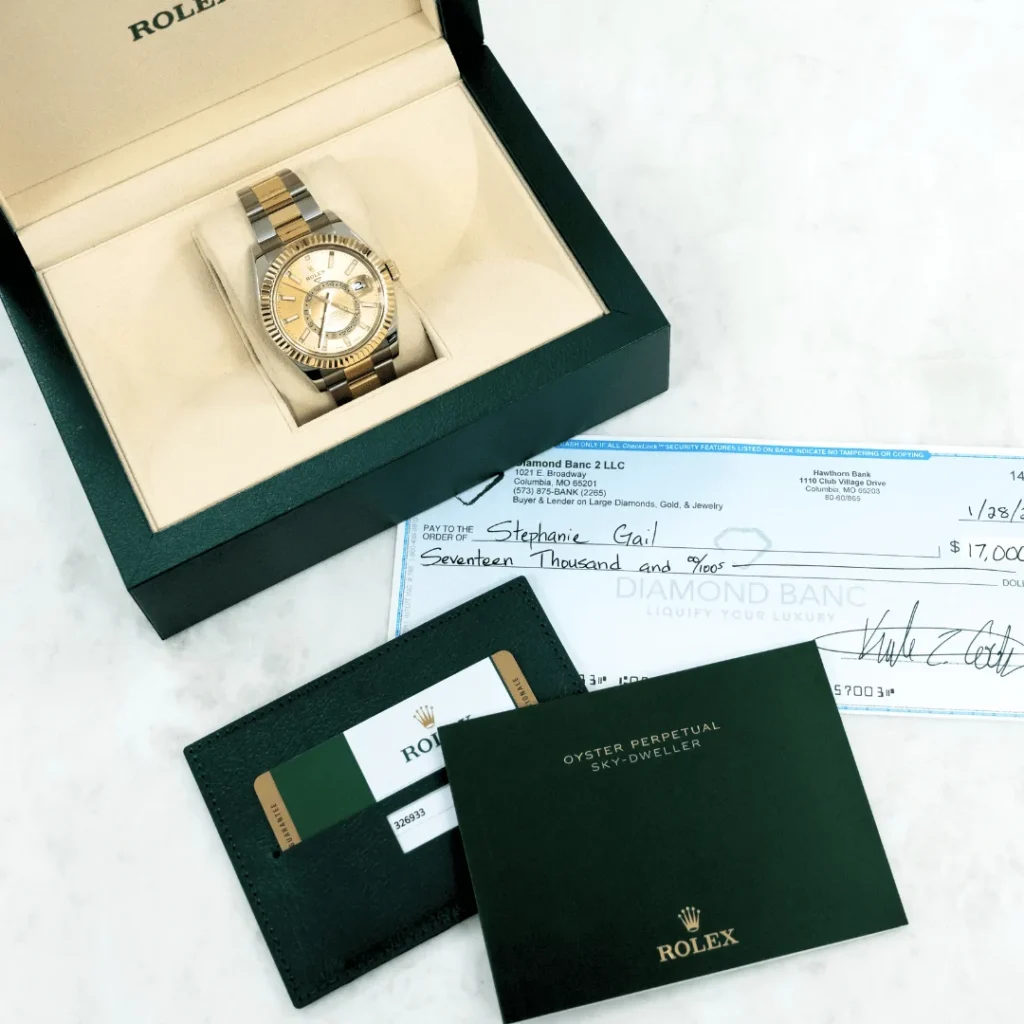
If you accept the offer, funds are issued promptly and the transaction is documented for your records. That paper trail can be useful for internal bookkeeping and communication with your accountant.
Types of Business Capital and Where This Option Fits
Capital for business refers to the financial resources a company uses to operate, invest, and grow. It can come from multiple sources, and each source has tradeoffs related to control, cost, timing, and risk.
The main types of business capital include:
- Equity financing: capital raised by giving up an ownership stake
- Debt financing: borrowed funds that must be repaid
- Retained earnings: profit reinvested into the business
- Asset sales: converting owned assets into cash
- Alternative funding sources: such as crowdfunding, seed funding, or business grants
Many people searching for capital in business examples are comparing options such as venture capital, angel investors, business loans, crowdfunding, or start-up capital for small business. Those funding models can be appropriate in the right context, but they are not always ideal for established owners who simply need liquidity now and prefer not to give up equity or take on debt.
In that sense, selling a Rolex is not venture capital, not angel investment, and not equity financing. It is an asset-based liquidity strategy that may help an owner meet a capital need without changing ownership, repayment obligations, or financing structure.
What is capital for business?
Capital for business refers to the financial resources that a company uses to fund its operations and growth. It includes both equity and debt, and can come from various sources such as investors, loans, or retained earnings. This capital is essential for purchasing assets, covering expenses, and investing in future opportunities.
How do I raise capital for my business?
To raise capital for your business, you can explore several options including securing a business loan, attracting venture capital, seeking angel investors, or launching a crowdfunding campaign. Each option has different requirements and benefits, so it’s important to assess which aligns best with your business goals and growth stage.
How This Compares to Other Funding Paths
Owners researching how to raise capital for a small business often compare a wide range of financing structures. Here is how some common sources differ from selling a luxury watch asset:
- Venture capital: Typically designed for scalable companies seeking substantial growth funding in exchange for equity and investor oversight.
- Angel investors: Individual financial backers who may provide seed funding or startup funding in exchange for ownership or convertible terms.
- Equity financing: Useful when preserving cash is important, but it dilutes ownership.
- Debt financing: Includes business loans, lines of credit, and other obligations that require repayment and may involve collateral or guarantees.
- Crowdfunding: Can validate demand, but often depends on marketing traction and platform performance.
- Business grants: Attractive when available, though they are limited and often competitive.
For capital for business start up needs, founders often rely on seed funding, personal resources, angel investors, or early debt. For established companies, however, a luxury asset sale can be an efficient supplemental liquidity tool when timing and simplicity matter more than building a long-term financing structure.
Is This the Right Fit for Your Business?
This option may be a strong fit if you need capital for business but do not want new debt, do not want a lien, and do not want to sign a personal guarantee. It is also appropriate when you do not need the watch back later and view it as a non-core asset that can be turned into working cash.
If your goal is to keep ownership of the watch and access liquidity temporarily, a loan may be the better structure. In that case, explore Diamond Banc’s loan against your Rolex option instead.
Business owners with additional luxury assets may also want to review designer jewelry loans. If you want broader information on valuation and the watch selling process, see selling your Rolex.
Get a Business Capital Quote
If you are evaluating ways to create investment capital or working cash without increasing liabilities, Diamond Banc offers a discreet, professional path to convert a Rolex into usable funds. Start with a quote to understand the current market value of your watch and how it may support your business needs.
If you would rather retain ownership and borrow instead, visit the Rolex loan page for the keep-your-watch alternative.
What is capital for business?
Capital for business is the money or financial resources a company uses to operate, grow, buy inventory, cover expenses, hire staff, or invest in opportunities. It can come from equity, debt, retained earnings, or the sale of assets that the business or owner no longer needs to hold.
How do I raise capital for my business?
You can raise capital through business loans, lines of credit, venture capital, angel investors, crowdfunding, retained profits, business grants, or asset sales. For owners who want funding without new debt or ownership dilution, selling a high-value Rolex or jewelry asset can be a practical alternative.
What are the types of business capital?
The main types of business capital include equity financing, debt financing, retained earnings, and proceeds from asset sales. Startup funding may also include seed funding, angel investment, or crowdfunding. The right choice depends on your timing, growth plans, ownership preferences, and tolerance for repayment obligations.
How does venture capital work?
Venture capital involves investment firms providing funding to high-growth companies in exchange for equity. In most cases, investors expect significant upside, influence over strategic decisions, and an eventual exit. It is very different from selling a luxury asset, which creates liquidity without changing ownership or governance.
What is the difference between equity and debt financing?
Equity financing gives investors an ownership stake in exchange for capital, while debt financing requires repayment, often with interest and lender conditions. Selling a Rolex is different from both because it is an asset sale, not borrowed money and not a transfer of ownership in your business.
How can small businesses get funding?
Small businesses can get funding through bank loans, SBA programs, business lines of credit, angel investors, financial backers, crowdfunding, grants, retained earnings, or asset-based liquidity strategies. When speed, discretion, and balance-sheet simplicity matter, converting a luxury asset into cash can be a useful option.
What is working capital and why is it important?
Working capital is the money available to cover short-term operating needs such as payroll, rent, inventory, and vendor payments. Strong working capital management helps a business maintain stability, meet obligations on time, and protect profit margins during uneven revenue cycles or temporary cash-flow gaps.
Does this affect my business credit or my personal credit?
No. Selling a Rolex is a sale, not a loan, so there is no credit application, no credit inquiry, and no repayment history involved. It does not appear on your business credit report or your personal credit report the way a loan, line of credit, or credit card would.
Will this show up as debt or a liability on my balance sheet?
No. Proceeds from selling a Rolex are recorded as cash from an asset sale, not as a loan payable or other liability. There is no debt covenant, no lien, and no direct change to your debt-to-equity or leverage ratios from the sale itself. Review the specific accounting treatment with your own CPA or advisor.
Can I use this if the Rolex is a personal asset rather than a business asset?
Yes. Many owners sell a personally owned Rolex and use the proceeds to fund the business rather than selling a business-titled asset. Diamond Banc’s evaluation and offer process is the same either way — how you use the funds afterward, whether for payroll, inventory, or another business need, is up to you.
How is this different from a business loan or line of credit?
A business loan or line of credit is debt: you borrow money, sign loan documents, often provide a personal guarantee or collateral, and repay the balance with interest over time. Selling a Rolex is an outright sale — you receive cash for the watch, there is nothing to repay, and you are not taking on a personal guarantee or a lien against business assets.
How fast can I actually get funds for a business need?
Most owners can get a quote the same day, and funds are typically issued promptly once an offer is accepted. That is considerably faster than the weeks-to-months timeline typical of SBA loans and many bank term loans.
Our Offices Nationwide
Diamond Banc operates in key cities across the U.S., making it easy to access trusted jewelry selling and loan services near you.

 Instagram
 Facebook
 Tiktok
 YouTube