How To Identify Which Rolex Model You Inherited
 Written By: Mills Menser
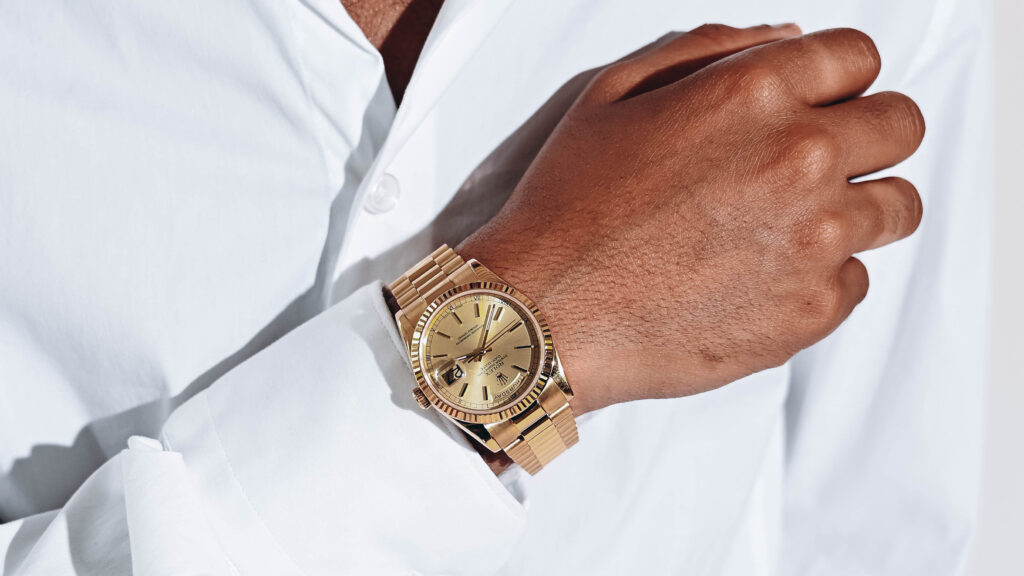
Identifying an inherited Rolex involves locating two crucial, tiny engravings on the watch case that reveal the specific model, production year, and materials.
Inheriting a Rolex is both meaningful and sometimes confusing. The sentimental value is clear, but understanding exactly what you have on your wrist (or tucked away in a box) is a different matter. Without original paperwork, warranty cards, or receipts, many people are left wondering which Rolex model they own, what era it was produced in, and what it might be worth.
At Diamond Banc, we evaluate and purchase inherited Rolex watches daily. Our team of watch specialists has decades of combined experience identifying every Rolex collection, from vintage Submariners to modern Datejusts. Whether you are looking to sell your Rolex or simply want to understand what you have, we offer complimentary, no-obligation evaluations to help you get started.
Where To Find the Reference Number on Your Inherited Rolex
The most reliable way to identify any Rolex model is through its reference number, also called the model number. This 4 to 6 digit code reveals the watch’s collection, bezel style, and case material.
Location on the Watch Case
The reference number is engraved between the lugs on the 12 o’clock side of the case, where the bracelet connects to the watch head at the top. The bracelet must be carefully detached using a spring bar tool to reveal the engraving. If you are not comfortable removing the bracelet yourself, any qualified watchmaker or Rolex specialist can do this safely.
What the Reference Number Tells You
Each section of a Rolex reference number encodes specific information. Take the modern 6-digit reference 126610LN as an example. The first five digits (12661) identify the model family, in this case the Submariner Date. The final digit (0) reveals the case material, here stainless steel.
Letter codes at the end, like LN (French for “Lunette Noire,” meaning black bezel), describe the bezel color. On classic dress models like the Datejust and Day-Date, the second-to-last digit also indicates bezel style, but this does not apply to professional sport models like the Submariner or GMT-Master.
How Reference Number Length Indicates the Era
The number of digits alone can tell you when a Rolex was produced. A 4-digit reference (such as 1675 or 5513) indicates a vintage piece from before the late 1970s. A 5-digit reference (such as 16610 or 16233) points to the late 1970s through early 2000s. A 6-digit reference (such as 126710 or 126334) means it is a modern production piece from the 2000s onward.
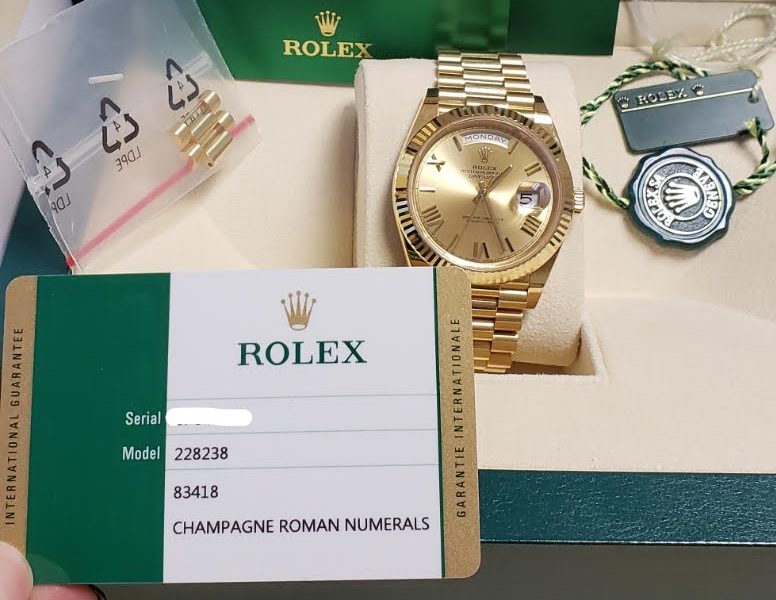
How To Locate and Use the Rolex Serial Number
The serial number identifies the individual watch and helps approximate when it was manufactured.
Where the Serial Number Is Engraved
On watches produced before 2007, the serial number is engraved between the lugs at the 6 o’clock side, opposite the reference number. Beginning in late 2006, Rolex also started laser-engraving serial numbers on the inner bezel ring (the rehaut), visible through the crystal without removing the bracelet.
Determining the Production Year
From the 1920s through mid-1987, Rolex used sequential numerical serial numbers. Starting in 1987, a letter prefix was added before six digits, though the letters did not follow alphabetical order. After 2010, Rolex switched to randomized serial numbers, making production year dating through serial numbers alone impossible for newer watches.
When Original Paperwork Helps
If a warranty card or guarantee certificate was passed down with the watch, the serial and reference numbers will both be printed there. These documents add provenance and value if you ever choose to explore your liquidity options.
Identifying Your Rolex Model by Visual Characteristics
Even without removing the bracelet to check numbers, visual features can help narrow down which Rolex family your inherited watch belongs to.
Bezel Type and Markings
A unidirectional rotating bezel with minute markers indicates a Submariner or Sea-Dweller. A bidirectional bezel with 24-hour markings points to a GMT-Master. A smooth bezel is common on the Oyster Perpetual and Explorer. A fluted bezel with a ridged pattern is a hallmark of both the Datejust and the Day-Date.
Dial Features and Complications
A date window at 3 o’clock with a Cyclops lens appears on the Datejust, Submariner Date, and GMT-Master II. A spelled-out day display at 12 o’clock is exclusive to the Day-Date. Three chronograph sub-dials indicate a Daytona. A time-only dial with 3, 6, and 9 numerals signals an Explorer.
Case Size and Bracelet Style
Vintage models typically measure 34mm to 40mm, while modern references run 36mm to 44mm. The Oyster bracelet (three flat links) is most common on sport models, the Jubilee (five-link) is associated with the Datejust, and the President bracelet (three semi-circular links) is found on the Day-Date and certain precious-metal Lady-Datejust models.

Common Rolex Models Found in Inherited Collections
Certain Rolex models appear more frequently in estate collections. Knowing which models were popular during specific decades helps narrow down what you have.
Rolex Datejust
In continuous production since 1945, the Datejust is the most commonly inherited Rolex. It features a date window with a Cyclops lens and was offered with varied dial colors, bezel options, and materials. Five-digit references beginning with 162 (such as 16233 or 16234) indicate a Datejust, while 6-digit Datejust 36 models begin with 1262 and Datejust 41 models begin with 1263.
Rolex Submariner
A top seller since 1953, inherited Submariners are often 5-digit references like the 16610 (1989 to 2010) or vintage 4-digit references like the 5513 (1962 to 1989). The rotating bezel and Mercedes-style hands make it instantly recognizable.
Rolex Day-Date (“Presidential”)
Produced exclusively in 18k gold or 950 platinum, the Day-Date features the President bracelet and full day-of-the-week display at 12 o’clock. Five-digit references starting with 180 or 182 (such as 18038 or 18238) and 6-digit references starting with 118 or 228 indicate a Day-Date.
Rolex GMT-Master and Daytona
The GMT-Master is identifiable by its 24-hour rotating bezel and bicolor insert. Vintage references like 1675 appear often in inherited collections. The Daytona, with three chronograph sub-dials and a tachymeter bezel, is less common but potentially the most valuable.
What To Do After You Identify Your Inherited Rolex Model
Once you know which Rolex model you have, the next step depends on your goals. Condition plays a major role in market value, with original dials, unpolished cases, and intact bracelets all contributing to higher valuations.
Diamond Banc’s Rolex Calculator provides a fast, free estimate based on your reference number and condition. For those who want to keep the watch but need funds, a Rolex equity loan lets you borrow against its value without giving it up. If selling is the right choice, our process is fast, transparent, and pressure-free. Visit a Diamond Banc office near you or start the process online.
Frequently Asked Questions
The Rolex model number (reference number) is engraved between the lugs on the 12 o’clock side of the watch case. The bracelet must be removed to see it. It is a 4- to 6-digit number that identifies the model, bezel type, and case material.
The serial number, found between the lugs at 6 o’clock (or on the rehaut in post-2007 models), can be cross-referenced with serial number charts to approximate the production year. Watches manufactured after 2010 use randomized serials, so year dating is not possible for newer models through serial numbers alone.
On post-2006 models, the serial number is laser-engraved on the rehaut and visible through the crystal. The reference number requires bracelet removal to access. Visual traits like bezel style, dial layout, and bracelet type can also help narrow down the model family.
The reference number identifies the model type, and all watches of the same variant share it. The serial number is unique to each watch and approximates its production date. Both are engraved between the lugs on opposite sides of the case.
The Datejust, Submariner, Day-Date, GMT-Master, and Daytona appear most frequently. The Datejust is the most common, in continuous production since 1945 and a popular milestone gift.
Authentic Rolex watches have precise engravings, a smooth-sweeping seconds hand, a Cyclops magnifying lens, solid weight, and matching serial and reference numbers. A professional evaluation is the most reliable way to confirm authenticity.
Condition directly impacts market value. Original unpolished cases, original dials, and intact bracelets command higher prices. Watches with replacement parts or heavy polishing are valued lower.
Missing paperwork is common with inherited watches and does not prevent identification. The reference and serial numbers engraved on the watch provide the information needed. A professional evaluation can confirm the model, assess the condition, and provide a current market value whether you plan to sell your jewelry or hold onto it.
 Instagram
 Facebook
 Tiktok
 YouTube