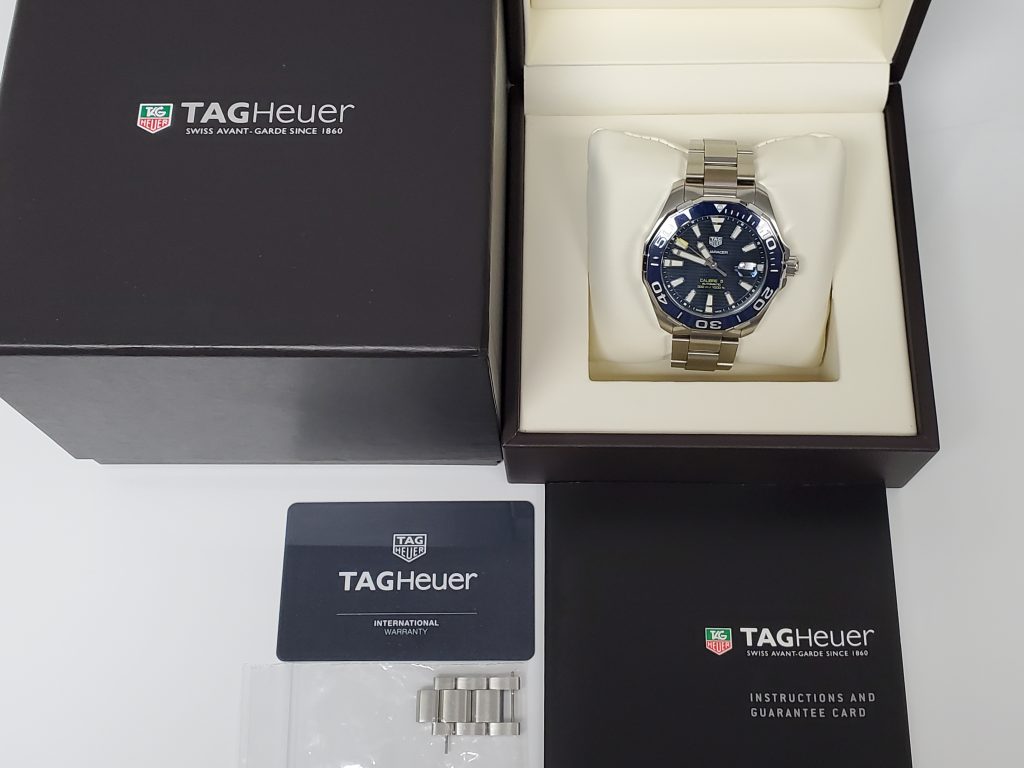
A TAG Heuer on your wrist or in a drawer is worth less today than the receipt says it cost, and the gap is usually bigger than owners expect. If you’re trying to raise cash and wondering whether to sell the watch outright or use it as collateral for a loan, the answer depends almost entirely on how much value the piece has already lost, and how much it’s likely to lose if you hold onto it longer. Here’s what the numbers actually show, model by model, and how that should shape your decision.
How Fast Does a TAG Heuer Lose Value?
The sharpest drop happens in the first year of ownership, before a watch has any service history or box-and-papers wear to worry about. A tracked TAG Heuer Aquaracer Professional 300 (reference WBP5110), which retails at $4,350, shows a secondary-market price of $2,768 as of September 2026, a loss of roughly $1,580, or about 36% of retail value, with no damage or missing parts involved. That’s not a worst-case example. It’s a normal, undamaged watch sold through ordinary secondary-market channels.
After the first year or two, the curve flattens. Most of the loss front-loads early, driven by the simple fact that a new watch can no longer be sold as new the moment it leaves the store. By year five to seven, a well-maintained TAG Heuer tends to lose value more slowly, assuming the model has held steady demand, but it rarely climbs back toward its original retail price the way a handful of Rolex references do.
Does the Model Change How Fast It Depreciates?
Yes, significantly. Not every TAG Heuer collection depreciates at the same rate, and the differences are large enough to change what you should do with a specific watch.
- Aquaracer: As shown above, a Professional 300 lost about 36% of retail value. The newer Aquaracer Professional 500 Date launched at $5,400 in a limited run of 1,500 pieces per colorway, and limited production can support resale demand better than an unlimited reference, though it’s too new to have an established secondary-market track record yet.
- Monaco: A tracked Monaco Calibre 11 (reference CAW211R), retailing around $7,000, shows a secondary-market price of $5,600 as of October 2026, holding roughly 80% of retail. That’s a meaningfully smaller loss than the Aquaracer example, largely because the Monaco’s square case and motorsport heritage keep it in steadier collector demand. Current Monaco retail pricing runs from $8,300 to $28,500 depending on complication and case material.
- Carrera: TAG Heuer’s Carrera line spans the widest retail range of the three, from $3,200 to $46,250 as of 2026, and depreciation within that range varies by movement and limited-edition status rather than following one simple pattern.
- Formula 1: As the brand’s entry-level line, Formula 1 watches typically depreciate fastest in percentage terms, since lower retail prices leave less room for the watch to hold dollar value once it’s no longer new.
The practical takeaway: a Monaco and an Aquaracer bought at similar price points can land in very different places a few years later. Before deciding to sell or use a TAG Heuer as collateral, check where your specific reference currently sits on the secondary market rather than assuming all TAG Heuers behave the same way.
Warranty, Service History, and What They Mean for Resale Value
TAG Heuer’s international limited warranty runs 2 years from purchase, extendable to 5 years total if you register the watch on TAG Heuer’s website. An unregistered watch past its second year, or one whose warranty has lapsed entirely, is worth less to a buyer or lender than an identical watch still under coverage, simply because the next owner inherits more risk.
TAG Heuer also recommends a complete overhaul roughly every 5 years, and any service performed through an authorized center carries its own 2-year service warranty. That warranty, and the brand’s original warranty, is voided if the watch has been opened or repaired by anyone outside TAG Heuer’s authorized network. If you’re considering a cheap third-party repair to get a watch running before a sale or a loan appraisal, don’t. It can strip away coverage that a buyer or appraiser would otherwise factor into the offer, and the cost of fixing it afterward usually exceeds what you saved.
Sell Outright or Use It as Collateral?
Once you know roughly where your TAG Heuer sits in its depreciation curve, the sell-or-collateral decision comes down to two questions: do you need the cash permanently, and do you expect to want the watch back?
Selling makes sense when you’re ready to part with the piece for good, especially if it’s a model like the Aquaracer example above that has already absorbed most of its depreciation. There’s little financial reason to hold onto a watch that’s unlikely to regain value, if you’d rather have the cash. You can sell the watch outright and walk away with a lump sum based on its current market condition.
A loan makes more sense if you expect to want the watch back, whether because it has sentimental value, because you believe its specific reference will hold up well, or because you just need bridge funding. Using a TAG Heuer as collateral lets you access cash now while keeping the option to reclaim the watch once the loan is repaid, rather than giving up ownership permanently.
What’s Legally Different Between a Collateral Loan and a Personal Loan
This is the part most people skip, and it matters. Under federal rule, a loan only qualifies as a true non-recourse, item-secured loan if the lender holds sole physical possession of the collateral for the entire loan term, and the lender’s only recourse if you don’t repay is keeping that item. If a loan is structured that way, the law caps your downside precisely: you can either repay the loan or let the lender keep the watch, and either way you walk away with no further financial obligation, even if the watch is worth less than what you borrowed.
That’s fundamentally different from a personal loan, unsecured or otherwise, where a default can leave you personally liable for the shortfall, subject to collections, and exposed to damage on your credit report. The protection only applies if the loan actually meets that federal structural test, so it’s worth confirming, before you sign, that the lender holds the item for the full term and that your only risk on default is losing the watch itself, not owing additional money on top of it.
TAG Heuer vs. Rolex: What the Comparison Means for Your Decision
If you’re weighing whether to hold a TAG Heuer long-term or shift your collection toward pieces that hold value more predictably, it helps to see the contrast directly. Rolex references, particularly steel sport models, are known for holding or exceeding retail price in ways that few other brands match, which is part of why owners more often choose to sell a Rolex at a price close to what they paid rather than take a loss. TAG Heuer sits in a different tier of the market: some references, like the Monaco example above, hold up respectably, while others, like certain Aquaracer configurations, shed over a third of retail value quickly. That doesn’t make TAG Heuer a poor choice to own, but it does mean the depreciation math, and therefore the sell-versus-collateral decision, has to be made reference by reference rather than assumed.
Making the Decision
Before you decide, get a current, model-specific valuation rather than relying on what the watch cost new or what a general online estimate suggests. A reference-specific read on where your TAG Heuer sits today, weighed against whether you want the cash permanently or just need it temporarily, is what actually determines whether selling or a collateral loan is the better move. For more on how watch-secured lending works in practice, see our guide on how to use a watch as collateral. Whichever path fits your situation, working with a specialist who prices by exact reference, rather than by brand name alone, is the difference between an offer that reflects your watch’s real standing in the market and one that doesn’t.
Like what you’re reading?
Add us in Google — more like this is on the wayRelated Posts


 Instagram
 Facebook
 Tiktok
 YouTube