Diamond symmetry refers to how precisely a diamond’s facets are aligned and proportioned. It evaluates the balance, placement, and angles of each facet to ensure they reflect light evenly. Symmetry is a key component of a diamond’s cut quality, directly impacting its brilliance. When the facets are not symmetrical, light leaks through misaligned angles, reducing sparkle and making the diamond appear dull, even if it has high color and clarity grades.
Symmetry plays a major role in a diamond’s overall value. A diamond with excellent symmetry reflects light more efficiently, producing greater brightness and fire. This level of visual appeal increases buyer demand and leads to stronger resale performance. Symmetry is graded by laboratories, such as the Gemological Institute of America (GIA), using a scale that includes excellent, very good, good, fair, and poor.
Each grade reflects how free the diamond is from symmetry defects such as misaligned facets, off-center cutlets, uneven girdles, and misshapen tables. Diamonds with lower symmetry grades show visual imperfections even to the naked eye.
Expert symmetry grading significantly boosts a diamond’s market value. For buyers, symmetry is a sign of craftsmanship and light performance. For sellers, it enhances liquidity.
Diamond Banc closely assesses symmetry during evaluation, as it significantly influences both the aesthetic quality and resale potential of the stone. A diamond with excellent symmetry commands a price premium, making it more desirable in both retail and secondary markets.

Table of Contents
- What Is Diamond Symmetry?
- Why Does Diamond Symmetry Matter for Diamond Value?
- How Is Diamond Symmetry Graded?
- Are Symmetry Grades Visibly Different?
- What Factors Affect a Diamond’s Symmetry Grade?
- How Does Symmetry Affect Diamond Pricing?
- How to Check for Diamond Symmetry?
- How Does Expert Symmetry Grading Boost Your Diamond’s Value?
- Why does the shape of your diamond matter to the symmetry?
- Does the diamond shape affect how symmetry is graded?
- How does shape affect the resale value of your diamond?
- Do imperfections in symmetry affect a diamond’s sparkle?
- What makes “Triple Excellent” diamonds distinct?
- How does symmetry impact cut grades?
- What’s the difference between optical symmetry and facet symmetry?
- What does “8X” mean in diamond symmetry grading?
- How are polish and symmetry related?
- Is re-polishing worth it for symmetry issues?
- Do diamond certifications add value by verifying diamond symmetry?
What Is Diamond Symmetry?
Diamond symmetry is the precision with which a diamond’s facets are aligned, ensuring each side mirrors the other in shape and angle. It reflects the geometric consistency in the diamond’s structure, including how well the facets are proportioned, how centered the table and culet are, and how evenly the girdle is shaped. Symmetry is a crucial aspect of overall cut quality and plays a vital role in how a diamond interacts with light.
When symmetry is ideal, light enters the diamond, bounces between facets in a controlled way, and reflects through the top. This creates the brilliance and fire that high-quality diamonds are known for. In contrast, poor symmetry causes misdirected light, dark areas, and reduced sparkle, even in diamonds with excellent color or clarity.
Symmetry directly affects a diamond’s appearance and value. It influences visual balance, face-up appeal, and the stone’s overall attractiveness to the human eye. Professional grading laboratories, such as the Gemological Institute of America (GIA), include symmetry as a component of the cut grade because it determines how effectively the diamond returns light.
Buyers prefer diamonds with excellent symmetry grades because they look more brilliant and refined. Consequently, symmetry is not just a technical detail; it is a main factor that shapes a diamond’s beauty and market price.
What Defines Diamond Symmetry?
Diamond symmetry is the precision with which each facet is aligned to create a balanced, mirror-like structure. Cutters aim for exact proportions, ensuring that every facet reflects light uniformly. This alignment determines how efficiently light enters the diamond, bounces between facets, and exits through the crown.
Symmetry is assessed under 10x magnification by grading laboratories, such as the Gemological Institute of America (GIA), which evaluate minor inconsistencies, including misaligned facets, off-center cutlets, and uneven girdles.
The components that define diamond symmetry are:
- Table Alignment
Table alignment refers to how centered and level the top flat facet (table) is about the rest of the diamond. A centered table allows light to enter uniformly, supporting optimal brilliance. If misaligned, it disrupts light paths and creates uneven sparkles across the surface.
- Culet Centering
Culet centering is the positioning of the bottom point of the diamond in line with the vertical axis. A centered culet ensures even light return from the pavilion. When off-center, light reflects unevenly, causing dark spots and reduced brilliance.
- Facet Matching
Facet matching refers to the condition where each corresponding facet is equal in size, shape, and angle on opposite sides of the diamond. Balanced facets ensure symmetrical light reflection. Mismatched facets distort the diamond’s face-up pattern, lowering visual appeal and creating asymmetrical light behavior.
- Crown and Pavilion Alignment
This refers to how well the upper (crown) and lower (pavilion) facets align vertically around the diamond’s perimeter. Proper alignment enables a smooth transition of light between the top and bottom. Misalignment breaks the light path, reducing fire and creating visual imbalance.
- Girdle Consistency
Girdle consistency is the uniformity of the diamond’s outer edge thickness. A consistent girdle supports even facet placement and symmetry of shape. An uneven girdle causes lopsided reflections and increases the risk of chipping, especially in thin areas.
Each of these symmetry components must be precisely crafted to ensure full light performance, visual harmony, and structural balance. Imperfections in any one of them cause light leakage, dullness, or visible defects, ultimately lowering both aesthetic appeal and value.
Why Does Diamond Symmetry Matter for Diamond Value?
Diamond symmetry is crucial for diamond value because it directly impacts how well the diamond performs optically and how buyers and grading institutions perceive it. Symmetry controls how precisely light enters, reflects, and exits the diamond. When the facets are aligned correctly, light bounces through the diamond in a controlled pattern, creating maximum brilliance, fire, and sparkle. If the symmetry is poor, light escapes unevenly, resulting in dullness, dark zones, and distorted reflections.
These imperfections reduce both the visual appeal and market desirability of the diamond. Grading laboratories, such as the Gemological Institute of America (GIA), include symmetry in the cut grade, meaning even a diamond with high color and clarity loses its value if symmetry is compromised.
The diamond symmetry for diamond value matters because of the following:
- Light Performance
Symmetry determines how effectively light moves through the diamond. Well-symmetrical diamonds reflect light back through the crown, maximizing sparkle. Poor symmetry causes misdirected light and reduces brilliance.
- Visual Appeal
Symmetrical diamonds have balanced and consistent face-up patterns. They appear more attractive and lively. Diamonds with symmetry issues may appear uneven, featuring off-center tables or irregular facet shapes that disrupt visual harmony.
- Craftsmanship
Symmetry is a measure of cutting precision and skill. High symmetry indicates expert workmanship. Poor symmetry reflects rushed or low-quality cutting, which diminishes both the appearance and confidence in the diamond’s quality.
- Grade Impact
Symmetry is factored into the cut grade on GIA and other professional grading reports. Diamonds with excellent symmetry achieve higher cut grades, which positively affects appraisal and resale value. Lower symmetry grades reduce the diamond’s official quality classification.
- Perceived Value
Buyers equate symmetry with quality and brilliance. A diamond with excellent symmetry is preferred, even if it shares the same carat and clarity as another with lower symmetry. This increases demand and the market price.
Symmetry is a defining factor in both how a diamond performs and how much it’s worth. It enhances beauty, affects grading outcomes, and boosts consumer confidence, making it critical for long-term value and desirability.
Should Symmetry Come Before Clarity or Color?
Yes. Symmetry should take precedence over clarity or color when evaluating overall diamond beauty and value. The 4Cs (cut, color, clarity, and carat) are the foundation of diamond grading. Symmetry is a sub-factor of cut, which governs how well the diamond reflects light.
A diamond with excellent symmetry appears brighter and more brilliant than one with poor symmetry, even if the latter has better color or clarity. Poor symmetry disrupts light performance, reducing sparkle and visual appeal, which affects perceived quality more than slight differences in clarity or color.
How Is Diamond Symmetry Graded?
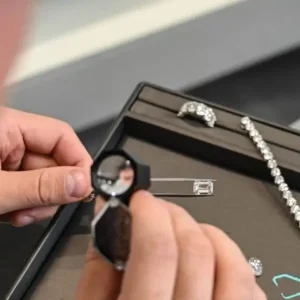
Diamond symmetry is graded based on the precision and alignment of its facets, using a standardized scale evaluated under magnification by professional gemologists. Grading laboratories, such as the Gemological Institute of America (GIA), evaluate symmetry as part of the overall cut quality assessment.
The inspection process involves a detailed visual and optical analysis under 10x magnification, where experts check for both major and minor symmetry issues. Minor issues include slightly misaligned facets or a table that is just slightly off-center.
In contrast, major issues involve visibly misshaped facets, uneven girdles, or a misaligned culet that significantly impacts the diamond’s light performance and face-up appeal.
The diamond symmetry grades include:
- Excellent
No visible symmetry flaws under 10x magnification. The facets are perfectly aligned with the ideal proportion. Excellent symmetry allows for optimal light return, resulting in high brilliance and fire. Also yields the best resale value.
- Very Good
Very small symmetry deviations are present but are difficult to detect without magnification. Light performance remains strong, with minimal effect on sparkle. Still maintains high value and strong buyer preference.
- Good
Noticeable symmetry variations are seen under magnification. Light reflection may be slightly uneven. Diamonds with this grade may show reduced brilliance. Market value is moderately impacted.
- Fair
Multiple visible symmetry issues affect the alignment of facets. Light leakage becomes apparent, diminishing fire and sparkle. Lower desirability and resale potential.
- Poor
Major symmetry flaws are visible without the aid of magnification. These diamonds show unbalanced proportions and uneven light return. Significantly reduced visual appeal and value.
Symmetry grades help define how well a diamond is cut and how effectively it reflects light. Diamonds with excellent symmetry consistently offer superior brilliance and retain higher market value over time.
Are Symmetry Grades Visibly Different?
Yes, symmetry grades in diamonds are visually different; symmetry grades are primarily based on technical flaws that may not be visible to the naked eye but are detectable under magnification. There is a distinction between visible and technical symmetry issues.
Technical flaws involve minor misalignments, such as slightly off-center tables or facets, which require 10x magnification to identify. Visible flaws, on the other hand, such as misaligned facet junctions or uneven girdles, can sometimes be seen without magnification, especially in larger diamonds.
Symmetry is assessed using a loupe or microscope at 10x magnification, where gemologists examine the uniformity of facet placement, culet centering, and table alignment. While a small, well-cut diamond with good symmetry may appear visually similar to one with very good symmetry, larger stones tend to magnify these differences.
In larger carat weights, even minor symmetry inconsistencies become more noticeable to the human eye, affecting overall appearance and perceived quality.
What Factors Affect a Diamond’s Symmetry Grade?

The factors that affect a diamond’s symmetry grade are structural details that determine how precisely the facets are aligned, shaped, and proportioned. These factors are evaluated under 10x magnification during professional grading and include both minor and major flaws.
Minor flaws are small inconsistencies that do not significantly impact light performance and are only visible under magnification. The final symmetry grade depends on both the number of flaws present and their severity; a single major issue lowers the grade more than several minor ones.
The common factors affecting a diamond’s symmetry grade are:
- Misaligned Facets
Misaligned facets occur when opposing facets are not positioned in an even manner. Minor misalignments may have little visual impact, but they still count toward the grading. Major misalignments disrupt light reflection, affecting both brilliance and the balance of symmetry.
- Off-Center Table or Culet
An off-center table or culet shifts the diamond’s vertical alignment. Slight offsets are minor, but significant displacement affects how light enters and exits, lowering both visual symmetry and grading.
- Misshapen Girdle
A girdle that varies in thickness or has irregular curves disrupts the diamond’s outline. If slight, it’s considered a minor flaw. Severe inconsistencies lead to structural weakness and visual imbalance, qualifying as a major flaw.
- Uneven Crown
An uneven crown results from variations in the height or angle of crown facets. This subtly alters light dispersion. Minor unevenness is graded leniently, but significant irregularities affect face-up appeal.
- Pavilion Angles
Inconsistent angles in the pavilion facets cause poor internal reflection. Small variations may seem minor, while significant angle mismatches reduce brilliance and symmetry, resulting in a lower grade.
Grading labs, such as GIA, evaluate the impact of each flaw on light performance and appearance. A diamond with multiple minor flaws may still achieve a good or very good grade, but any major flaw reduces the symmetry grade to fair or poor, regardless of the presence of other perfect features.
How Does Symmetry Affect Diamond Pricing?
Symmetry is a key quality factor that works in conjunction with the 4Cs (cut, color, clarity, and carat) to determine diamond value. As part of the cut grade, symmetry has a direct impact on how light interacts with the diamond, influencing its brilliance, visual appeal, and market value.
Higher symmetry grades lead to better light performance, which justifies a higher price point. Poor symmetry reduces optical quality, impacting the diamond’s grading and lowering its value.
The ways symmetry affects diamond pricing include:
- Impact on Brilliance
Symmetry controls how light enters, reflects, and exits the diamond. Excellent symmetry results in greater brilliance, fire, and scintillation. Poor symmetry misdirects light, reducing sparkle and lowering appeal. Diamonds with stronger brilliance command premium prices.
- Visual Appearance
A symmetrical diamond displays a well-balanced and harmonious face-up pattern. This enhances overall beauty and makes the diamond more attractive to buyers. Better visual appeal contributes to higher pricing due to stronger consumer demand.
- Symmetry Grades
Grading laboratories like GIA assess symmetry on a scale: Excellent, Very Good, Good, Fair, and Poor. Each grade reflects the presence and severity of symmetry flaws. Diamonds with excellent symmetry receive higher valuations due to optimal facet alignment.
- Symmetry and Cut
Symmetry directly influences the diamond’s overall cut grade—the most important pricing factor among the 4Cs. A lower symmetry score downgrades an otherwise ideal diamond. Since cut grade heavily impacts value, symmetry indirectly sets the diamond’s price tier.
Symmetry not only enhances light performance and visual quality but also elevates a diamond’s grading classification and market price.
How to Check for Diamond Symmetry?
Diamond symmetry can be evaluated either visually by the buyer or professionally by trained gemologists. While a basic inspection reveals surface-level irregularities, accurate grading requires magnification and expert analysis to identify underlying issues. Symmetry influences not only brilliance and visual appeal but also plays a role in determining the cut grade and final market value.
- Visual Examination
Symmetry is checked visually under proper lighting. Look for signs like an off-center table, irregular facet shapes, or an uneven outline. These are basic cues that indicate possible alignment issues.
- 10x Magnification (Professional Assessment)
Jewelers and gemological labs use a 10x loupe or microscope to inspect symmetry in detail. This process detects precise flaws such as misaligned facet junctions, off-center culets, uneven girdles, and inconsistent facet angles, elements that are not visible to the naked eye.
- Grading Report Review
Symmetry is graded by professional institutions, such as GIA, and is listed clearly in the diamond grading report. Grades include Excellent, Very Good, Good, Fair, or Poor. This symmetry grade offers a standardized measure of precision and structural alignment.
- Higher Grades = Better Light Performance and Visual Appeal
Diamonds with higher symmetry grades reflect light more efficiently. Facet alignment improves brilliance, fire, and overall sparkle. This results in a more attractive diamond, which commands a higher market price.
- Symmetry Influences Overall Cut Grade
Symmetry is a sub-factor of the cut grade, which is one of the most heavily weighted factors in diamond pricing. Even with high color and clarity, a diamond falls into a lower pricing tier if its symmetry is graded poorly, resulting in reduced optical performance.
Symmetry evaluation, whether done visually or professionally, is essential for understanding a diamond’s light behavior, beauty, and price potential.
Diamond Banc offers expert diamond evaluations with a focus on symmetry and overall cut quality. The team works with GIA-accredited graders to ensure each diamond is assessed with the highest accuracy.
Whether selling or securing a loan, trust Diamond Banc to provide transparent, market-based valuations based on detailed symmetry analysis.
How Does Expert Symmetry Grading Boost Your Diamond’s Value?
Symmetry is a key quality factor that works in conjunction with the 4Cs (cut, color, clarity, and carat) to determine diamond value. As part of the cut grade, symmetry has a direct impact on how light interacts with the diamond, influencing its brilliance, visual appeal, and market value.
Higher symmetry grades lead to better light performance, which justifies a higher price point. Poor symmetry reduces optical quality, impacting the diamond’s grading and lowering its value.
The ways symmetry affects diamond pricing include:
- Impact on Brilliance
Symmetry controls how light enters, reflects, and exits the diamond. Excellent symmetry results in greater brilliance, fire, and scintillation. Poor symmetry misdirects light, reducing sparkle and lowering appeal. Diamonds with stronger brilliance command premium prices.
- Visual Appearance
A symmetrical diamond displays a well-balanced and harmonious face-up pattern. This enhances overall beauty and makes the diamond more attractive to buyers. Better visual appeal contributes to higher pricing due to stronger consumer demand.
- Symmetry Grades
Grading laboratories like GIA assess symmetry on a scale: Excellent, Very Good, Good, Fair, and Poor. Each grade reflects the presence and severity of symmetry flaws. Diamonds with excellent symmetry receive higher valuations due to optimal facet alignment.
- Symmetry and Cut
Symmetry directly influences the diamond’s overall cut grade—the most important pricing factor among the 4Cs. A lower symmetry score downgrades an otherwise ideal diamond. Since cut grade heavily impacts value, symmetry indirectly sets the diamond’s price tier.
Symmetry not only enhances light performance and visual quality but also elevates a diamond’s grading classification and market price.
How to Check for Diamond Symmetry?
Diamond symmetry can be evaluated either visually by the buyer or professionally by trained gemologists. While a basic inspection reveals surface-level irregularities, accurate grading requires magnification and expert analysis to identify underlying issues. Symmetry influences not only brilliance and visual appeal but also plays a role in determining the cut grade and final market value.
- Visual Examination
Symmetry is checked visually under proper lighting. Look for signs like an off-center table, irregular facet shapes, or an uneven outline. These are basic cues that indicate possible alignment issues.
- 10x Magnification (Professional Assessment)
Jewelers and gemological labs use a 10x loupe or microscope to inspect symmetry in detail. This process detects precise flaws such as misaligned facet junctions, off-center culets, uneven girdles, and inconsistent facet angles, elements that are not visible to the naked eye.
- Grading Report Review
Symmetry is graded by professional institutions, such as GIA, and is listed clearly in the diamond grading report. Grades include Excellent, Very Good, Good, Fair, or Poor. This symmetry grade offers a standardized measure of precision and structural alignment.
- Higher Grades = Better Light Performance and Visual Appeal
Diamonds with higher symmetry grades reflect light more efficiently. Facet alignment improves brilliance, fire, and overall sparkle. This results in a more attractive diamond, which commands a higher market price.
- Symmetry Influences Overall Cut Grade
Symmetry is a sub-factor of the cut grade, which is one of the most heavily weighted factors in diamond pricing. Even with high color and clarity, a diamond falls into a lower pricing tier if its symmetry is graded poorly, resulting in reduced optical performance.
Symmetry evaluation, whether done visually or professionally, is essential for understanding a diamond’s light behavior, beauty, and price potential.
Diamond Banc offers expert diamond evaluations with a focus on symmetry and overall cut quality. The team works with GIA-accredited graders to ensure each diamond is assessed with the highest accuracy.
Whether selling or securing a loan, trust Diamond Banc to provide transparent, market-based valuations based on detailed symmetry analysis.
How Does Expert Symmetry Grading Boost Your Diamond’s Value?
Diamond Banc is a luxury diamond buyer specializing in the acquisition of high-quality, certified diamonds, with a focus on precision elements such as symmetry and cut quality. Unlike casual buyers who rely solely on carat, color, and clarity, Diamond Banc evaluates diamonds with a deep understanding of how symmetry impacts brilliance, demand, and long-term value.
Symmetry is a key factor in Diamond Banc’s professional evaluation process. Every diamond is inspected under 10x magnification to assess the alignment of facets, table centering, girdle consistency, and culet position. These microscopic details influence how efficiently light travels through the diamond, which directly affects its visual performance. Diamonds with excellent symmetry grades reflect light more evenly, producing stronger brilliance and fire, qualities that make them more desirable and easier to resell in luxury markets.
Diamond Banc uses this technical precision to offer highly competitive value assessments. Instead of relying only on surface attributes, their experts assign value based on how well a diamond performs structurally and optically. Symmetry is viewed as a performance metric that strengthens the overall appeal and liquidity of the stone.
Ultimately, precision isn’t just about sparkle; it’s a strategic asset. Diamond Banc leverages symmetry grading as a quantifiable quality indicator, turning exact craftsmanship into measurable financial return. This allows sellers to unlock more value from their certified diamonds, especially those with superior symmetry and cut profiles.
Why does the shape of your diamond matter to the symmetry?
The ‘Shape of Your Diamond’ matters and directly influences how symmetry is judged and maintained. Different shapes have different facet structures, making precise alignment more complex in fancy shapes like ovals or pears. Round diamonds are easier to grade for symmetry due to their uniform facet layout. Inconsistent shape proportions lead to visible symmetry issues, which impact brilliance and value.
Does the diamond shape affect how symmetry is graded?
Yes. The diamond shape affects symmetry grading because each shape has unique facet patterns and alignment challenges. Round brilliant cuts are graded more uniformly, while fancy shapes, like marquise or heart, require shape-specific symmetry standards.
Minor facet misalignments are more noticeable in elongated shapes, making grading stricter. The shape also determines how symmetry flaws appear, which influences the final symmetry grade during lab evaluation.
How does shape affect the resale value of your diamond?
Shape affects the resale value of your diamond through its demand, symmetry difficulty, and visual presentation. Round diamonds retain higher value due to easier symmetry control and market preference.
Fancy shapes sell for less because they are more difficult to cut symmetrically and appeal to a narrower audience. Symmetry flaws in less common shapes reduce brilliance and impact the resale potential.
Do imperfections in symmetry affect a diamond’s sparkle?
Yes. Symmetry imperfections affect how light reflects inside the diamond. Even minor misalignments cause light to leak out or scatter unevenly, reducing brilliance and fire. When facets are not evenly aligned, sparkle becomes inconsistent, especially in larger or fancy-shaped stones.
Precision in symmetry ensures light returns through the crown, maximizing optical performance and visual appeal. Poor symmetry directly reduces a diamond’s perceived sparkle.
What makes “Triple Excellent” diamonds distinct?
“Triple Excellent” diamonds are graded Excellent in cut, polish, and symmetry by GIA. This combination reflects optimal craftsmanship and alignment, ensuring maximum light performance. These diamonds show superior brilliance, fire, and scintillation due to precise facet placement and smooth surfaces.
Buyers view Triple Excellent diamonds as premium stones with high resale potential. This grading distinction makes them more valuable and desirable in luxury and secondary markets.
How does symmetry impact cut grades?
Symmetry is a sub-factor of cut grade and directly affects it. GIA considers symmetry when determining overall cut quality, which is one of the strongest price drivers. A diamond with excellent symmetry is more likely to receive an Excellent cut grade, increasing its visual appeal and market value.
Poor symmetry, even with high clarity or color, can downgrade the cut grade, reducing the diamond’s brilliance and its resale value.
What’s the difference between optical symmetry and facet symmetry?
Facet symmetry refers to the physical alignment of a diamond’s facets, while optical symmetry is how light patterns appear when viewed face-up. Optical symmetry is assessed using tools such as ASET or hearts-and-arrows scopes, which reveal internal light performance.
A diamond can have excellent facet symmetry but poor optical symmetry if angles don’t support ideal reflection. Both types influence beauty, but optical symmetry speaks directly to how the diamond sparkles.
What does “8X” mean in diamond symmetry grading?
“8X” refers to a diamond that achieves excellent grades in eight performance categories, including symmetry. This ultra-premium distinction goes beyond GIA’s Triple Excellent by including light performance metrics like optical precision, contrast, and fire.
An 8X diamond represents the highest standards in cutting and visual impact. It signals elite craftsmanship and justifies top-tier pricing for collectors or luxury buyers looking for superior optical symmetry and brilliance.
How are polish and symmetry related?
Polish and symmetry are both parts of a diamond’s cut quality, but they evaluate different aspects. Polish assesses the smoothness of each facet surface, while symmetry focuses on facet alignment and placement. Together, they influence how light interacts with the diamond.
Poor polish blurs reflections, and poor symmetry disrupts light direction. High grades in both result in better brilliance, fire, and overall visual sharpness, supporting higher value.
Is re-polishing worth it for symmetry issues?
Yes, re-polishing corrects symmetry flaws, especially in valuable diamonds with otherwise strong color, clarity, and carat. It improves brilliance, enhances light return, and may increase the cut grade.
However, re-polishing may cause slight weight loss, so it’s most worthwhile when the symmetry improvement justifies a better resale tier or certification upgrade. Evaluation by a professional is essential before making a decision.
Do diamond certifications add value by verifying diamond symmetry?
Yes. Diamond certifications add value by verifying diamond symmetry. Certifications from labs like GIA include symmetry as part of the grading report, providing objective proof of facet alignment and cut precision. This verification boosts buyer trust and marketability. Diamonds with certified excellent symmetry are perceived as higher quality, making them easier to sell at higher prices.
CONTACT DIAMOND BANCGET A LOANSELL MY DIAMOND
Like what you’re reading?
Add us in Google — more like this is on the wayRelated Posts


 Instagram
 Facebook
 Tiktok
 YouTube